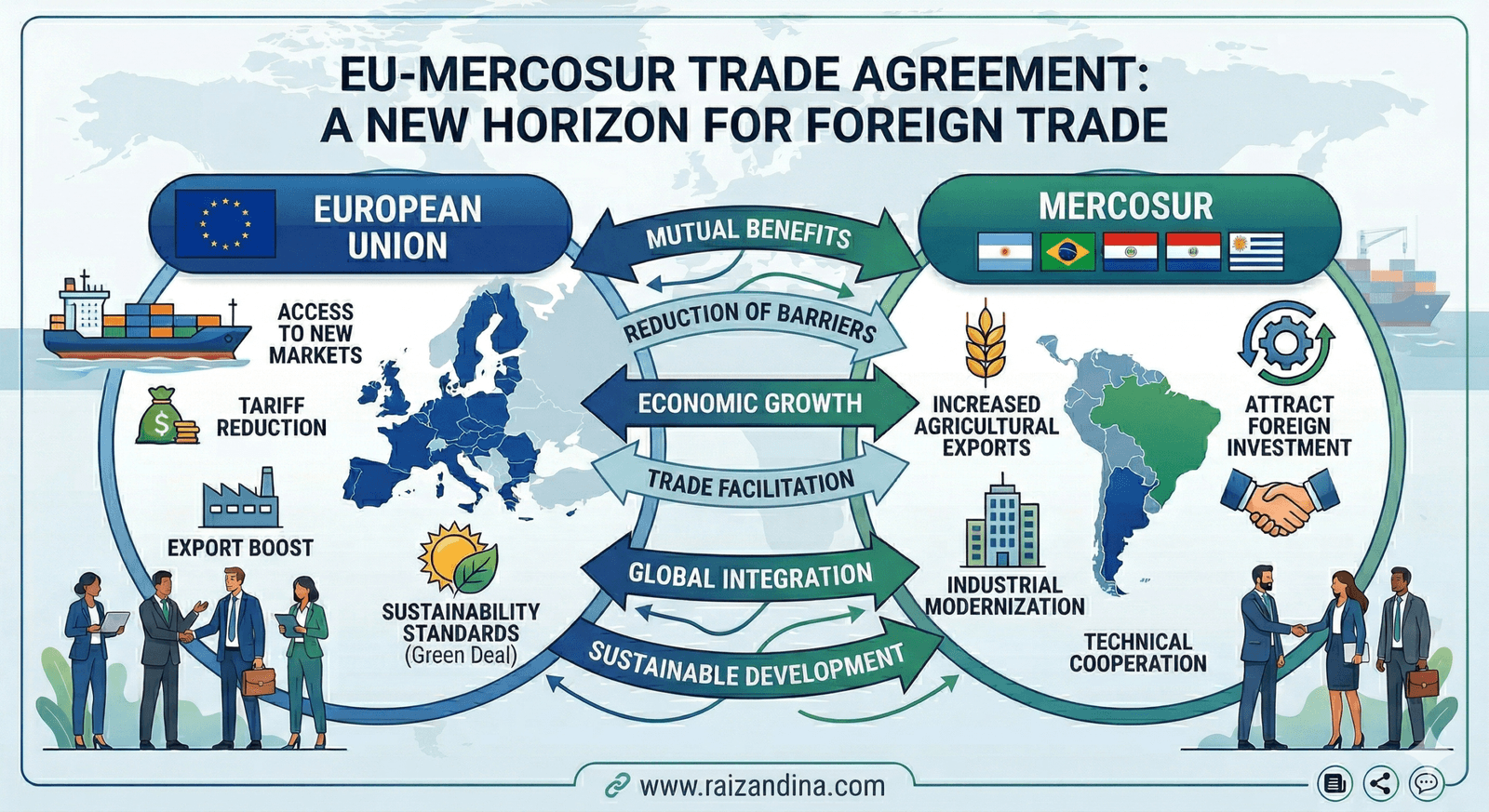
The EU–Mercosur trade relationship has finally entered an operational phase after more than 25 years of negotiations. For European importers of walnuts, almonds, hazelnuts, and pistachios from Argentina, Brazil, Paraguay, and Uruguay, the 2026 transition opens a potential window of opportunity — but also requires contractual caution and precise compliance.
Executive Summary
- May 1, 2026: Provisional application of the Interim Trade Agreement (ITA) begins.
- The ITA is the EU’s autonomous commercial instrument, separated from the broader EU–Mercosur Partnership Agreement (EMPA).
- For European nut importers, the key impact is the potential reduction or elimination of tariffs, depending on the tariff line and rules of origin.
- The full EMPA still faces a long political and legal path, including a pending opinion from the Court of Justice of the European Union (CJEU).
- Treat 2026 as a commercial opportunity window, but with contractual safeguards.
1. What Happened in the Last 120 Days: A Verified Timeline
Between January and March 2026, the EU–Mercosur process accelerated dramatically:
- 9 January 2026: The EU Council approved the signature of both the EMPA and the ITA. Five Member States voted against (France, Poland, Ireland, Austria, Hungary).
- 17 January 2026: Official signing ceremony in Asunción, Paraguay.
- 21 January 2026: The European Parliament suspended its consent procedure and requested a CJEU opinion, potentially delaying the full agreement by 16–18 months.
- February–March 2026: All Mercosur countries completed internal ratification.
- 5 March 2026: The EU adopted Regulation (EU) 2026/687 on agricultural safeguard clauses.
- 23 March 2026: The European Commission confirmed 1 May 2026 as the start of provisional application of the ITA.
From that date, tariff preferences apply only if:
- the product meets the rules of origin, and
- the preferential tariff line is already loaded in TARIC.
2. ITA vs. EMPA: The Distinction Importers Cannot Ignore
The EU split the agreement into two parallel instruments:
EMPA (full agreement)
- Includes political, cooperation, and trade pillars.
- Requires ratification by all 27 Member States.
- Long, complex process.
ITA (Interim Trade Agreement)
- Covers areas under exclusive EU competence.
- Requires only Council + Parliament approval.
- Enters into provisional application independently.
- Will be replaced once the EMPA enters into force.
For importers: From 1 May 2026, tariff preferences under the ITA are legally applicable — but subject to operational, legal, and political conditions.
3. What Changes for Southern Cone Tree Nuts
Current MFN Tariffs (pre-ITA)
The relevant tariff codes for our sector are 0802.31 – in-shell walnuts – 4.0% · 0802.32 – shelled walnuts – 5.1% · 0802.21 – in-shell hazelnuts – 3.2% · 0802.22 – shelled hazelnuts – 3.2% · 0802.51 – in-shell pistachios – 1.6% · 0802.52 – shelled pistachios – 1.6% · 0802.11 – in-shell almonds – 5.6% · 0802.12 – shelled almonds – 3.5%.
For decades, Argentine walnuts paid 4–5%, while Chilean walnuts entered at 0% under the EU–Chile agreement. This created a structural disadvantage of €4,400–€5,500 per 20-ton container of shelled Chandler walnuts.
The Potential Closing of the Gap
The ITA foresees:
- Immediate tariff elimination for many lines
- 4-, 7-, or 10-year phase-outs for others
- Tree nuts are not classified as sensitive products
If confirmed in Annex 2-A and reflected in TARIC, Argentine walnuts could enter the EU at 0%, matching Chile.
This affects:
- Supplier allocation
- Payment terms
- Origin diversification
4. SPS Framework: What Improves and What Doesn’t
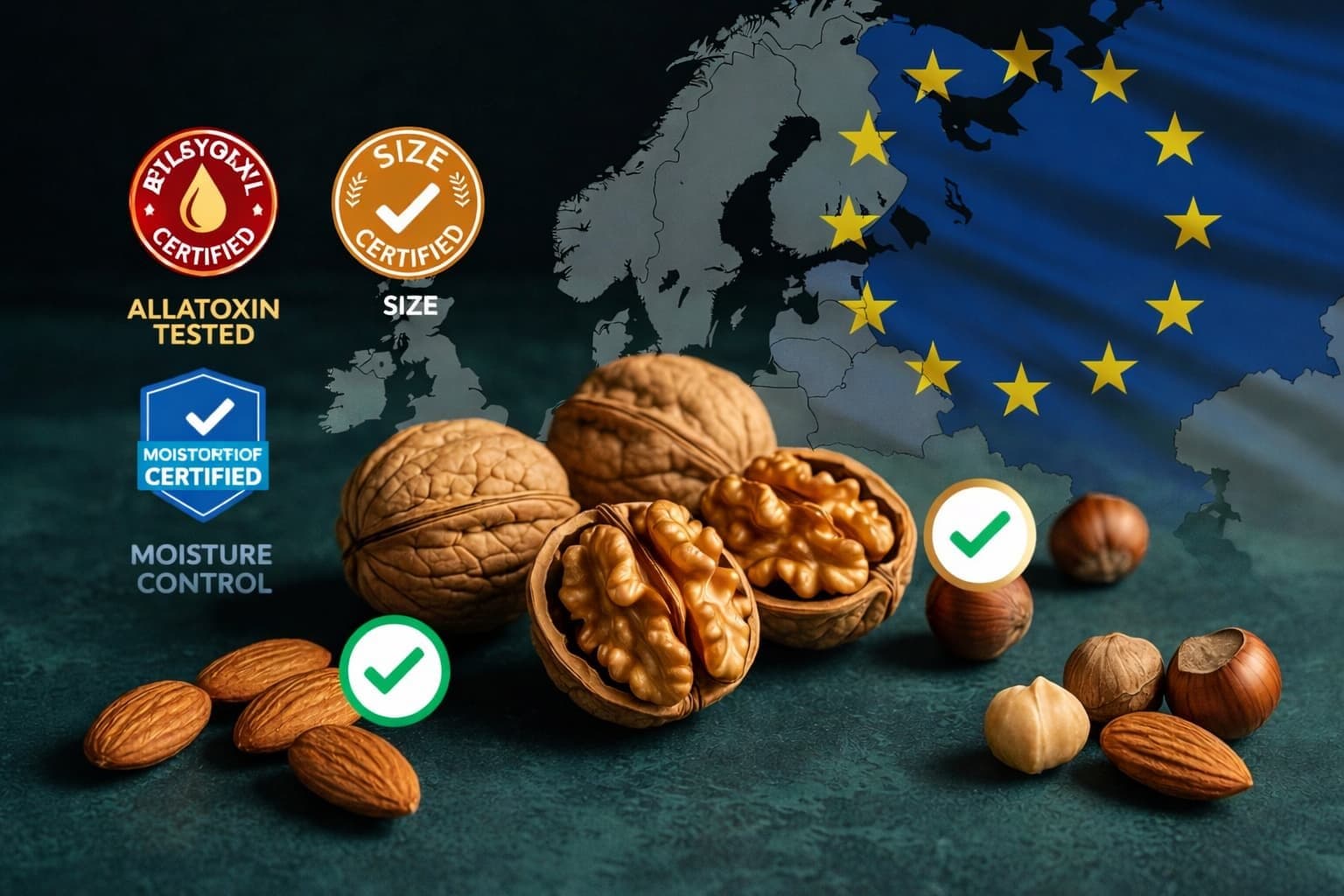
The ITA improves cooperation and predictability but does not replace EU food safety requirements. Aflatoxin limits, UNECE standards, border controls and documentary requirements remain fully in force.
5. Why Italy Is Structurally Well Positioned
Italy benefits more than most EU markets due to:
- High domestic demand vs. limited local production
- Strong food industry exports to Mercosur (chocolate, confectionery, bakery)
- Protection of Italian GIs (Parmigiano Reggiano, Prosciutto di Parma, etc.)
- Established maritime routes between Buenos Aires and Mediterranean ports
France’s opposition reflects its domestic walnut sector — but this does not affect Italian import dynamics.
6. The Three Real Regulatory Risks
Risk 1: CJEU Opinion (High)
A negative ruling could suspend or invalidate provisional application.
Risk 2: Agricultural Safeguard Regulation (Low for nuts)
Tree nuts are not on the sensitive product list.
Risk 3: Evolving EU ESG and Due Diligence Rules (Medium)
Even if nuts are not in the EUDR list, the trend is toward stricter traceability.
7. Rules of Origin Under the ITA: What Importers Must Know
The ITA uses self-certification (“statement on origin”), similar to REX.
Key operational points:
- Declaration must appear on invoice or commercial document
- Must be signed by the exporter
- Exporter must be registered
- Importer must retain supporting documentation for audits
- Without valid proof of origin, there is no preference
Self-certification simplifies the process but does not reduce the underlying documentary requirements.
8. What Importers Should Do Before May 1
- Verify TARIC classification and preferential status.
- Coordinate origin statements with Mercosur suppliers.
- Recalculate landed cost under new tariff scenarios.
- Adjust pricing strategy for distribution, HORECA, and industry.
- Reopen negotiations with Chilean suppliers.
- Add contingency clauses for CJEU outcomes.
- Update internal compliance documentation.
Conclusion: A Window of Opportunity That Rewards Precision
The agreement does not turn Argentina into a global walnut powerhouse — but it removes a long-standing legal distortion that penalized Southern Cone origins.
Importers who act early, adjust supplier strategies, and secure compliant documentation will capture the competitive advantage during the 2026 Southern Hemisphere harvest.