Two Chandler walnut offers on the table. Same origin, same Incoterm, same price per kilo. One says kernel yield ≥ 48 %; the other says nothing about yield.
These are not the same offer, and the difference is not a technicality: it is money. If the second one yields 44 %, every kilo of usable kernel costs you 9 % more than in the first, even though the invoice reads identically. Caliber — the first thing everyone looks at — would never have warned you.
This article explains what each field of a nut spec sheet means, which one actually drives cost, and what red flags to look for when a field is missing. We wrote it using the spec sheets we publish ourselves, openly available on every product page: if anything below does not match what we offer, it can be checked.
1. The twelve fields, and which ones matter
A serious nut spec sheet has twelve fields. They are not twelve opinions: they are twelve measurements somebody made in a laboratory on a specific lot.
| Field | What it is | Why it matters |
|---|---|---|
| Botanical variety | Species and cultivar | Defines processing behaviour and shelf life |
| Product type | In-shell, shelled, halves, pieces | Changes price more than anything else |
| Caliber / size | Millimetres or pieces per pound | Drives presentation, not real cost |
| Colour grade | USDA scale | The biggest price factor in shelled walnut |
| Maximum moisture | % water | Water you pay for, and a shelf-life risk |
| Kernel yield | % usable kernel | The field that decides real cost |
| Aflatoxin B1 and total | µg/kg | Legal requirement for EU entry |
| Peroxide value | meq O₂/kg | Predicts rancidity you cannot taste yet |
| Maximum defects | % | What you will discard at the plant |
| Foreign matter | % | Shell, stones, dust: weight you pay for |
| Microbiological | Salmonella, E. coli | Blocks customs clearance if it fails |
The two that move money are marked. Let us start there.
2. Kernel yield: the field that decides real cost
Kernel yield is the percentage of weight that remains as usable product after cracking and cleaning. It is the number that turns a price per kilo into a cost per usable kilo, which makes it the only field that lets you genuinely compare two offers.
The maths is simple: price per kilo ÷ yield = real cost of the usable kilo. At an identical price, a 50 % yield against a 46 % yield is almost nine percentage points of difference in what the product actually costs you.
Across our sheets the range runs from 46 % for Chilean Chandler to 55 % for Argentine pecan. Almond plays a different game — ≥ 95 % — because it is sold already shelled, and there yield measures something else: whole kernels against broken ones.
What to check: that yield is stated as a guaranteed minimum (≥) and not as "approximately". An "approx. 48 %" is not a specification: it is an expectation, and you cannot claim against it.
3. Colour grade: the biggest price factor in shelled walnut
Colour is not cosmetics. In shelled walnut the USDA scale — extra light, light, light amber, amber — is the main price determinant, and the gap between two adjacent grades can run into double-digit percentages.
The reason is end use. Bakery and premium snack pay for extra light and light, because the product is visible. Industry that grinds, or makes praline or fillings, works perfectly well with light amber and pays considerably less for the same walnut.
That is where the expensive mistake happens in both directions: buying extra light in order to grind it is throwing money away, and buying amber for a clear bag on a retail shelf guarantees returns.
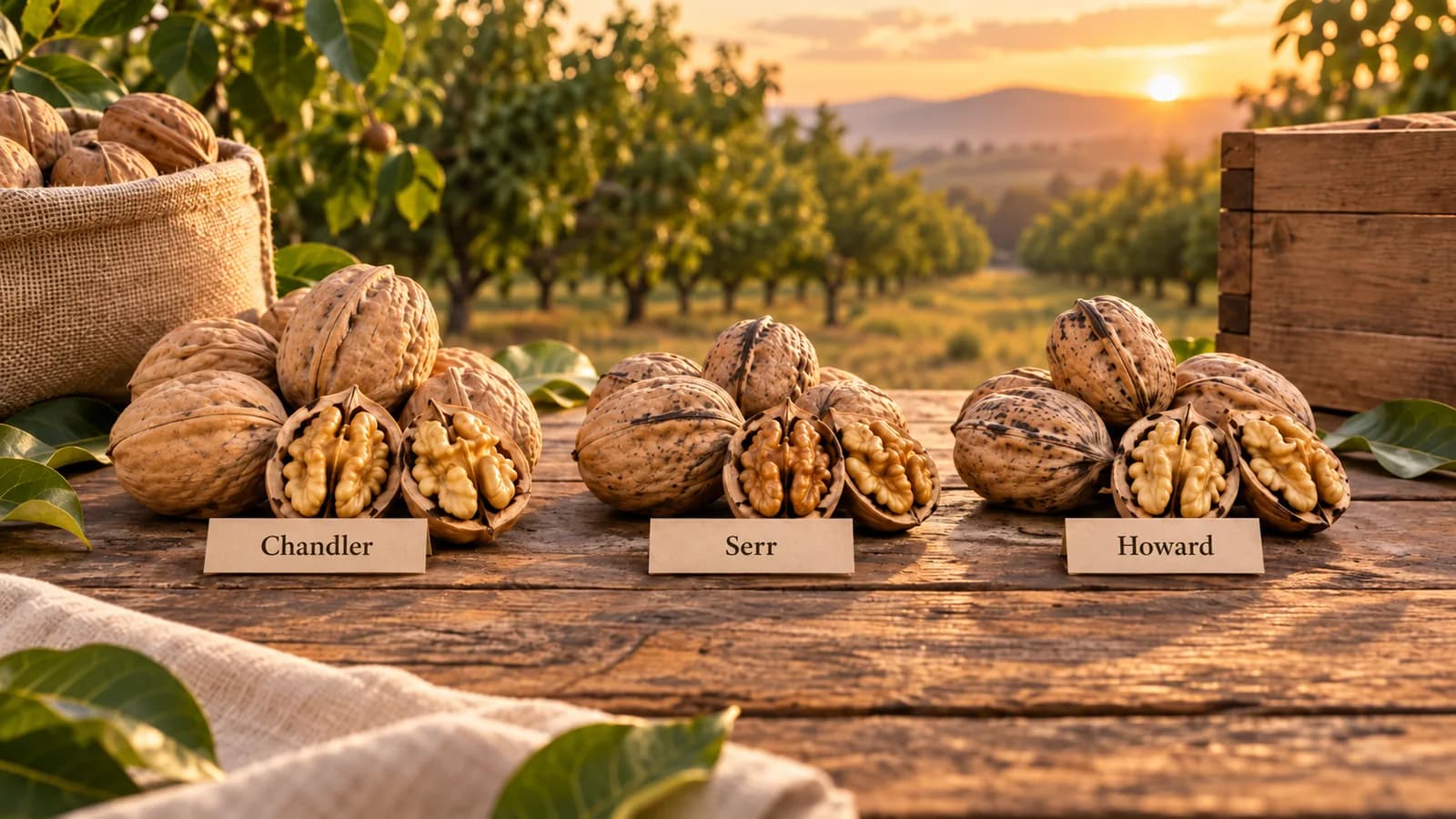
In our sheets, Chandler and Howard are declared Extra Light / Light; Serr, Light / Light Amber. It is not that one is worse: Serr tends to a warmer tone, which makes it a better candidate for transformation than for display.
What to check: that the grade refers to a named standard. "First-grade colour" or "good colour" mean nothing contractually.
4. Caliber: it matters less than you think, and is not measured the same way everywhere
Caliber governs presentation and end-customer perception, but it is the field that says least about cost. And it carries a trap: the unit changes with the product, which means two sheets cannot be compared directly.
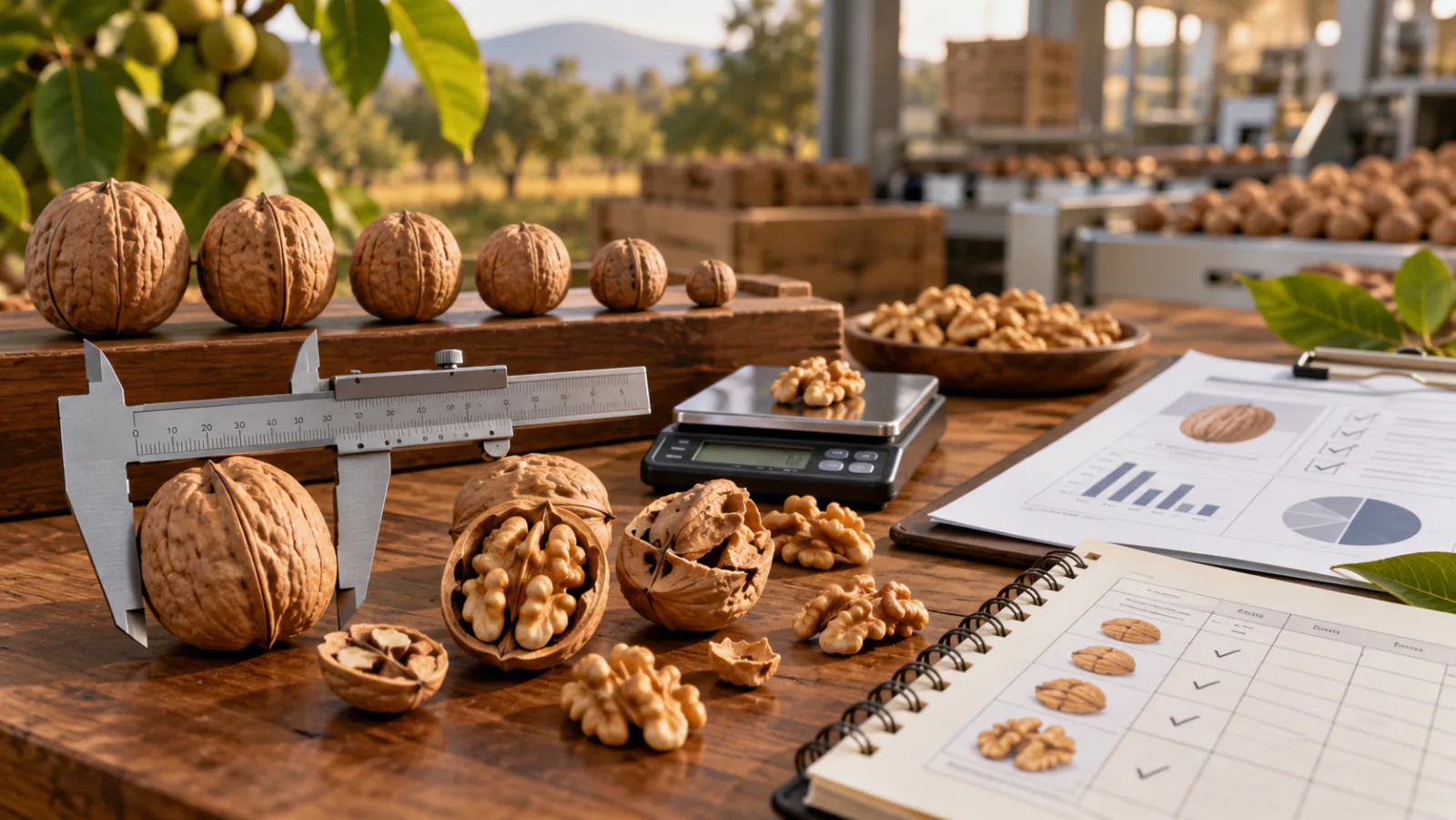
- In-shell walnut: diameter in millimetres. Argentine Chandler 32-36 mm, Chilean Chandler 30-34 mm, Serr 28-32 mm.
- Pecan: pieces per pound. Mammoth and Junior Mammoth, 250-350 pieces per pound. More pieces means a smaller half.
- Almond: millimetres, in narrow ranges (23-25 mm, 25-27 mm).
Argentine Chandler running 2 mm above the Chilean does not make it a better walnut: it makes it better suited to formats where the whole piece is on show.
What to check: that caliber comes with its unit and a closed range. A caliber without a unit is not data, and a "30 mm+" with no ceiling allows anything above that to be shipped.
5. Moisture: one percentage point is water you pay for
Maximum moisture looks like a preservation technicality, and it is also a billing matter: water weighs, and it is invoiced as product. The difference between a lot at ≤ 6 % and one at ≤ 7 % is one point of water in every kilo you buy.
The serious reason, though, is shelf life. Above the threshold, the risk of mould and of deterioration in transit rises in a distinctly non-linear way, and a container crossing the Atlantic in summer is unforgiving.
In our sheets: Argentine walnut ≤ 6 %, Chilean walnut ≤ 7 %, pecan ≤ 5 %, almond ≤ 6 %. Pecan is the strictest because it is the fattiest, and for the same reason it is the first to go rancid.
6. Peroxide value: the field almost nobody asks for
This is the data point that separates a serious sheet from a list of good intentions. Peroxide value measures oxidation already under way in the fat, in milliequivalents of oxygen per kilo. In plain terms: it predicts the rancidity you cannot yet taste.
A lot can pass tasting at origin and arrive rancid if it shipped with oxidation already advanced. By then there is no argument to be had, because nobody measured anything at loading.
Our sheets declare < 5 meq O₂/kg. If an offer does not mention peroxide value and the product is high in fat — walnut, pecan, macadamia — that is the first question we would ask.
7. Aflatoxins: the field that decides whether the goods get in
Aflatoxins are the only field on the sheet that can stop a container at the border. Regulation (EU) 2023/915, which since April 2023 sets maximum levels for contaminants in food, establishes different ceilings depending on the nut and on whether the product goes to the final consumer or passes through a sorting process first.
Our sheets declare aflatoxin B1 < 2 µg/kg and total < 4 µg/kg, the limit applicable to walnut destined for final consumption. And, more important than the figure: the analysis is done per lot, with results available before shipment, alongside the microbiological testing.
What to check, and this is what really matters: that the analysis is per lot and not generic. An aflatoxin certificate from eight months ago, from another campaign, tells you nothing about the container they are about to send you. If the supplier cannot deliver the analysis of the specific lot before loading, the regulatory risk is yours, not theirs.
8. The six sheets, compared
Data from our catalogue, exactly as published:
| Product | Caliber | Colour | Moisture | Yield |
|---|---|---|---|---|
| Chandler walnut (Argentina) | 32-36 mm | Extra Light / Light | ≤ 6 % | ≥ 48 % |
| Chandler walnut (Chile) | 30-34 mm | Extra Light / Light | ≤ 7 % | ≥ 46 % |
| Howard walnut (Chile) | 30-34 mm | Extra Light / Light | ≤ 7 % | ≥ 48 % |
| Serr walnut (Chile) | 28-32 mm | Light / Light Amber | ≤ 7 % | ≥ 50 % |
| Pecan (Argentina) | 250-350 pcs/lb | Light Amber / Amber | ≤ 5 % | ≥ 55 % |
| Almond (Chile) | 23-25 / 25-27 mm | White / Cream | ≤ 6 % | ≥ 95 % |
Read alongside the sections above, the table interprets itself: Serr yields more and costs less per usable kilo, but its colour points it towards transformation; Argentine Chandler has the largest piece and the best colour, which is exactly what you pay for in formats where the walnut is visible.
9. Five signs that a sheet is not a sheet
- No kernel yield, or yield given as "approximate". Without that number you cannot compare price.
- Colour not referenced to a standard. "First quality" is not a grade.
- No peroxide value on a high-fat product.
- Aflatoxin analysis not per lot, or not delivered before shipment.
- Defects and foreign matter missing. One per cent of foreign matter in a 20-tonne container is 200 kilos of shell and dust invoiced as walnut.
10. Three checks before signing
- Divide price by yield; do not compare prices per kilo. It is the only way to know which of two offers is actually cheaper.
- Match the colour grade to the end use, not to the budget. Overpaying and underpaying cost the same.
- Ask for the analysis of the lot they will ship you, dated. If it does not exist yet, ask in writing for a commitment to deliver it before loading.
None of the three requires laboratory knowledge. All three are done by reading a PDF.
Let us work together
We publish the full technical sheet for every product on its product page and deliver the per-lot analysis before shipment, together with the phytosanitary certificate and the certificate of origin.
We are looking for distributors and industrial buyers across Europe and Latin America: minimum one pallet, terms and lead times agreed in writing before any shipment. If you would like to benchmark these specifications against your current supplier's, write to us or see our wholesale terms.
The regulatory limits cited correspond to Regulation (EU) 2023/915 as in force in September 2026 and may vary by nut and by the product's final destination. Product specifications are those published in our catalogue as of that date.