It is the question almost no supplier wants to answer in writing: wouldn't it be cheaper to buy straight from the grower? The honest answer is: sometimes, yes. This article explains when — and we are writing it from the other side of the counter. We are a trading company, and we would rather deal with a distributor who chooses with full information than one who discovers the hidden costs after the goods are on the water.
Direct sourcing and the trader are not rivals in every case: they are two tools for two different situations. Let's take it apart.
1. The two routes, in one sentence each
Buying direct means contracting with the farm or the processing plant at origin: you negotiate the price, audit the quality, book the freight and manage the paperwork — or you pay third parties for each of those pieces.
Buying from a trading company means contracting an outcome: goods that match the technical specification, at your port or your warehouse, with the full document package and a single commercial counterpart if anything goes wrong. The trader aggregates volume across farms and origins, and that margin pays for selection, control and recourse.
The per-kilo price of direct buying is almost always lower on the invoice. That is not the right question. The right question is what the rest of the operation costs, and who stands behind it.
2. When buying direct is the right call
No hedging: if you meet all of these conditions, direct sourcing will probably win on margin.
- Large, stable volume in a single reference. Several containers a year of the same variety and size. With a quarterly 40' of Chandler, the farm will happily serve you and your management overhead pays for itself.
- A buying team with presence at origin. Someone of yours — or a trusted agent — who visits the plant, checks the sizing and signs off the lot before shipment. Nut quality is decided at origin, not at destination.
- In-house document and logistics capability. Phytosanitary certificates, lot analysis, B/L, insurance, vessel booking. Every piece still exists in the direct model; the only thing that changes is who does the work.
- Financial tolerance for origin risk. Your advance payment travels on trust you built yourself; if the lot arrives off-spec, your recourse is 12,000 km away in another jurisdiction.
This profile exists: large industrial buyers and distributors with decades in the category. If that is you, our honest advice is to buy your high-volume reference direct — and keep reading, because the hybrid model in section 5 probably applies to you anyway.
3. What the direct price does not include
The gap between farm-gate FOB and a trader's price is not air: it is line items that still exist in the direct model — they simply move to your side of the table. Here is the full comparison:
| Line item | Buying direct | With a trading company |
|---|---|---|
| Supplier search and validation | You (origin trips, references) | Included — an already-audited grower base |
| Lot quality control | You, or an agent hired at origin | Included — lot verified against spec before shipment |
| Practical minimum volume | High: farms want the full container | 1 pallet (~2,100 kg) via LCL groupage |
| Mixing references in one container | Very hard: each farm grows its own crop | Yes — one 40' can combine walnuts, pecans, almonds and dried fruit |
| Coverage across seasons and origins | You manage several suppliers | Included — both hemispheres in one programme |
| Export documentation | You coordinate plant and customs broker | Included — full package per shipment |
| Recourse on a quality incident | International claim, on your own | One commercial counterpart, your language and time zone |
| Counterparts per operation | Farm + processor + forwarder + broker + lab | One |
Raíz Andina operational data, September 2026. The "buying direct" column describes the general case of a distributor without their own structure at origin; an industrial buyer with a purchasing team based in South America internalises several of these items.
Two of those rows carry most of the real risk: quality control at origin — because a container rejected at the border or a lot outside colour grade cannot be fixed with a discount — and recourse on incidents, because the cost of a problem is not the problem; having no one to solve it with is.
4. What the trader takes on — and what it lives off
Our margin pays for specific work. In Raíz Andina's case, these five things:
- Origin aggregation. Eleven references from five origins — Argentina, Chile, the US, South Africa and China — in a single buying programme. No farm can offer that, because no farm grows Chandler walnuts, pecans, almonds, macadamias and pistachios at the same time.
- Selection and control with recourse. The lot is verified against the technical spec before shipment (size, colour, moisture, lot analysis). If something still arrives wrong, we answer for it: that is the difference between a supplier and a middleman.
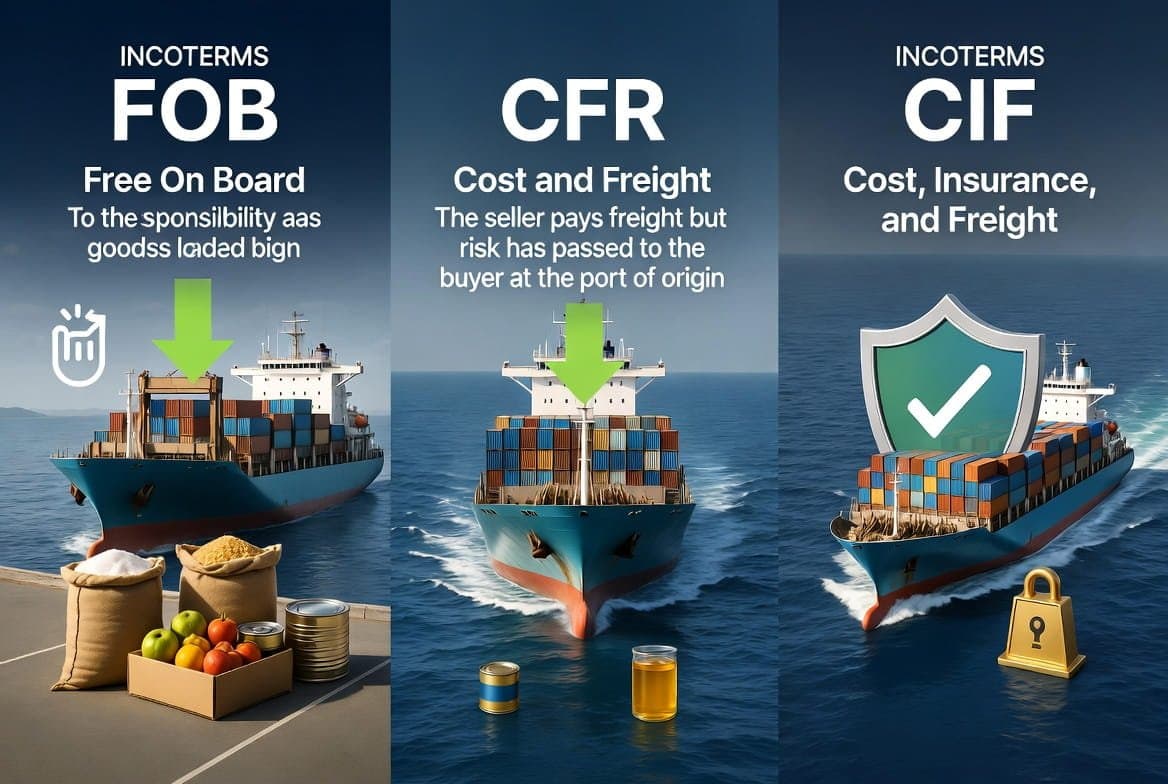
- One operation, one contract. One invoice, one Incoterm — from FOB to DDP, you choose how far we go — and one counterpart. The full mechanics are laid out step by step in our guide to importing nuts for the first time.
- Consolidation. The trial pallet and the mixed 40' exist because we aggregate cargo across clients and references. That is what makes testing an origin viable without tying up capital.
- Continuity. Southern-hemisphere harvest from February to May, northern complements the rest of the year: the programme does not stop when a season does.
5. The hybrid model: what experienced distributors actually do
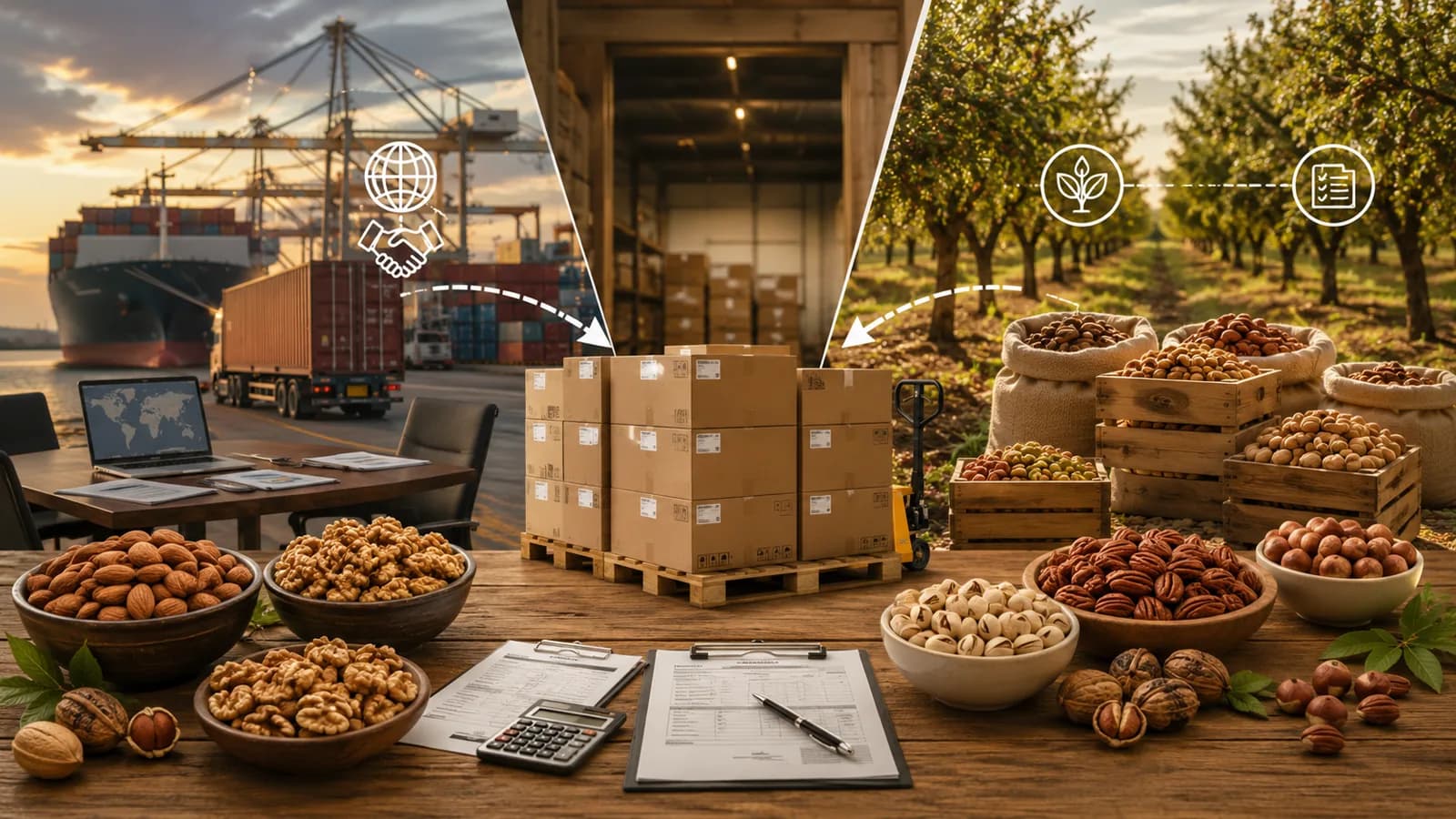
In practice, the most seasoned buyers do not pick one route — they use both. They buy their high-volume reference direct, where the relationship is already built, and work with a trader for everything else:
- the rest of the range, where no single volume justifies its own sourcing operation;
- new origins, where a trial pallet is worth more than any sales presentation;
- coverage when their own season fails or the direct supplier comes up short.
For a serious trader this client is not a problem — it is the best possible client, because they know exactly what they are buying through each channel.
6. How to vet a trader before the first order
With us or with anyone else, demand these five things. A serious supplier has them ready; an improvised one gives themselves away on the first:
- Technical spec before price. Size, colour, moisture and yield per reference. Two prices can only be compared against the same specification.
- Samples from the actual lot, not from "a representative season".
- The document package of a previous shipment (anonymised): invoice, packing list, B/L, phytosanitary, certificate of origin and lot analysis.
- Written terms: minimum volume, available Incoterms, payment structure and indicative lead times.
- Fast, concrete answers. Whoever takes two weeks to quote will take two months to resolve an incident.
Frequently Asked Questions
Does buying through a trader make the operation more expensive?
It raises the invoice per kilo and lowers the total cost of the operation in most small and mid-volume cases: it removes origin trips, document management, unrecoverable quality risk and the need for one supplier per reference. From several containers a year of a single reference, the balance can flip — and we will tell you openly if that is your case.
What is the minimum order with Raíz Andina?
1 pallet, around 2,100 kg, shipped LCL. It is the way to validate a reference with your end customer without tying up capital. A farm selling direct rarely goes below a full container.
Can I combine several references in one container?
Yes. A 40' takes Chandler from Argentina and Chile, pecans, almonds and dried fruit in a single shipment. It is the trader's structural advantage over the single-crop grower, and the most efficient way to widen your range without multiplying freight.
What happens if the lot arrives off-spec?
Raíz Andina answers for it — not a farm 12,000 km away. The lot travels verified against the technical spec and with lot analysis; if there is still an incident, the commercial resolution is with us, in your language, with the long-term relationship as the incentive.
Do you send samples before an order?
Yes, from the actual lot being quoted. Samples and sub-pallet quantities are handled separately from the standard operation.
Does working with you require exclusivity?
No. Many of our clients buy their main reference direct and use us for the rest of the range or for new origins. The hybrid model is the norm among experienced distributors, not the exception.
Getting started
We are looking for distributors, importers and food-industry buyers across Europe, the Middle East and the Americas. Entry terms: from 1 pallet (~2,100 kg), quotes in FOB, CIF, CFR or DDP, payment by international wire transfer or letter of credit.
If you know your product, volume and destination, write to us and we will prepare the proposal: request a quote. If you would rather see terms and process by volume first, it is all in Wholesale.