The most common complaint from an importer on a first deal is not price or lead time. It is this: "the sample was perfect and the container looks nothing like it."
It is almost never fraud. It is a misunderstanding about what a sample can prove. A 2 kg pack says a great deal about a product's variety, colour and flavour, and next to nothing about whether the 20 tonnes behind it meet the aflatoxin limit. For that, EU law itself asks for something else: 100 increments of about 200 g spread across the whole lot, adding up to 20 kg.
This article covers what each sample decides, what to check when it reaches your warehouse, how to tie the specification to the contract and what we check before the container is sealed. It is the stretch between "I'm interested" and the first shipment — which is where most deals go wrong.
1. A deal has three samples, not one
People talk about "the sample" in the singular, but a well-run deal has three, and each one answers a different question.
| Sample | When | What it decides | What it does not decide |
|---|---|---|---|
| Commercial sample (type sample) | Before negotiating | Whether variety, size, colour and flavour fit your end customer | Whether a specific lot meets the spec |
| Pre-shipment sample | Once the lot is allocated, before loading | Whether the lot about to ship matches what was agreed | Legal compliance on contaminants: that comes from the lot analysis |
| Reference sample (retained) | Kept from contract signature | What a claim is compared against | Nothing on its own: it is the evidence, not the verdict |
The first is for choosing a product. The second, for approving a lot. The third, for settling a dispute without it being one word against another. A buyer who only asks for the first has approved a variety, not a container.
2. Why a 2 kg sample cannot certify aflatoxins
The reason is statistical, and the regulation settled it years ago. Aflatoxins are not evenly spread: they concentrate in a handful of contaminated kernels inside an otherwise sound lot. A small sample may contain none of them, or happen to contain the only one — and both results are equally misleading.
That is why Commission Implementing Regulation (EU) 2023/2782, which has set the official sampling methods for mycotoxins since 1 April 2024 — replacing the long-standing (EC) 401/2006 — lays down an aggregate sample for tree nuts that grows with the size of the lot:
| Lot size | Incremental samples (~200 g) | Aggregate sample | In practice |
|---|---|---|---|
| ≤ 0.1 t | 10 | 2 kg | Up to ten 10 kg cartons |
| > 0.5 – 1 t | 30 | 6 kg | Half a pallet |
| > 2 – 5 t | 60 | 12 kg | 1 pallet (~2,100 kg) |
| > 10 – 15 t | 100 | 20 kg | Part container |
| 15 – 125 t | 100 per 25 t sublot | 20 kg per sublot | Full 20' container |
Source: Commission Implementing Regulation (EU) 2023/2782, Annex I, Part D, Tables 1 and 2 (groundnuts, apricot kernels, tree nuts and dried spices with large particle size). Accessed September 2026. Above 10 kg, the aggregate sample is split into two laboratory samples before grinding.
Read the table from the buyer's side: a 1–5 kg commercial sample is the size the EU requires for a lot of under one tonne — and it comes from a single point, not sixty. It is good for what is homogeneous — colour, size, flavour, approximate moisture — and not for what is not.
Compliance on contaminants is shown by the certificate of analysis for the lot, run on a representative sample in an ISO/IEC 17025-accredited laboratory. The limits that certificate must meet are set out in our guide to quality standards for walnut imports into the EU.
3. How to request a sample that is actually useful
A sample requested without context arrives with the warehouse's most saleable spec, not the one you need. Before asking, say four things:
- End use. Snack in a clear bag, bakery, praline, industrial filling. It changes which colour grade is worth sending you.
- Target spec. Variety, format (halves, pieces, in-shell), size and colour if you have them. If you don't, say so: we will propose two contrasting options.
- Destination. It determines the applicable rules and the recommended origin.
- Expected volume. A trial pallet and an annual programme are not served with the same sample.
With that, we send 1 to 5 kg with the product spec sheet. For qualified buyers the sample is free of charge and travels by courier: 5 to 7 working days to Europe. Ask for the label to state whether it is a type sample or drawn from a specific lot; that is the difference between assessing a product and assessing a consignment.
4. What to check when the sample arrives
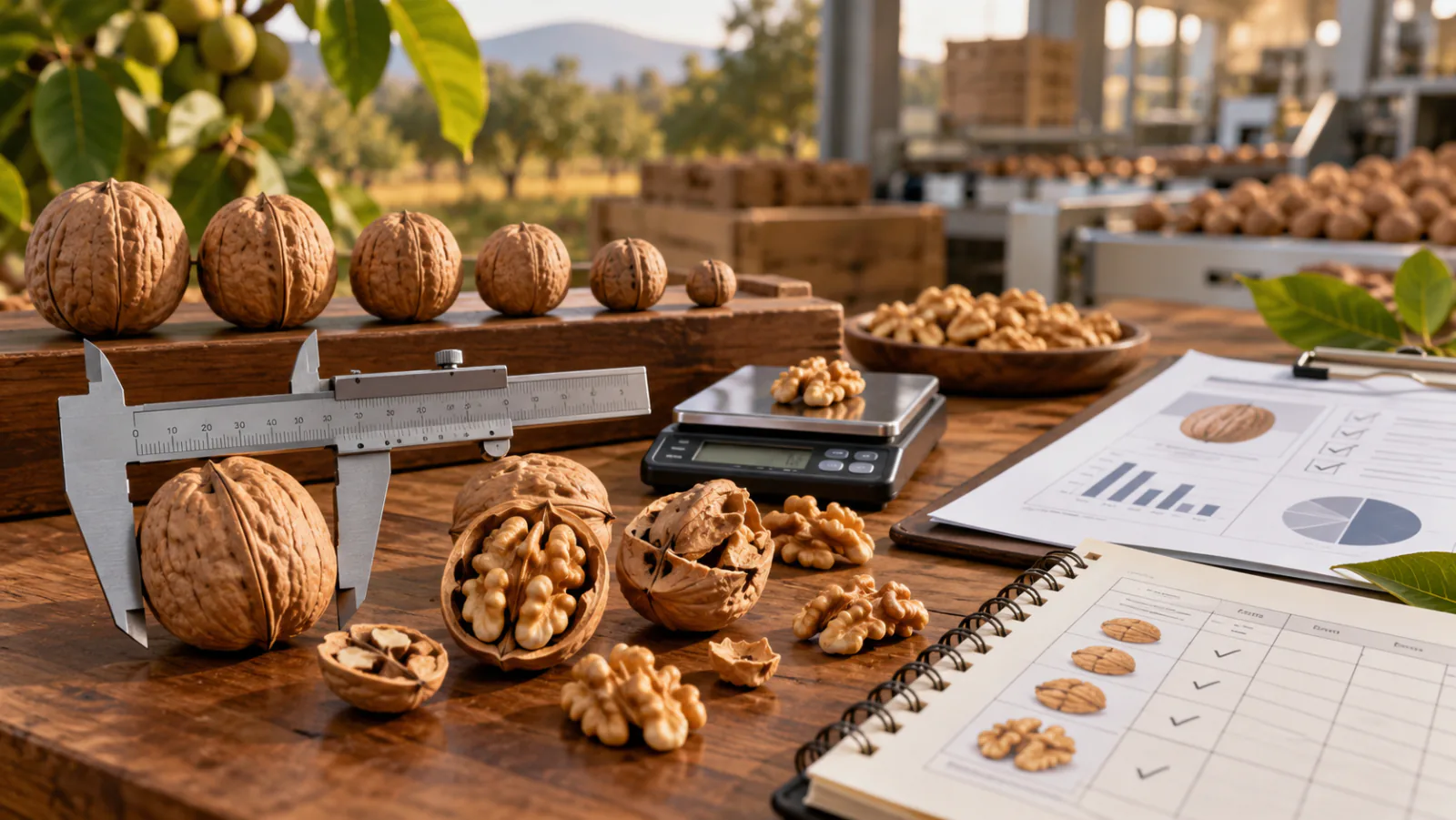
Most of the evaluation needs no laboratory. It needs a method, a scale and daylight. This is the protocol we recommend, in the order it is best done:
| Test | How | What to look for |
|---|---|---|
| Size | Measure 100 pieces with a caliper, or count pieces per pound for pecans | That the actual range sits within the declared one, not just the average |
| Colour | Halves on a white background, natural light, against the USDA chart | Share of pieces outside the declared grade |
| Halves vs pieces | Separate and weigh | If your format sells halves, this percentage is price |
| Defects | Hand-sort shrivelled, insect-damaged, mouldy and stained kernels; weigh | Compare with the spec maximum (for Chandler, < 5 %, with at most 2 % serious defects) |
| Foreign matter | Shell, septum, dust; weigh | In our walnut spec sheets, < 0.1 % |
| Cut and taste | Crack, smell, taste raw | Rancid, bitter, damp or "warehouse" flavour |
| Moisture | Moisture meter if you have one; otherwise ask for the lot figure | Argentine walnut ≤ 6 %, Chilean ≤ 7 %, pecan ≤ 5 % |
| Peroxide value | External lab, only if the product will spend months in your cold store | < 5 meq O₂/kg for Chandler and Serr; < 3 for Howard and pecan |
Two tips that save you a second sample. First: run the evaluation with your end customer in the room, or send them part of it. A buyer supplying an industrial bakery who approves alone approves by their own standard, not by the standard of the one paying. Second: keep half the sample unopened, cool and labelled. If the deal goes ahead, that is your reference sample.
What each field on the spec sheet means — and which one decides the real cost — is covered in how to read a walnut spec sheet.
5. From sample to contract: what to put in writing
An approved sample binds nobody to anything unless the contract mentions it. What turns a good impression into an enforceable obligation is writing down five things:
- The spec in numbers, with the sign. Kernel yield ≥ 48 %, moisture ≤ 6 %, aflatoxin B1 < 2 µg/kg. "Approx." or "good quality" cannot be claimed against.
- The reference to the sample. "As per spec sheet dated X and reference sample Y." If sheet and sample contradict each other, the contract should say which prevails.
- The lot analysis before shipment, with test date and laboratory. Not a season certificate: the one for the lot being loaded.
- A claims window from arrival, long enough for your QA team to inspect before the product is mixed with other stock.
- A technical referee. Which independent laboratory decides if the parties disagree, and who pays for the test (usually: whoever is wrong).
None of this is mistrust. It is what lets a one-point moisture discrepancy be settled with a lab test in a week rather than three months of emails.
6. What we check before the container is sealed
On the seller's side, evaluating the lot does not end when the sample is approved. Before every shipment:
- We allocate the lot and mark its code on every package and in the paperwork.
- We analyse the lot: aflatoxins under Regulation (EU) 2023/915 and microbiology (Salmonella, E. coli, yeasts and moulds). Results are available before shipment, not after.
- We check the lot against the agreed spec sheet: size, colour, moisture, defects.
- We photograph the lot and the loading.
- We prepare the full file: spec sheet, proforma and commercial invoice, packing list, certificate of origin, phytosanitary certificate (SENASA in Argentina, SAG in Chile), bill of lading and certificate of analysis.
If your quality policy requires independent inspection at origin or a pre-shipment sample for your own lab, say so in your first enquiry: it gets built into the loading schedule from the start, not at the end, when a vessel is already booked.
7. The first order: why start with one pallet
Even with an approved sample and a well-written contract, the first order is still a test. It is the first time you see the product at scale: the packaging after an ocean crossing, consistency from carton to carton, how your production line handles it.
That is why we recommend a first deal of 1 pallet (~2,100 kg), even though the per-kilo price of groupage is higher than a full container. The extra cost is small next to finding a fit problem with 20 tonnes in your warehouse.
A realistic timeline from first enquiry:
| Stage | Indicative time |
|---|---|
| Enquiry → sample and spec sheet dispatched | 24–48 h |
| Sample courier to Europe | 5–7 working days |
| Evaluation at destination | Up to the buyer (typically 1–2 weeks) |
| Contract → preparation, lot analysis and loading | 1–3 weeks |
| Ocean transit | 18–25 days from Buenos Aires; 22–30 from Valparaíso or San Antonio |
| Customs clearance at destination | 2–10 days |
Raíz Andina indicative lead times as of September 2026, assuming no incidents. They depend on stock, route and the level of border checks.
All told, two to three months from requesting a sample to the first pallet in your warehouse. If you need product by a specific date, request the sample with that margin, not when stock is already running out. When to buy by origin is covered in counter-season: why buy Southern Hemisphere walnuts, and the full sequence of a first import — Incoterm, payment, documents — in the guide to starting to import nuts.
Frequently asked questions
Do samples cost anything?
Not for qualified buyers. We send 1 to 5 kg with the product spec sheet by courier, and they take 5 to 7 working days to reach Europe. To evaluate properly, include the end use, target spec, destination and expected volume in your request.
If the sample is good, will the container be too?
The commercial sample confirms variety, size, colour and flavour, but it is not statistically representative of a 20-tonne lot. What secures the container is the analysis of that specific lot before shipment and a written specification in the contract that refers to a retained sample.
What sample size does the EU require for aflatoxin testing?
Under Implementing Regulation (EU) 2023/2782, the aggregate sample for tree nuts is 12 kg (60 increments) for a 2–5 tonne lot and 20 kg (100 increments) for each sublot of up to 25 tonnes. That is why a commercial sample of a few kilos cannot certify contaminants.
Which documents should I receive before the shipment leaves?
At a minimum, the agreed spec sheet and the certificate of analysis for the lot with its test date (aflatoxins and microbiology). The commercial invoice, packing list, certificate of origin, phytosanitary certificate and bill of lading travel with the shipment.
Can I ask for a pre-shipment sample of the lot I will receive?
Yes. Ask in your first enquiry so it is built into the loading schedule. You can also require independent inspection at origin, usually at the buyer's expense.
What should I do if the goods that arrive don't match what was agreed?
Document it with photos and measurements before mixing it with other stock, notify within the contract's claims window and compare against the retained reference sample. If the parties still disagree, the independent laboratory named in the contract decides.
What is the minimum order for a first deal?
One pallet, about 2,100 kg. It is the format we recommend for a first order even though the per-kilo cost is somewhat higher than a container, because it lets you validate the product at scale without tying up 20 tonnes.
We are looking for distributors
We work with importers, distributors and food manufacturers in Europe, the Middle East and the Americas, and the process is the one this article describes: sample with spec sheet, specification in writing and lot analysis before loading. If you are starting to compare, Argentine Chandler, Chilean Serr and Chilean Howard are three different profiles — display, industry and long storage — worth sampling side by side.
Clear terms from the outset: minimum 1 pallet (~2,100 kg) per product, 1–5 kg samples, quotes FOB, CIF, CFR or DDP, and payment by bank transfer or letter of credit.
Tell us the end use and destination, and we will send the samples that make sense for that case. Request samples and a quote or write to us via contact.
Official sample sizes are taken from Implementing Regulation (EU) 2023/2782 as in force in September 2026. The specifications quoted are those published in our catalogue spec sheets at that date. Lead times are indicative and do not replace confirmation of stock and shipping line for a specific deal. This article is not legal advice on drafting contracts.