A distributor asks us for "shelled walnuts, large caliber, light color" and considers the specification closed. That is where half of all claims begin: three different varieties meet that description, and the three behave differently on the shelf, on the production line and after eight months in storage.
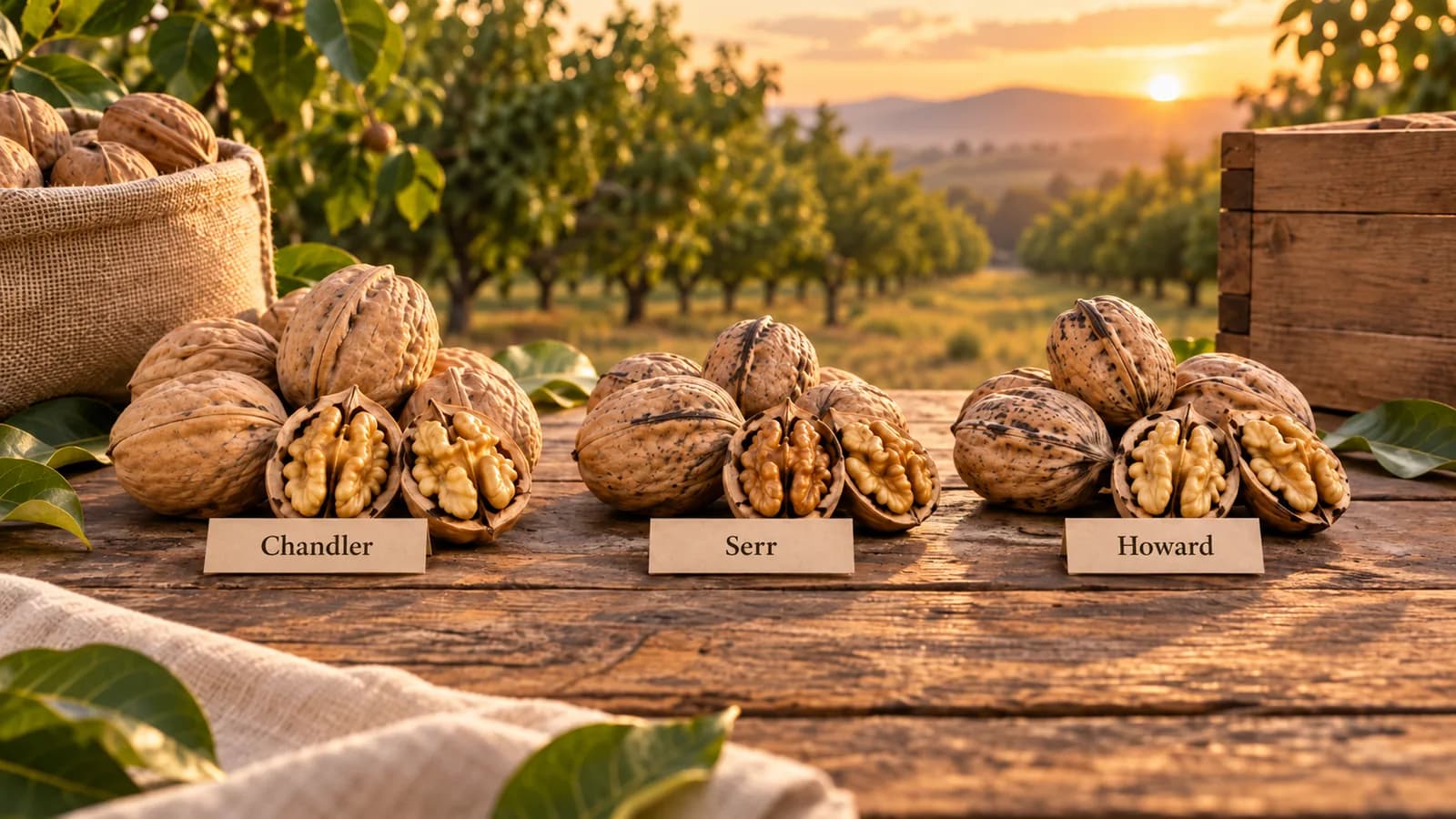
Chandler, Serr and Howard are all Juglans regia. The difference is not the trade name but four variables you do decide when buying: caliber, color, kernel yield and oxidative stability. This article walks through them with the real specifications of the lots we ship, so the order goes out with the variety that matches the end customer rather than the one that matches habit.
1. The three varieties, in one table
Data from our technical sheets in force as of September 2026, for shelled kernels. Aflatoxin limits are those of Regulation (EU) 2023/915, identical for all three.
| Chandler Argentina | Chandler Chile | Serr Chile | Howard Chile | |
|---|---|---|---|---|
| Caliber | 32–36 mm | 30–34 mm | 28–32 mm | 30–34 mm |
| Color | Extra light / light | Extra light / light | Light / light amber | Extra light / light |
| Kernel yield | ≥ 48 % | ≥ 46 % | ≥ 50 % | ≥ 48 % |
| Moisture | ≤ 6 % | ≤ 7 % | ≤ 7 % | ≤ 7 % |
| Peroxide value | < 5 meq O₂/kg | < 5 meq O₂/kg | < 5 meq O₂/kg | < 3 meq O₂/kg |
| Total defects | < 5 % | < 5 % | < 6 % | < 5 % |
| Declared shelf life | 12 months | 12 months | 12 months | 14 months |
| Harvest | March–May | February–April | February–April | March–April |
| Availability | April–December | March–November | March–November | April–December |
| Port of origin | Buenos Aires | Valparaíso / San Antonio | Valparaíso / San Antonio | Valparaíso / San Antonio |
| Transit to the Mediterranean | 18–25 days | 22–30 days | 22–30 days | 22–30 days |
Source: Raíz Andina technical sheets, 2026 season. Aflatoxin limits per Reg. (EU) 2023/915.
2. Caliber and color: what the consumer sees
Caliber rules when the walnut is visible. Clear bag on the shelf, snack tray, pastry decoration: there, a large light-colored half justifies a price that a small piece cannot sustain, even if the flavor is identical.
Chandler Argentina is the largest caliber in our catalog (32–36 mm) with consistent extra light color. It is what we recommend for premium private-label packing and for retail customers competing against Californian product.
Chandler Chile drops to 30–34 mm at the same color grade, with very high uniformity between pieces. When the customer values all halves looking alike more than them being large, it works better than the Argentine.
Color stops mattering once the walnut is transformed. If it goes into a dough, a filling, a nougat or a toasted granola, paying for extra light grade is giving away margin. That is where Serr comes in.
3. Kernel yield: where industry wins or loses
Serr Chile has the highest kernel yield in the catalog: ≥ 50 %, against 46–48 % for the others. On a 20' container with ~19,000 kg of in-shell walnuts, those 2–4 percentage points are between 380 and 760 kg of additional kernel.
The trade-off is color: light to light amber, not extra light. For an industrial customer who buys kernel and toasts it, chops it or blends it into a dough, amber is irrelevant. For one who packs it whole and visible, it is not.
It is also the first to arrive: harvested February to April, available from March. When a customer needs to cover a stock gap before the Argentine season comes in, Serr is the one on hand.
4. Stability: the problem that shows up in month eight
Shelled walnuts go rancid through oxidation. The indicator is the peroxide value, and it is the variable almost nobody checks when buying and everyone checks when the claim arrives.
Howard Chile ships at < 3 meq O₂/kg against < 5 for the others, and declares 14 months of shelf life instead of 12. The difference shows in three specific scenarios:
- Warm destination. Gulf, North Africa, Southeast Asia: if the cold chain is not guaranteed at destination, the initial peroxide margin is all that separates a compliant lot from a rancid one.
- Long transit or transshipment. More days in a container means more hours above the recommended 18 °C.
- Slow rotation. A distributor buying one container for nine months of sales, not three.
If your customer sells the product in under six months and stores it between 15 and 18 °C, the Howard premium over Chandler will not pay for itself. Otherwise, it will.
5. How we decide
When a distributor describes their end customer, the variety usually picks itself:
| If the end customer… | Variety |
|---|---|
| Packs in clear bags for premium retail | Chandler Argentina |
| Wants piece uniformity over size | Chandler Chile |
| Chops, toasts or blends into dough | Serr Chile |
| Is in a warm climate or rotates stock slowly | Howard Chile |
| Needs product before April | Serr or Chandler Chile |
| Needs to cover the October–December gap | Chandler Argentina or Howard |
None of these rules is absolute. An industrial pastry customer in Dubai with fast rotation may be better off with Serr than Howard; a retail customer in Milan with an unconditioned warehouse may need Howard even when packing visible product.
6. What to ask for in the sample
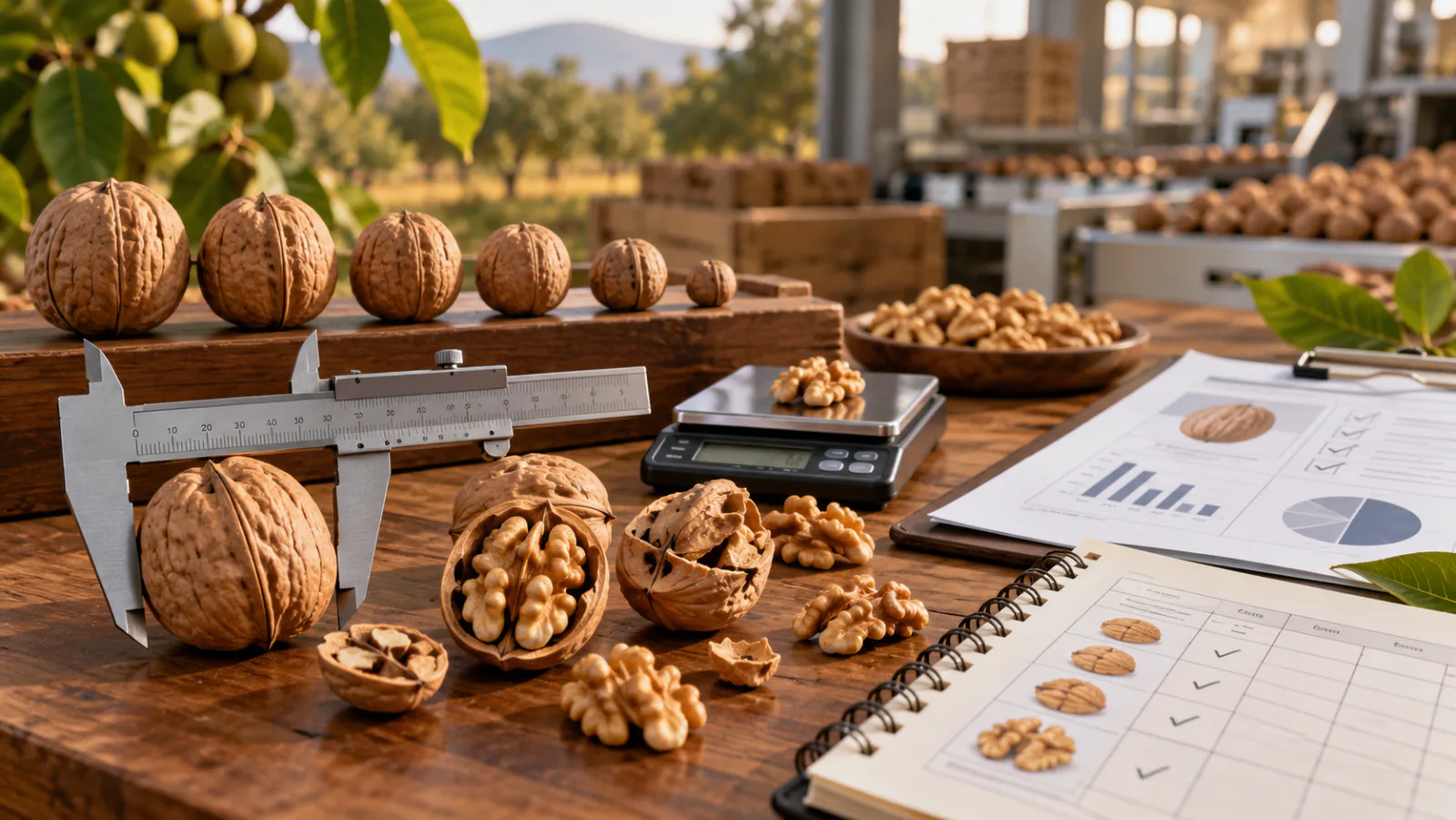
Before a first container we send samples of 1 to 5 kg. Ask for these four figures from the actual lot, not from the generic sheet:
- Measured caliber on the sample, not the nominal range.
- Peroxide value at the time of analysis, dated.
- Moisture — above 7 % the declared shelf life no longer holds.
- Aflatoxin certificate for the lot, not for the season.
With those four numbers you can compare varieties against each other and suppliers against each other. Without them you are comparing adjectives. Our guide on quality standards for walnut imports into the European Union covers what EU customs requires for each.
Frequently Asked Questions
Chandler Argentina or Chile, if the customer wants "the biggest"?
The Argentine: 32–36 mm against 30–34 mm for the Chilean, both in extra light color. The Chilean compensates with greater uniformity between pieces and with availability one month earlier.
Is Serr lower quality because kernel is cheaper?
No. It meets the same aflatoxin, moisture and microbiological limits. Its color is light to light amber instead of extra light, and it allows one more point of total defects (< 6 % against < 5 %). For transformed product that difference never reaches the consumer; its higher kernel yield does reach your margin.
How much do Howard's 14 months of shelf life really add?
It depends on storage. All three varieties declare shelf life at 15–18 °C and under 65 % relative humidity. Outside those conditions, Howard's peroxide margin (< 3 against < 5 meq O₂/kg) is what buys you room; within them, the advantage narrows.
Can I mix varieties in one container?
Yes. A 20' takes 10 EUR pallets and a 40' HC takes 20. Varieties and calibers can be combined per pallet, always respecting the 1-pallet minimum (~2,100 kg) per reference. This is standard practice for a first trial shipment.
Which variety is available in August?
Chandler Argentina and Howard Chile, both available April to December. Serr and Chandler Chile cover March to November. Between the four there is no uncovered month, which is the real argument for southern-hemisphere counter-seasonality.
Do specifications change from season to season?
Caliber ranges and regulatory limits stay the same. Color and yield do vary somewhat by season and growing area; that is why the analysis of the shipped lot takes precedence over the commercial sheet.
We are looking for distributors
We work with importers, wholesale distributors and the food industry in more than 15 countries. Minimum order 1 pallet (~2,100 kg) per reference, samples of 1 to 5 kg for evaluation, quotes FOB, CIF, CFR or DDP and payment by wire transfer or letter of credit.
Tell us what your end customer does with the walnut and we will propose the variety and send you the sheet for the available lot. Request a quote or write to us from contact.