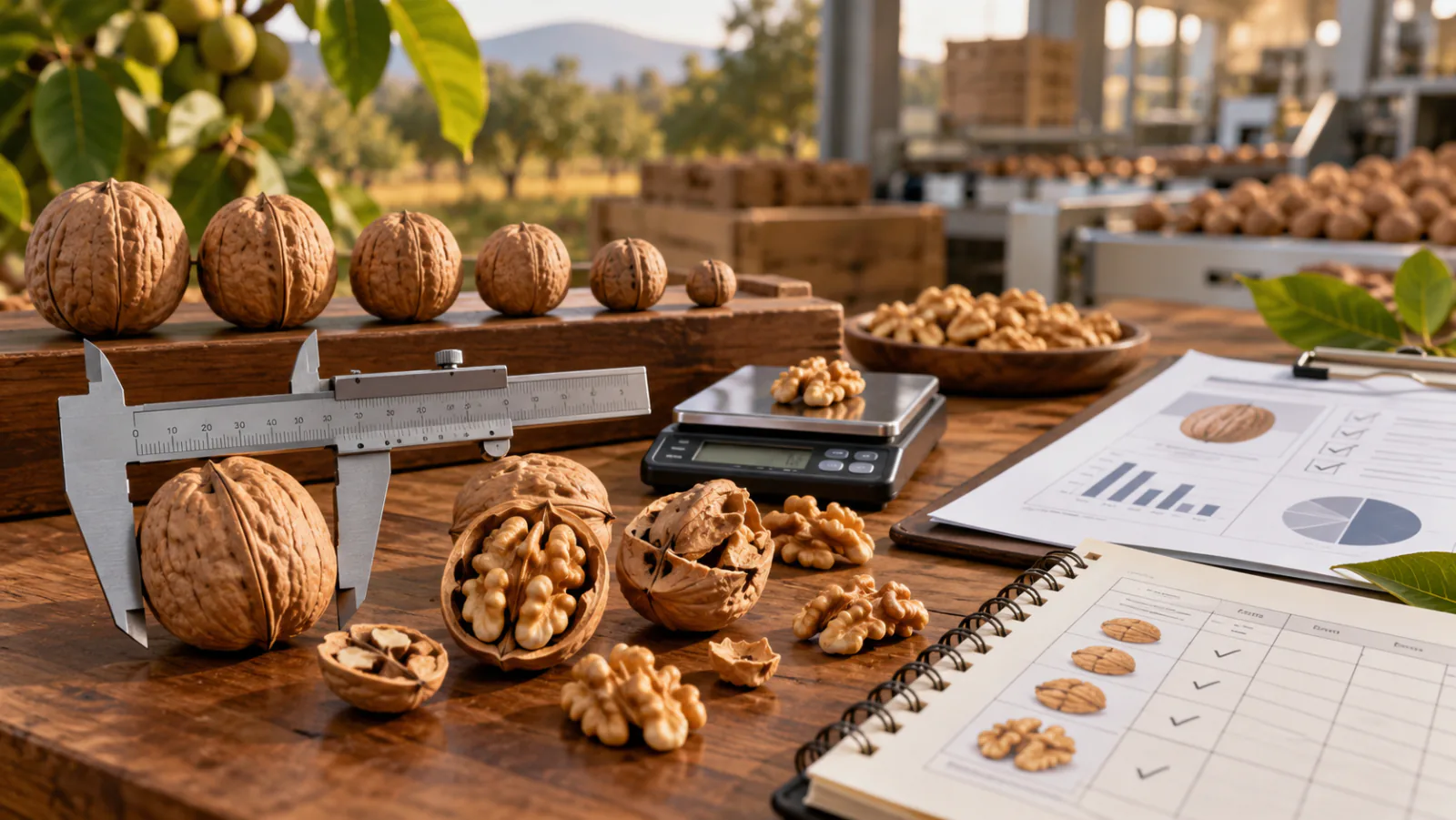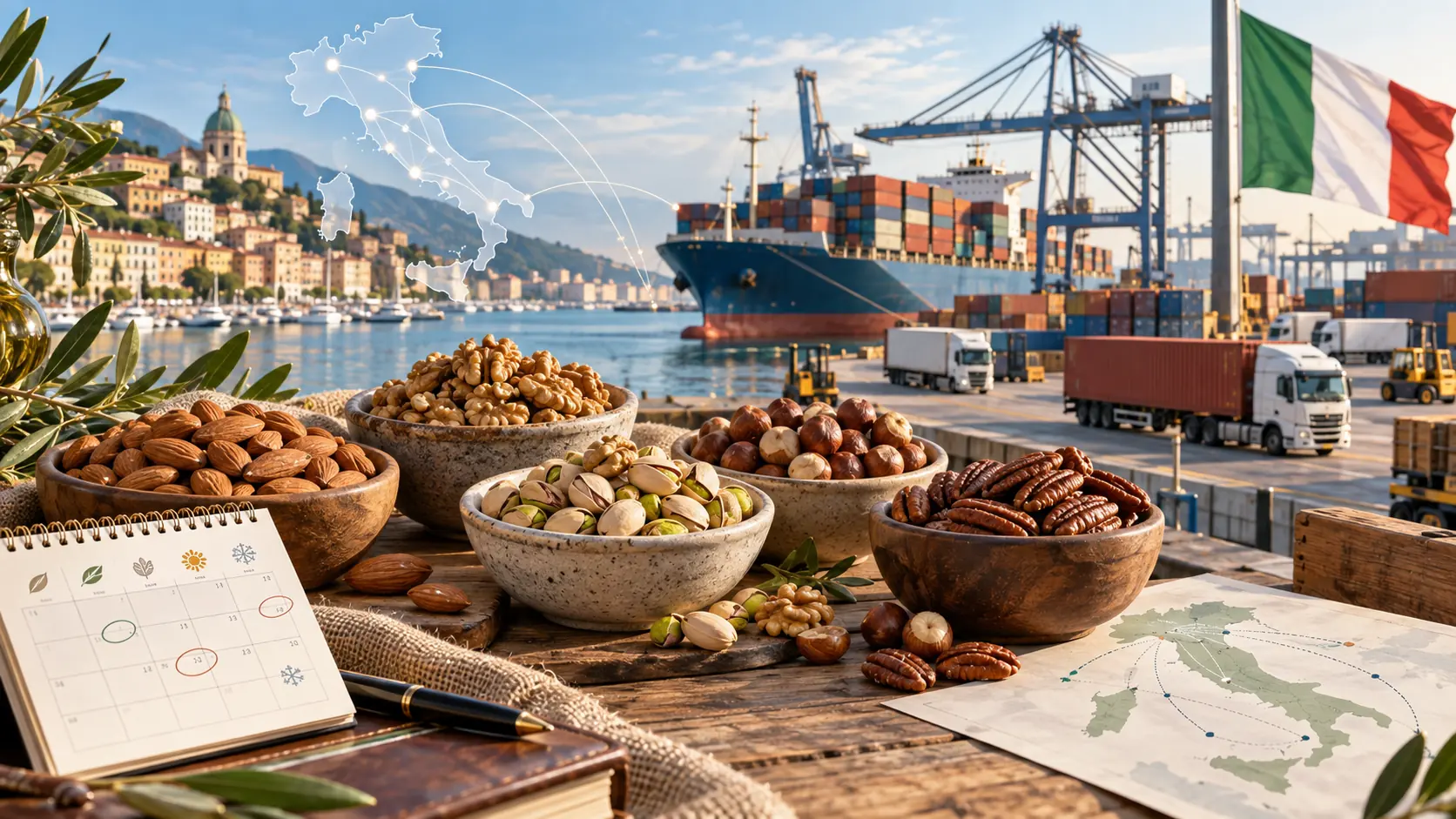
It is 20 September and a European buyer has two offers of shelled Chandler walnuts on the desk. Same variety, same declared caliber, same Incoterm.
The first is Californian, from the crop that finished in October last year: eleven months in storage. The second is Chilean, harvested in March: six months. A third option, Argentine from April, has five.
That is all counter-season supply is. Not a commercial strategy, not an origin slogan: a calendar — and the calendar translates into months of storage the product has already spent before it reaches your plant. This article covers when that difference genuinely matters, when it matters not at all, and how to plan a buying year across both hemispheres instead of picking a side.
1. The two calendars, in one table
Harvest and availability per the technical data sheets in our catalog, current as of September 2026. Availability is subject to stock; the harvest months are what do not move.
| Product | Origin | Harvest | Availability |
|---|---|---|---|
| Chandler walnut | Argentina | March – May | April – December |
| Chandler walnut | Chile | February – April | March – November |
| Serr walnut | Chile | February – April | March – November |
| Howard walnut | Chile | March – April | April – December |
| Pecan | Argentina | March – May | April – December |
| Almond | Chile | February – April | March – November |
| Macadamia | South Africa | February – June | April – December |
| Chandler walnut | USA (California) | September – November | December – August |
| Pistachio | China | August – October | November – July |
Read it from the bottom up and the mechanism is obvious: the two availability blocks are almost complementary. California covers December to August; Argentina and Chile, March to December. The real overlap — months with fresh-crop product on both sides — is short: April and, at best, May.
The rest of the year, one side has crop-fresh product and the other has stored product. In January, the fresh one is Northern. In September, it is Southern.
2. What actually ages in a stored walnut
"Fresh" and "old" are not contractual categories. What degrades over time in a high-fat tree nut is the fat, and that can be measured.
The peroxide value quantifies oxidation already under way, in milliequivalents of oxygen per kilo. Our walnut sheets declare < 5 meq O₂/kg at the time of analysis — Howard, < 3 — and declared shelf life is 12 months for Chandler and Serr and 14 months for Howard, always at 15-18 °C and below 65 % relative humidity.
That last condition decides everything. An eleven-month-old walnut kept in temperature-controlled storage can arrive impeccable. The same walnut, eleven months in an unconditioned warehouse through a Mediterranean summer, arrives rancid — something the aflatoxin analysis does not detect and the commercial sheet does not anticipate, because nobody measured peroxides again after shipment.
Counter-season supply performs no miracles: what it does is shorten the stretch of time in which something can go wrong. Six months of chain is six months of risk; eleven is nearly double. How to read the rest of the sheet — yield, color, moisture — is covered in our guide to reading a walnut spec sheet.
3. Where the supply comes from: the real size of each origin
Volumes are worth placing properly, because counter-season supply does not change who runs the market.
California produced an estimated 710,000 short tons (about 644,000 metric tonnes) in 2025, 18 % above 2024, per the USDA-NASS objective measurement report published in September 2025. It is by far the largest origin in the world and the one that sets the price reference.
Chile is the second-largest exporter: around 128,000 tonnes exported in 2025, at a record value of USD 631 million, per end-of-season figures from ChileNut. Destinations have been shifting towards the Middle East and India, and Europe competes for that volume.
Argentina is small by comparison — roughly 14,000 tonnes across some 15,000 hectares, per Alimentos Argentinos (MAGyP) — but heavily concentrated on the European market: Italy takes around 84 % of Argentine walnut exports. It is not a commodity origin: it is a large-caliber, extra-light-color origin for buyers who pay for that.
The practical consequence for a distributor: the Southern Hemisphere does not compete on volume, it competes on calendar and on color. Anyone needing 400 containers a year cannot do without California. Anyone needing crop-fresh product in August can do without California for those months.
4. Month by month: what to buy and when
| Months | Origin with crop-fresh product | What to ship |
|---|---|---|
| January – February | North (California, Sep-Nov harvest) | Chandler USA; the South is still harvesting |
| March – April | Overlap: South arriving, North still valid | Chilean Chandler and Serr, first departures |
| May – July | South | Argentine Chandler, Chilean Howard, pecan |
| August – October | South | Argentine Chandler and Howard (12-14 months of shelf life ahead) |
| November – December | South, closing the season | Last Southern shipments; Northern product starts arriving |
The two months worth the most are August and September, for a commercial reason rather than a quality one: that is when European industry buys for the Christmas season. In that window Northern product has ten or eleven months of storage behind it and Southern product four or five, with almost the entire declared shelf life ahead. It is exactly the argument we develop for the Italian market in our guide to Italy: market, ports and buying calendar.
Transit has to be added, and it is not trivial: 18-25 days from Buenos Aires to the Mediterranean and 22-30 days from Valparaíso or San Antonio. A shipment leaving in August arrives in September. Anyone who wants product in plant on 1 October closes in August, not in September.
5. What counter-season supply does not solve
We write this knowing it works against us, but a commercial argument that only holds up by omitting half the data does not survive the second meeting.
It is not a discount. Southern Hemisphere pricing is not structurally lower: it tracks the Californian reference at a premium or a discount depending on the season, caliber and color. Anyone selling counter-season as a synonym for cheap is selling something else.
It does not replace lot analysis. A freshly harvested walnut with poor post-harvest handling is worse than a well-stored ten-month-old one. Harvest date is an indication; a dated peroxide value is the data point.
It does not always win on caliber. Californian Chandler reaches 32-36 mm just as the Argentine does. Between January and March it is also the fresh one. Buying Southern in February means paying for counter-season and receiving previous-crop product.
It does not remove single-crop exposure. Concentrating the year on one hemisphere leaves the operation hanging on one frost, one drought or one logistics disruption. The serious reason to work with both is not freshness: it is not depending on a single harvest.
6. How to plan a year across both hemispheres
What we recommend to a distributor with steady consumption, without origin romance:
- Split the year into two buying blocks, not one. January-March on Northern product; May-December on Southern. April is the decision month, when both are available and can be compared.
- Close August in June. The pre-Christmas window is the most contested and the first to run out of large caliber. Contracts for that window are negotiated two or three months ahead.
- Always ask for the lot's harvest date, not the crop year. "2026 crop" spans February to November depending on the hemisphere, and means nothing on its own.
- Fix the peroxide value in the contract, with the analysis dated before shipment. It is the only number that turns "fresh" into an enforceable obligation.
- Choose the variety by how long the product will sit in your warehouse. If it turns in six weeks, the variety is irrelevant. If it will spend six months in your storage, Howard — < 3 meq O₂/kg and 14 declared months — has margin the others do not. It is compared in detail in Chandler, Serr or Howard.
And if this will be your first import operation, the order of the steps — volume, Incoterm, payment, documents — is in our guide to start importing nuts.
Frequently Asked Questions
What exactly does "counter-season" mean in tree nuts?
That the Southern Hemisphere harvests between February and May while the Northern Hemisphere harvests between September and November. A European buyer sourcing from Argentina or Chile receives current-crop product in the months when local or Californian product already has eight to eleven months of storage behind it.
Are Southern Hemisphere walnuts better than Californian ones?
Not in intrinsic quality: it is the same variety, Juglans regia, with the same aflatoxin and moisture limits. The difference is the calendar. Between May and December, Southern product is the crop-fresh one; between January and March, Northern product is. What decides is the month you buy in, not the hemisphere.
In which months is it not worth buying from the Southern Hemisphere?
January to March. In that window the South American harvest is not finished, available stock is previous-crop and Californian product has just come in. Buying Southern in those months brings no freshness advantage.
Which products are available in August?
Argentine Chandler, Chilean Howard, Argentine pecan and South African macadamia, all with declared availability from April to December. Chilean Chandler and Serr cover March to November. Between them, no month of the year is left uncovered.
How do you verify that a lot really is current crop?
With three documents requested before shipment: the lot's harvest date on the sheet, the peroxide value analysis with its test date, and the phytosanitary certificate, whose issue date brackets the period. If the three are consistent, traceability holds; if the supplier only provides the crop year, it does not.
How long does a Southern Hemisphere shipment take to reach Europe?
18 to 25 days from Buenos Aires to Mediterranean ports and 22 to 30 days from Valparaíso or San Antonio, plus customs clearance. For planning purposes, an order closed in August is available at a European plant in early October.
Can I combine Northern and Southern origins in the same year?
That is what we recommend. The minimum is one pallet (~2,100 kg) per reference, so a container takes several varieties and origins. Working both hemispheres covers all twelve months and avoids exposure to a single harvest.
We are looking for distributors
We operate both hemispheres: Argentine Chandler and pecan from Mendoza and Entre Ríos, Chandler and Howard from Chile, and Californian Chandler for the January-to-March window. That lets us quote all twelve months without selling stored product as if it were crop-fresh.
The terms, clear from the start: minimum 1 pallet (~2,100 kg) per reference, 1 to 5 kg samples for evaluation, quotes FOB, CIF, CFR or DDP, payment by wire transfer or letter of credit, and a technical sheet with lot analysis before any shipment.
Tell us which months you need covered and we will propose the origin that covers them. Request a quote or write to us from contact.
Harvest and availability months come from the technical data sheets in our catalog, current as of September 2026, and are subject to stock. Production and export figures correspond to the sources cited for the periods indicated. Transit times are industry orders of magnitude and do not replace carrier confirmation for a specific shipment.