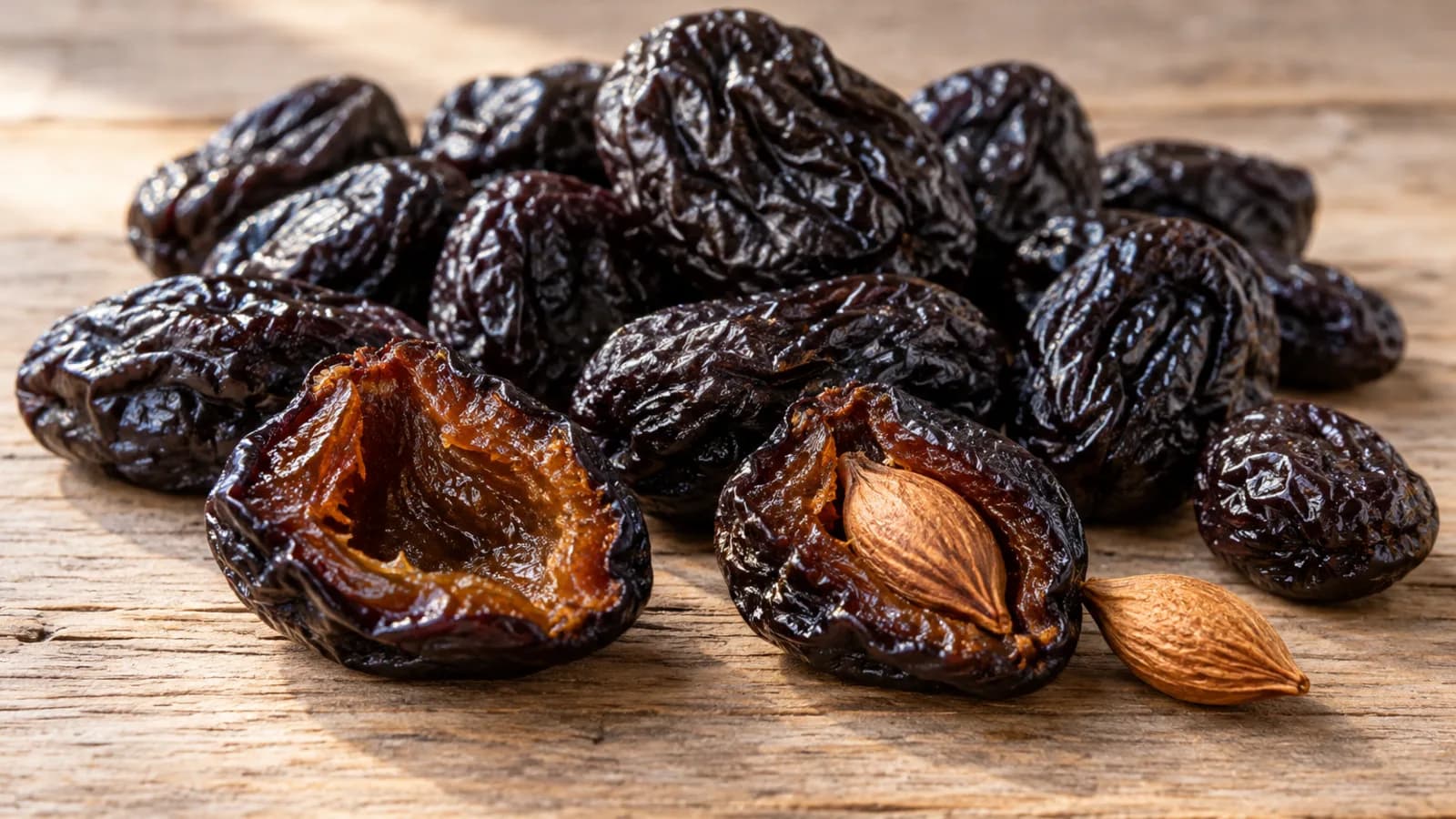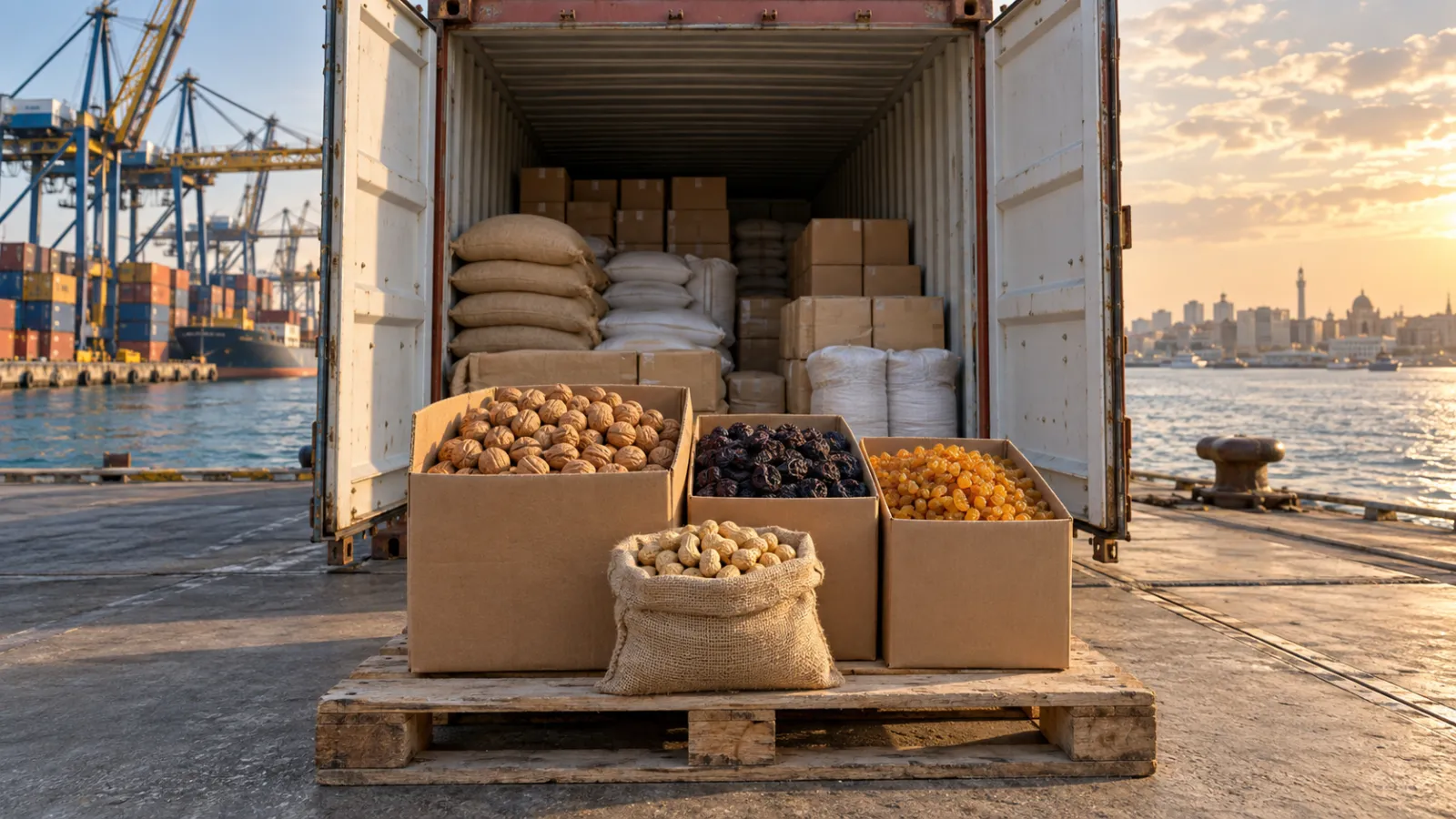
Egypt produces almost no tree nuts and imports more than USD 80 million a year in walnuts, almonds, hazelnuts and pistachios alone. What few exporters realise is that the origin of the goods determines the duty: under the Mercosur–Egypt Free Trade Agreement, in force since 1 September 2017, Argentine product enters at zero or near-zero duty, while the same product from Chile, the US or Turkey pays the general tariff.
The short answer:
- Prunes, raisins and peanuts of Argentine origin: 0% duty. Without the preference, prunes pay 30%, raisins 40% and peanuts 5%.
- Walnuts, pecans and almonds of Argentine origin: the phase-out ends in 2026 (§2.2). Without the preference, they pay 20%.
- Walnuts from Chile or the US: the full 20%. Neither country has a trade agreement with Egypt.
On a USD 100,000 CIF container of walnuts, that is a USD 20,000 difference in duty. This guide explains how the preference is applied, which documents support it, how the advance cargo registration (ACI) that Egypt has required since 2021 works, and what to keep in mind on routing, payment and the buying calendar.
1. What Egypt buys and where Argentina stands
According to the import data Egypt reports to UN Comtrade (retrieved via WITS), these were the 2024 purchases of the products South America exports:
| HS code | Product | USD thousand | Tonnes | Main suppliers | Argentina |
|---|---|---|---|---|---|
| 0813.20 | Prunes | 2,537 | 599 | Argentina 309 t, Spain 142 t, France 73 t | 1st (52% of value) |
| 1202.20 | Shelled peanuts | 4,895 | 2,632 | Sudan 684 t, Argentina 630 t, Tanzania 449 t | 2nd |
| 0802.31 | In-shell walnuts | 6,358 | 2,931 | US 2,065 t, China 273 t, Argentina 233 t, Chile 147 t | 3rd |
| 0802.32 | Walnut kernels | 6,619 | 1,359 | US 588 t, Lebanon 437 t, Syria 174 t | — |
| 0802.90 | Other nuts (including pecans) | 2,250 | 200 | Lebanon, Sudan, US, Brazil, Argentina (18.5 t) | 5th |
| 0806.20 | Raisins | 792 | 319 | Turkey 127 t, Iran 94 t, Syria 50 t | — |
| 0802.12 | Shelled almonds | 21,533 | 4,789 | Spain 2,111 t, US 1,805 t | — |
| 0802.50 | Pistachios | 22,570 | 2,378 | US, Syria, Lebanon, Iran | — |
Three things explain these figures:
Walnuts are the big market that shrank. Between 2019 and 2023, Egypt imported 26,314 t of walnuts from the US and 21,641 t from Chile, with a record in 2021, according to the USDA report on walnuts in Egypt (January 2025). The foreign currency shortage and the devaluation of the pound in March 2024 crushed consumption: in 2024 Chile sold just 147 t. When demand recovers, the gap Chile left can be filled by an origin that clears customs 20 points cheaper.
Walnuts are a Ramadan ingredient. The USDA explains that most are consumed in traditional pastry: the kahk of the last week of Ramadan and Eid al-Fitr, kunafa, qatayef, umm ali and basbousa. Demand and prices rise in those weeks.
Argentina is already the reference origin for prunes and peanuts. That means there are Egyptian importers who know the product, the sizes and the Argentine paperwork.
2. The Mercosur–Egypt FTA, line by line
2.1 The phase-out categories
The agreement assigns tariff lines to categories (article 11 of the treaty text):
- A: zero duty from entry into force.
- C: phase-out in 8 annual stages.
- D: phase-out in 10 annual stages; the first was on 1 September 2017.
These are the categories in Egypt's schedule (annex to the agreement, published on Brazil's Siscomex portal), compared with the general tariff paid by any origin without an agreement (Presidential Decree 419/2018, as reported by the USDA):
| HS code | Product | Category | General tariff (MFN) | Argentine origin |
|---|---|---|---|---|
| 0806.20 | Raisins | C | 40% | 0% |
| 0813.20 | Prunes | C | 30% | 0% |
| 1202.41 / 1202.42 | In-shell and shelled peanuts | A / C | 5% | 0% |
| 0802.31 / 0802.32 | In-shell walnuts and kernels | D | 20% | 0% once the phase-out ends |
| 0802.90 | Pecans (other nuts) | D | 20% | 0% once the phase-out ends |
| 0802.11 / 0802.12 | Almonds | D | 20% | 0% once the phase-out ends |
| 0802.61 / 0802.62 | Macadamias | C | 10% | 0% |
| 0813.50 | Mixtures of nuts and dried fruit | D | 20% | 0% once the phase-out ends |
Category C completed its phase-out in September 2024. That is why Argentine prunes, raisins and peanuts already enter duty-free.
2.2 When walnuts reach zero
With ten stages starting in September 2017, the final category D cut falls on 1 September 2026. That is what the ANBA news agency reported in February 2026, explicitly mentioning nuts. Not all official Argentine sources agree, however: the Ministry of Agriculture gives 1 January 2027, and the 2025 Business Guide of the Argentine Embassy in Cairo refers to the end of 2026.
In practice, the difference is small: even if one stage were outstanding until January, the residual duty would be one tenth of the base rate. Before you quote, confirm the applicable rate on the arrival date with your customs broker in Egypt.
2.3 The preference belongs to the origin, not the seller
The preferential duty applies to goods originating in Mercosur, with their certificate. Where the selling company is based does not matter:
- Argentine walnuts sold by a European trader keep the 0% rate, provided the paperwork is done properly (§3).
- Chilean walnuts sold by an Argentine company pay 20%. Chile has no trade agreement with Egypt: in 2019 it only agreed with Cairo on a working group to study one.
- The US has no free trade agreement with Egypt either, only a framework agreement (USDA, Exporter Guide 2025).
3. The certificate of origin: where the preference gets lost
Without a valid certificate of origin, Egyptian customs applies the general tariff. Three rules in the agreement are worth keeping in mind:
- Issuance. The certificate is issued in English and before the goods are exported (article 20); it covers a single import and is valid for 180 days. Only exceptionally is one issued afterwards accepted (article 21). In Argentina it is issued by the bodies authorised for ALADI and Mercosur agreements (Resolution SC 854/2017), including the Argentine-Arab Chamber of Commerce.
- Third-party invoicing (article 15). This is allowed: the goods can be Argentine and the invoice issued by a company in another country. The certificate must state the number and date of that invoice and the name, country and address of the invoicing operator. If the invoice is not yet known when the certificate is issued, the operator must include in it a signed declaration that it corresponds to those goods.
- Direct transport (article 14). Transhipment in a third country is permitted, provided the cargo remains under customs control and is not handled beyond unloading and reloading.
If you buy Argentine origin through an intermediary, ask for the draft certificate before shipment and check that the invoice you will receive matches what the certificate says.
4. ACI: advance cargo registration on Nafeza and CargoX
Since 1 October 2021, every sea shipment to Egypt must be registered before it leaves the port of origin on Nafeza, Egypt's single window for foreign trade. This is the ACI (Advance Cargo Information) system. The Argentine Embassy's Business Guide summarises the procedure:
- The exporter registers on CargoX, the platform that digitises documents for Nafeza. It is a one-off registration; company verification costs around USD 15 (S-GE).
- The importer registers the transaction on Nafeza at least 48 hours before the cargo departs. Customs and the competent authorities pre-approve it and generate the ACID, the cargo's unique number.
- The exporter uploads the documents to CargoX. The commercial invoice and the other documents must carry the ACID, the exporter's identifier and the importer's identifier.
- The shipping line submits the manifest up to 24 hours before departure.
- The importer completes the arrival details on Nafeza at least 48 hours before arrival.
According to the Argentine Embassy, under this system the documents do not require Egyptian consular legalisation.
The most common mistake: shipping without an ACID. Without that number on the documents, the cargo will not clear at destination. It is worth making the ACID a condition in the contract: "the seller ships only once the buyer has communicated the ACID in writing".
5. Sanitary and quality requirements
| Requirement | What Egypt requires | Responsibility |
|---|---|---|
| Importer licence | The importer needs a licence from the NFSA (National Food Safety Authority); those on the "white list" get simplified clearance and sampling | Importer |
| Sampling at port | Egyptian standard 7135/2010 provides for sampling and testing of 100% of lots, except for white-list importers | NFSA |
| Phytosanitary certificate | Issued by SENASA for Argentine goods | Exporter |
| Aflatoxins | The NFSA follows EU limits: almonds and raw pistachios, 10 µg/kg total and 8 µg/kg B1; peanuts, 4 µg/kg total and 2 µg/kg B1 (USDA FAIRS 2025) | Exporter: a lot fit for the EU is fit for Egypt |
| Shelf life | A product with a shelf life of 6 months or more must reach port with at least 3 months remaining | Exporter |
| Label | In Arabic (Egyptian standard 1546/2011), printed or with a permanent sticker, with no date discrepancies between languages | Importer and exporter, for retail sale |
| Factory registration (Decree 43/2016) | Only for a list of products packed for retail sale; dried fruit presented for consumers is included | Exporter, before shipment |
Bulk or retail packs. For a first container, the simplest option is to sell in bulk (industrial sacks or cartons) to an importer who packs or distributes. Retail packaging triggers factory registration with the GOEIC under Decree 43/2016 and the Arabic label.
Before you close, confirm with SENASA that the product has phytosanitary requirements agreed with the Egyptian plant quarantine authority. The Embassy itself recommends checking this product by product.
6. The route: to Alexandria without going through Suez
From Buenos Aires to Alexandria the transit time is around 29 days, with sailings every one or two weeks (Fluent Cargo). The route crosses the Atlantic, enters the Mediterranean through Gibraltar and does not pass through the Suez Canal or the Strait of Hormuz. In 2026 that is a reliability argument: shipments to Gulf ports carry war risk surcharges and Red Sea transits remain restricted.
Some practical points:
- Mediterranean ports: Alexandria, El Dekheila, Damietta and Port Said. Avoid Sokhna, on the Red Sea, if the route involves crossing Suez.
- Dry container. In-shell walnuts, prunes, raisins and peanuts travel in dry containers. In summer, walnut kernels are better shipped in reefers.
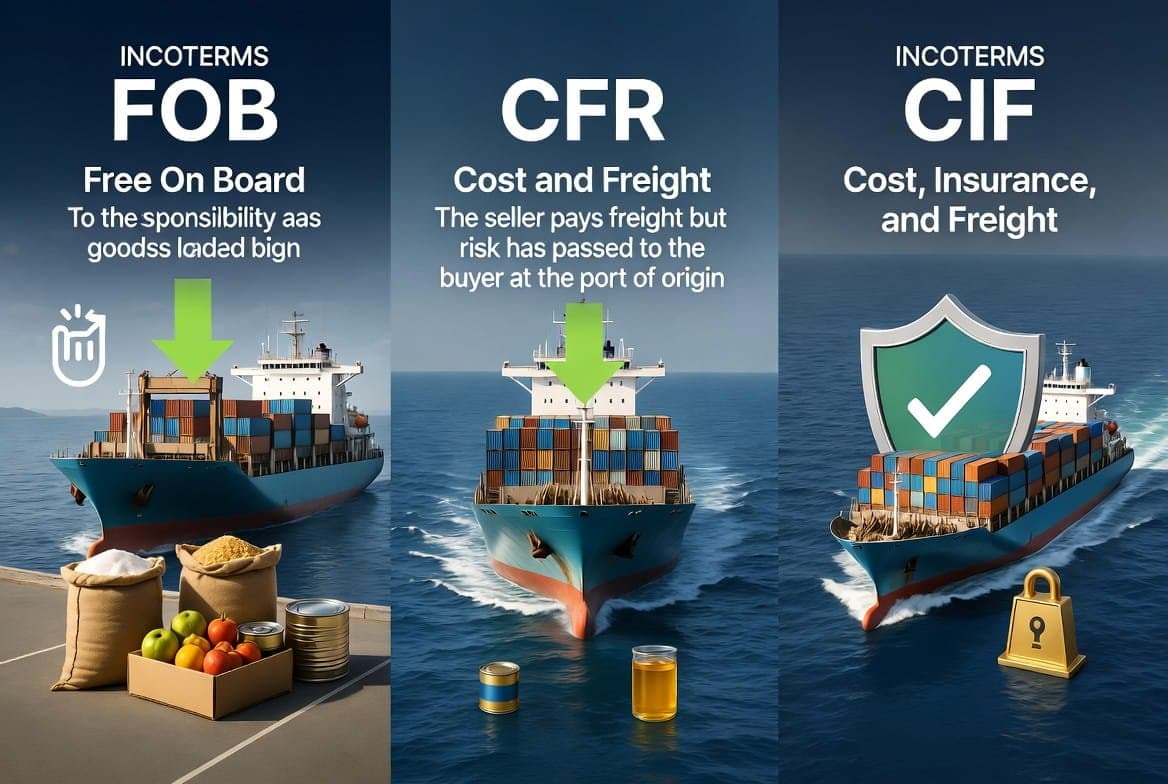
- Incoterm. The usual terms are CFR or CIF Alexandria, with a named port. We explain the differences in our Incoterms guide.
- Fuel surcharges. Shipping lines have applied emergency bunker surcharges since March 2026. Ask for the freight quote to itemise them and to have a short validity.
7. Payment: the part that weighs most
Egypt's risk is not demand, it is foreign currency:
- Between February and December 2022, the Central Bank required a letter of credit for all imports, and goods were held at ports for lack of dollars (Ahram).
- In March 2024 the pound was floated and the backlog cleared. In March 2026, with the war with Iran, it hit a record low of around 52.8 pounds to the dollar (Bloomberg).
With a new buyer, the sensible options are:
- Confirmed irrevocable letter of credit from a European or first-tier bank.
- Advance payment of 30 to 50% and the balance cash against documents (CAD), with the bill of lading to the order of the bank.
Avoid open account until you have a track record with the customer, and always quote in dollars.
8. The buying calendar: Ramadan yamish
In Egypt, the nuts and dried fruit eaten during Ramadan have a name of their own: yamish. In 2024, the country imported USD 124 million in coconut and nuts and around USD 2.5 million in prunes, according to Arab Finance, which notes that imports for the season are completed before it begins.
For Ramadan 2027, which will start around 8 February (Gulf News):
| When | What happens |
|---|---|
| October 2026 | Yamish contracts with the 2026 southern hemisphere crop |
| October to mid-December 2026 | Shipments (around 29 days' transit to Alexandria) |
| 7 to 10 December 2026 | Food Africa, the Cairo food trade fair |
| December 2026 and January 2027 | Arrival, clearance and distribution to wholesalers |
| ~8 February 2027 | Start of Ramadan; Eid al-Fitr around 10 March |
| April to June 2027 | New Argentine walnut and pecan crop: offers for the rest of the year |
9. Checklist for your first container to Egypt
- Product of Argentine origin (or from another Mercosur country), if you want the preference.
- HS code confirmed and applicable rate on the arrival date checked with the Egyptian customs broker.
- Exporter registered on CargoX and ACID communicated by the importer before shipment.
- Mercosur certificate of origin issued before export, with the third-party invoice details if applicable.
- SENASA phytosanitary certificate and product requirements confirmed.
- Lot analysis with aflatoxins within EU limits.
- Harvest date and shelf life: at least 3 months' margin on arrival.
- Bulk, or else a factory registered under Decree 43/2016 and an Arabic label if the packaging is retail.
- Confirmed letter of credit or advance payment; never open account with a new customer.
- CFR or CIF to a Mediterranean port, with freight surcharges itemised.
Frequently Asked Questions
What duty do Argentine walnuts pay in Egypt?
Walnuts are in category D of the Mercosur–Egypt FTA, whose phase-out ends in 2026: on 1 September according to the agreement's schedule, or in early 2027 according to some official Argentine sources. With a certificate of origin, the duty is zero or residual. Without the preference, Egypt's general tariff is 20%.
Do Chilean walnuts also enter Egypt duty-free?
No. Chile has no free trade agreement with Egypt, so its walnuts pay the general tariff of 20%. The same applies to US walnuts and almonds.
What duty do Argentine prunes and raisins pay in Egypt?
Zero. Both are in category C of the agreement, which completed its phase-out in September 2024. Without the preference, prunes pay 30% and raisins 40%.
Is the preference lost if a European company issues the invoice?
No. Article 15 of the agreement allows invoicing by an operator in a third country, provided the certificate of origin states the number and date of that invoice and the operator's details, or the invoice carries a signed declaration linking it to the goods.
What is the ACID and who requests it?
It is the unique number that identifies each shipment on Nafeza, Egypt's single window. The importer obtains it by registering the transaction before the cargo departs, and it must appear on the invoice and all other documents. The exporter, for their part, must be registered on CargoX to upload the documents.
Does Egypt require halal certification for nuts?
According to the USDA's FAIRS 2025 report, mandatory halal certification applies to meat and poultry, not to nuts or dried fruit. Some buyers ask for it anyway for retail sale; it is worth checking before you quote.
How long does a container take from Buenos Aires to Alexandria?
Around 29 days, via the Atlantic and Gibraltar, without passing through the Suez Canal. For Ramadan 2027, which starts around 8 February, the last useful shipment leaves in mid-December 2026.
We are looking for importers and distributors in Egypt
We work with Egyptian importers, wholesalers and roasters who want a supplier of Argentine origin at 0% duty, with the paperwork sorted from the first shipment. For Egypt we offer Argentine Chandler walnuts, Argentine pecans, prunes from Mendoza, raisins from San Juan and Argentine peanuts.
We quote CFR or CIF Alexandria, with a Mercosur certificate of origin, CargoX registration and lot analysis against EU limits. All five products can be combined by pallet in the same container, all with the tariff preference: a yamish wholesaler does not need to fill 20 tonnes with a single product. Minimum order: 1 pallet (~2,100 kg); samples from 1 to 5 kg. If you also operate in the Gulf, read our guide to the UAE and the GCC; for prunes, see our comparison of origins.
Tell us the product, volume and destination port, and we will send you the technical data sheet, the lot analysis and a quote for the Ramadan season. Request a quote for Egypt or write to us via our contact page.
The tariff categories come from Egypt's schedule under the Mercosur–Egypt FTA and the general tariffs from Presidential Decree 419/2018; the trade data from UN Comtrade (2024); and the requirements from the Argentine Embassy in Egypt's 2025 Business Guide and the USDA's FAIRS and Exporter Guide 2025 reports, all checked on 28 September 2026. Duties and requirements may change: always confirm the applicable rate and documentation with your customs broker before shipping. This article does not constitute legal or customs advice.