When a European importer negotiates the purchase of a container of food product from South America, one of the first questions on the table is deceptively simple: at what price? But in international trade, price is never just a number. There is always an Incoterm behind the price, and that Incoterm defines who pays the freight, who arranges insurance, who bears the risk during transport and at exactly which point responsibility changes hands.
Choosing the wrong Incoterm can turn a profitable operation into an expensive lesson. And yet it is one of the most frequent mistakes among importers taking their first steps in international agri-food trade.
In this guide we break down the three Incoterms most used in bulk food trade — FOB, CFR and CIF — explain their real differences with practical examples, and offer concrete criteria for choosing the term that best fits each operation.
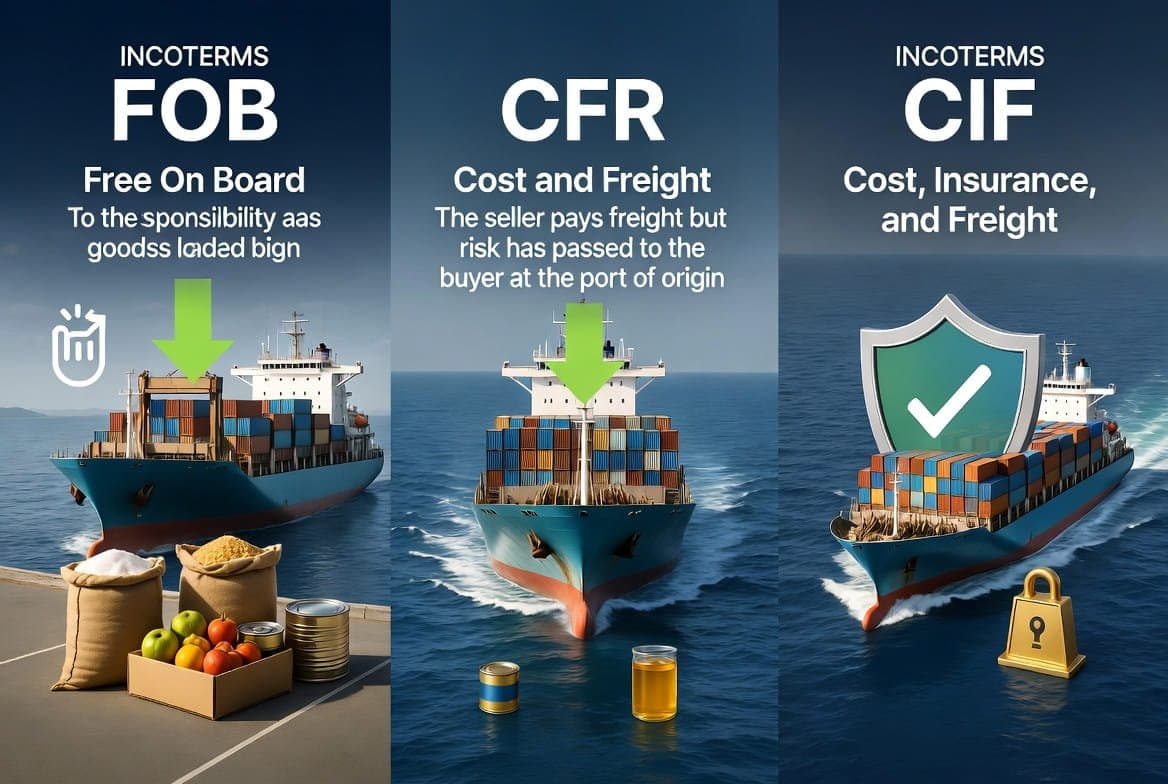
The difference, in one line
If you came here to find out what separates them, this is it:
- CIF vs. CFR — Identical except for insurance: under CIF the seller buys and pays for it; under CFR nobody does, and the buyer eats the loss if something goes wrong. The seller pays the freight in both.
- FOB vs. CFR — What changes is who books the freight: under FOB the buyer does; under CFR, the seller. Neither includes insurance.
- FOB vs. CIF — The two extremes: FOB leaves freight and insurance to the buyer; CIF hands both to the seller.
And the part that does not change in any of the three, which is where almost everyone gets it wrong: risk passes to the buyer once the goods are on board the vessel at the port of origin. The seller paying for freight does not mean the seller carries the risk of the voyage.
| Who pays freight? | Who buys insurance? | Where does risk pass? | |
|---|---|---|---|
| FOB | Buyer | Nobody (buyer's option) | On board, at origin |
| CFR | Seller | Nobody (buyer's option) | On board, at origin |
| CIF | Seller | Seller (ICC-C minimum) | On board, at origin |
The rest of this guide covers what each one means in practice, when it fits, and the mistakes that get expensive.
What Incoterms are and why they matter in the food sector
Incoterms (International Commercial Terms) are a set of 11 standardised rules published by the International Chamber of Commerce (ICC) that define the responsibilities of buyers and sellers in international transactions. The version in force is Incoterms® 2020, effective since 1 January 2020, with no new revision expected until approximately 2030.
These rules do not determine the price of the goods or the payment terms. What they do is establish three fundamental things with precision:
- Costs: who pays for transport, insurance, customs clearance and port charges.
- Risk: the exact point at which responsibility for loss of or damage to the goods passes from seller to buyer.
- Documentation: who must obtain and provide the transport documents, customs clearance and certificates.
In food trade, Incoterms take on additional relevance. Agri-food products are sensitive to time, to transport conditions and to the regulatory requirements of the destination country (phytosanitary rules, contaminants, traceability). A poor allocation of responsibilities can result not only in cost overruns, but in border rejections or deterioration of the goods.
The 11 Incoterms 2020: a quick classification
Before going deeper into the three terms most relevant to the sector, it is worth understanding the complete framework. Incoterms 2020 are divided into two broad groups according to mode of transport:
Any mode of transport (7 rules)
EXW (Ex Works): the buyer assumes practically all responsibility from the seller's door. FCA (Free Carrier): the seller delivers the goods to the carrier nominated by the buyer. CPT (Carriage Paid To): the seller pays for transport to the destination, but risk transfers on delivery to the first carrier. CIP (Carriage and Insurance Paid To): the same as CPT, but the seller also arranges insurance with ICC-A (all risks) cover. DAP (Delivered at Place): the seller delivers at destination, without unloading. DPU (Delivered at Place Unloaded): the seller delivers and unloads at destination. DDP (Delivered Duty Paid): the seller assumes absolutely everything, including import duties and taxes.
Sea and inland waterway transport only (4 rules)
FAS (Free Alongside Ship): the seller delivers the goods alongside the vessel at the port of shipment. FOB (Free On Board): the seller delivers the goods on board the vessel. CFR (Cost and Freight): the seller pays the ocean freight to destination, but risk transfers on loading. CIF (Cost, Insurance and Freight): the same as CFR, but the seller also arranges marine insurance.
Source: ICC Incoterms® 2020 Rules; U.S. International Trade Administration
In intercontinental agri-food trade by sea — the usual mode for containers of dry product between South America and Europe or the Persian Gulf — the three dominant Incoterms are FOB, CFR and CIF. Let us look at them in detail.
FOB — Free On Board
What does it mean?
Under FOB, the seller undertakes to deliver the goods loaded on board the vessel at the agreed port of shipment. Once the goods are on board, all subsequent risk and costs — ocean freight, insurance, unloading, import clearance — pass to the buyer.
Who pays what?
| Item | Seller | Buyer |
|---|---|---|
| Packing and preparation of the goods | ✓ | |
| Inland transport to the port of origin | ✓ | |
| Export customs clearance | ✓ | |
| Loading on board the vessel | ✓ | |
| International ocean freight | ✓ | |
| Transport insurance | ✓ | |
| Unloading at port of destination* | ✓ | |
| Import clearance and duties | ✓ | |
| Inland transport at destination | ✓ |
*Unloading at destination may or may not be included in the ocean freight, depending on the conditions of the carriage contract (liner terms, FIFO, LIFO, etc.). In any case, under FOB the cost and risk fall on the buyer.
When is FOB the right choice?
FOB is the preferred option when the buyer has logistics experience and established relationships with shipping lines. By controlling the freight, the importer can negotiate better rates if they have volume, choose routes and transit times, and arrange insurance directly with whatever cover they consider appropriate.
It is common in operations where the importer works with a trusted freight forwarder at destination and wants to maximise control over the logistics chain.
Advantages and risks
The FOB price usually looks lower in a quotation, but that appearance can be misleading if the buyer does not correctly calculate the total transport costs through to their warehouse. On the other hand, FOB gives the importer the freedom to optimise their logistics without depending on the seller's decisions.
The main risk: from the moment the goods are on board the vessel, any incident (delay, damage, loss) is the buyer's problem. If they have not arranged adequate insurance, the exposure is total.
FOB and containerised cargo: an important warning
In modern maritime trade practice, most dry food products travel in containers. And here there is a technical nuance that many importers are unaware of: for containerised cargo, the ICC recommends using FCA (Free Carrier) instead of FOB, since the real point of delivery in a container operation occurs when the goods are handed over to the carrier at the terminal, not when they are loaded on board the vessel.
Under FOB, risk theoretically transfers at the moment of loading on board. But in container operations, the seller loses physical control of the goods much earlier — when the container is delivered to the port terminal. This gap between actual delivery and contractual delivery can create grey areas of liability in the event of damage or loss.
Despite this ICC recommendation, FOB remains widely used in agri-food trade out of commercial inertia and because many buyers and banks are familiar with the term. Incoterms 2020 partially mitigated this problem by allowing the buyer, under FCA, to instruct the carrier to issue a bill of lading with an "on board" notation for the seller — thereby resolving the historic problem FCA had with letters of credit.
In any case, if you operate with containers and want maximum contractual precision, FCA is technically more appropriate than FOB.
CFR — Cost and Freight
What does it mean?
CFR is probably the most misinterpreted Incoterm in international trade, since it combines payment of freight by the seller with risk borne entirely by the buyer.
Under CFR, the seller pays for transport of the goods to the agreed port of destination. However — and this is the point that causes most confusion — risk transfers to the buyer at the moment the goods are loaded on board the vessel at origin, exactly as under FOB.
In other words: the seller pays the freight but does not bear the risk during the voyage. If the container is damaged in transit, the loss is the buyer's.
Who pays what?
| Item | Seller | Buyer |
|---|---|---|
| Packing and preparation of the goods | ✓ | |
| Inland transport to the port of origin | ✓ | |
| Export customs clearance | ✓ | |
| Loading on board the vessel | ✓ | |
| International ocean freight | ✓ | |
| Transport insurance | ✓ | |
| Unloading at port of destination* | ✓ | |
| Import clearance and duties | ✓ | |
| Inland transport at destination | ✓ |
*Unloading at destination may or may not be included in the ocean freight contracted by the seller, depending on the conditions of the carriage contract (liner terms). It is essential to verify this point when negotiating CFR.
When is CFR the right choice?
CFR works particularly well in markets where freight availability is limited, or where the seller, thanks to their export volume, can obtain better rates than the individual buyer. In bulk agri-food trade, CFR is frequently the term under which most deals close, because the exporter resolves the most complex part of the transaction — moving the cargo — and the buyer receives a price with visibility of the cost delivered to their port.
It is an especially popular term in the trade of cereals, oilseeds, pulses and bulk tree nuts.
Advantages and risks
CFR offers the buyer a more transparent price than FOB, because it includes the freight. But the trap lies in the insurance: since risk transfers at origin and CFR does not oblige the seller to arrange insurance, the buyer must make sure they have their own cover from the moment of shipment. Many inexperienced importers make the mistake of thinking that because the seller "pays through to destination", they also bear the risk through to destination. That is not the case.
CIF — Cost, Insurance and Freight
What does it mean?
CIF is the Incoterm that offers the greatest operational simplicity for the buyer in the maritime sphere. The seller pays the freight, arranges the insurance and covers all costs to the port of destination. The buyer receives a single price covering goods, transport and insurance.
That simplicity has an implicit cost, however: CIF significantly reduces the buyer's control over the logistics chain. The importer does not choose the shipping line, does not decide the routing or transit times, and does not control the terms of the insurance policy. In food commodity trade, where delivery times and transport conditions can directly affect product quality, this loss of control is not trivial.
Even so, just as under CFR, risk transfers to the buyer when the goods are loaded on board at the port of origin. The insurance arranged by the seller names the buyer as beneficiary, precisely because it is the buyer who bears the risk during transport.
Who pays what?
| Item | Seller | Buyer |
|---|---|---|
| Packing and preparation of the goods | ✓ | |
| Inland transport to the port of origin | ✓ | |
| Export customs clearance | ✓ | |
| Loading on board the vessel | ✓ | |
| International ocean freight | ✓ | |
| Transport insurance (minimum ICC-C cover) | ✓ | |
| Unloading at port of destination* | ✓ | |
| Import clearance and duties | ✓ | |
| Inland transport at destination | ✓ |
*As under CFR, unloading may be included in the freight contracted by the seller depending on the conditions of the carriage contract (liner terms). The cost and risk, in any case, fall to the buyer.
On insurance cover
An important detail: under CIF Incoterms® 2020, the seller is obliged to arrange insurance with minimum cover according to Institute Cargo Clauses (C) — so-called "minimum cover" — which covers a specific list of named risks. The insurance must cover at least 110% of the value of the goods under the contract of sale.
If the buyer needs broader cover (all risks, ICC-A), they must negotiate it with the seller or arrange supplementary insurance on their own account.
One aspect rarely mentioned in theoretical guides but relevant in practice: CIF insurance policies may be issued by insurers in the seller's country of origin, with whom the buyer has no prior relationship. This can make claims handling significantly more difficult in the event of a loss, particularly when dealing with operators in jurisdictions whose regulatory frameworks are less familiar to the European importer. The buyer should always request the full policy details before shipment and assess whether the cover and the insurer are genuinely adequate for their level of exposure.
Note: this differs from the CIP Incoterm, where Incoterms 2020 requires ICC-A (all risks) cover as a minimum. CIF retains minimum ICC-C cover because it is habitually used for commodities of lower unit value.
Source: ICC Academy — CIP or CIF
When is CIF the right choice?
CIF is the term preferred by importers seeking operational simplicity: one price, one invoice, minimal logistics management. It is especially suitable when the buyer has no established relationships with shipping lines or insurers, when they operate in markets where logistics are less accessible, or when they prefer to delegate transport management to the seller.
In the European Union, the CIF value is moreover the base reference on which the customs value of imported goods is calculated, adjusted in accordance with Articles 70–74 of the Union Customs Code (Regulation EU 952/2013). Import duties and taxes are applied to that customs value.
Advantages and risks
The main advantage of CIF is convenience. The buyer does not need to negotiate with shipping lines or arrange insurance. The risk: the seller may build a margin into the freight and the insurance, which means the buyer could be paying more than if they managed those services directly. In addition, minimum ICC-C cover may be insufficient for high-value or particularly sensitive products.
Head to head: FOB vs. CFR vs. CIF
| Criterion | FOB | CFR | CIF |
|---|---|---|---|
| Seller pays the freight | No | Yes | Yes |
| Seller arranges insurance | No | No | Yes (minimum ICC-C) |
| Point of risk transfer | On board at origin | On board at origin | On board at origin |
| Buyer's control over logistics | Maximum | Medium | Minimum |
| Cost transparency for the buyer | High (if well managed) | Medium | Low (all-inclusive price) |
| Suitable for first-time importers | Not recommended | With caution | Yes |
| Common use in food commodities | Frequent | Very frequent | Very frequent |
| Basis for customs valuation (EU) | Not directly | Not directly | Yes (with Art. 70–74 UCC adjustments) |
5 frequent importer mistakes when choosing Incoterms
1. Confusing "paying the freight" with "bearing the risk"
This is the most common mistake. Under both CFR and CIF, the seller pays the freight through to destination, but risk transfers to the buyer at the port of origin, at the moment of loading. If the goods are damaged in transit and the buyer has no insurance (or the CIF insurance does not cover that type of damage), the loss is theirs.
2. Not verifying the insurance cover under CIF
The compulsory insurance under CIF is minimum cover (ICC-C), which covers a closed list of risks. For high-value food products, or those especially sensitive to temperature, humidity or contamination, this cover may be insufficient. The buyer should always review the policy conditions and, where necessary, arrange additional cover.
3. Using FOB without real logistics capability
FOB is attractive for its apparently low price, but it requires the buyer to manage the freight, the insurance and the whole chain from the port of origin. An importer without experience or without a trusted freight forwarder may face delays, cost overruns and documentary problems that wipe out any theoretical saving.
4. Not specifying the port precisely
Incoterms require the port to be stated precisely. "FOB Buenos Aires" is not the same as "FOB Puerto de San Martín, Santa Fe". Inland transport costs, port capabilities and clearance times vary enormously. An Incoterm without a specific port is a guaranteed source of disputes.
5. Ignoring the relationship between Incoterms and payment methods
Incoterms interact directly with the method of payment. In operations using a letter of credit (L/C), the C group Incoterms (CFR, CIF, CPT, CIP) are generally smoother because the seller controls the transport document (bill of lading) and can present it directly to the bank. Under FOB, control of the bill of lading depends on the carrier nominated by the buyer, which can generate serious friction: the seller needs that document with an "on board" notation in order to be paid under the L/C, but has no direct control over who issues it or when. This dependency is one of the reasons many experienced exporters prefer to quote on C group terms.
Which Incoterm should you choose? Practical criteria for food importers
There is no universally "best" Incoterm. The choice depends on the specific situation of each operation. These are the criteria we recommend assessing:
The buyer's logistics experience. If the importer has consolidated relationships with shipping lines and freight forwarders, FOB may be the most efficient and economical option. If not, CFR or CIF reduce operational complexity.
Purchase volume. Importers with enough volume to negotiate competitive freight rates benefit from FOB. Occasional or smaller-scale buyers usually obtain better overall terms with CIF.
Product sensitivity. Products requiring special transport conditions (refrigerated container, humidity control, sensitivity to cross-contamination) demand closer control over the logistics chain. This may favour either FOB (if the buyer wants to choose the carrier) or CIF (if the seller has logistics expertise for that specific product).
Method of payment. If the operation is financed by letter of credit, the C group Incoterms (CFR, CIF) simplify the documentation. If payment is by direct transfer or documentary collection, the choice of Incoterm is more flexible.
Destination country regulations. Some countries restrict the use of foreign insurers in CIF/CIP operations. No such restriction exists in the European Union, but it is a factor to consider when operating into Gulf, Latin American or Asian markets.
Beyond FOB, CFR and CIF: when to consider other Incoterms?
While FOB, CFR and CIF dominate maritime food trade, there are situations where other Incoterms may be more appropriate:
FCA (Free Carrier) is advisable when the goods travel in containers and the point of delivery is not directly on board a vessel but at an inland terminal or a container depot. The ICC recommends FCA over FOB for containerised cargo, and Incoterms 2020 resolved the historic letter-of-credit problem by allowing the buyer to instruct the carrier to issue an "on board" bill of lading for the seller.
DAP (Delivered at Place) can be interesting when the seller has logistics capability through to the buyer's warehouse and both parties prefer a door-to-door delivery model, with the buyer responsible only for import clearance.
DDP (Delivered Duty Paid) is the opposite extreme to EXW: the seller assumes absolutely everything. It is uncommon in food commodities because of its tax and customs complexity, but it can make sense in mature commercial relationships with stable volumes and highly standardised processes.
How to specify an Incoterm correctly in a contract
A surprisingly common error is to state the Incoterm incompletely or ambiguously. Correct specification must include three elements:
- The Incoterm rule (three letters): CIF, FOB, CFR, etc.
- The named place or port: as specific as possible.
- The Incoterms version: currently, Incoterms® 2020.
Correct examples:
CIF Genoa, Italy — Incoterms® 2020FOB Buenos Aires, Argentina — Incoterms® 2020CFR Jebel Ali, United Arab Emirates — Incoterms® 2020
Omitting the Incoterms version can generate disputes, since responsibilities change between versions. Omitting the port makes the contract ambiguous as to where risk transfers and where each party's obligations end.
Source: ICC — Incoterms® 2020; Trade Finance Global
Frequently asked questions
What is the difference between CIF and CFR?
Insurance. Under CIF the seller buys and pays for marine insurance in the buyer's favour; under CFR there is no insurance included, and if the cargo is damaged in transit the loss falls on the buyer. Everything else is identical: the seller pays freight to the destination port and risk passes to the buyer once the goods are on board at origin.
What is the difference between FOB and CFR?
Who books the ocean freight. Under FOB the buyer picks the carrier and pays; under CFR the seller does it and builds the cost into the price. The risk transfer point is the same in both: on board the vessel at the port of origin.
Are CFR and CIF the same thing?
No, although they are close. Both have the seller paying freight, but CIF adds the obligation to buy insurance. A CIF price will be higher than the equivalent CFR price, and the gap is the premium.
What is the difference between FOB and CIF?
They are the two extremes of the three. Under FOB the buyer handles freight and insurance; under CIF both sit with the seller. FOB means more control and more work; CIF, less of each.
Which one suits a first-time importer?
CIF, usually. It avoids having to arrange freight and insurance from another country without the volume or contacts to negotiate them. As volume grows, moving to CFR or FOB tends to improve margin, because the buyer negotiates those costs directly instead of paying them inside the price.
Does CIF insurance cover the full value of the goods?
Not necessarily. The minimum Incoterms 2020 requires for CIF is ICC-C cover, the most basic tier, which excludes many of the losses that actually happen with food cargo. If the shipment justifies it, ask for ICC-A in writing and check the policy before loading.
Which Incoterm does EU customs use to calculate duty?
Customs value is based on the transaction value with the adjustments in Articles 70-74 of the Union Customs Code. In practice a CIF price already includes freight and insurance and sits close to that base; with FOB or CFR the missing elements have to be added.
Conclusion
Incoterms are not a minor technical detail in a commercial transaction — they are the backbone of the logistical and financial agreement between buyer and seller. In agri-food trade, where margins are tight, timing is critical and regulation is strict, choosing the right Incoterm can make the difference between a smooth operation and a chain of cost overruns and disputes.
For an importer starting out, CIF offers the simplest entry into international trade. For an operator with experience and volume, FOB can be the route to greater control and better margins. And CFR occupies the middle ground where, in practice, a large share of the world's food commodity transactions close.
What matters is not always using the same Incoterm, but understanding what each one implies and choosing according to each specific operation.
Unsure which Incoterm suits your next import?
At Raiz Andina we work with FOB, CFR and CIF according to each client's needs. Write to us at info@raizandina.com and we will help you define the best structure for your operation.
Raiz Andina is a trading company based in Milan, specialising in connecting South American producers with importers and distributors in Europe and the Middle East. We operate with complete transparency in commercial terms, logistics and documentation.
Disclaimer: This article is informative and educational in nature. It does not constitute legal advice and is no substitute for consulting professionals specialised in international trade, customs law or transport insurance. For specific operations, we recommend consulting a freight forwarder or specialist lawyer. The Incoterms® rules are the property of the International Chamber of Commerce (ICC) and are protected by copyright.