Which country is the largest peanut exporter in the world
Argentina and India are the world's two largest peanut exporters, and they trade the top spot. According to the USDA's PSD database, updated on 10 November 2026, Argentina leads the 2025/26 marketing year with 1.15 million tonnes, 22.7 % of world exports, ahead of India (1.0 million), China (0.9), the United States (0.63) and Brazil (0.48). In 2024/25 the top two places were reversed: India exported 1.15 million t and Argentina 1.08. For 2026/27, the USDA forecast gives the top four places to Argentina (1.10 million t), India (1.05), the United States (0.65) and Brazil (0.52).
By value, Argentina has been first for the last two years: USD 906 million of unroasted peanuts in 2025, against USD 749 million for India, according to what each country reports to UN Comtrade (heading 1202). The difference is where the peanuts go: 74 % of Argentina's exports go to the European Union; India sells 1.5 % there.
For a European importer, this has three practical consequences. First, the market for food-grade peanuts in Europe depends mainly on Argentina, and, to a lesser extent, on the United States and Brazil. Second, since 30 June 2026 Argentine peanuts face increased checks for aflatoxins at the EU border, just like U.S. peanuts. Third, Argentina's 2026 crop came in with quality problems, and the 2027 crop is dug between late March and May.
This article goes through the ranking and its sources, the profile of each origin, what the EU requires on aflatoxins and when it makes sense to buy.
1. The ranking: peanut exports by country, 2024/25 to 2026/27
| Country | 2024/25 | 2025/26 (estimate) | 2026/27 (forecast) | World share 2025/26 |
|---|---|---|---|---|
| Argentina | 1,084,000 t | 1,150,000 t | 1,100,000 t | 22.7 % |
| India | 1,150,000 t | 1,000,000 t | 1,050,000 t | 19.8 % |
| China | 675,000 t | 900,000 t | 500,000 t | 17.8 % |
| United States | 537,000 t | 629,000 t | 646,000 t | 12.4 % |
| Brazil | 430,000 t | 475,000 t | 520,000 t | 9.4 % |
| World | 4,655,000 t | 5,061,000 t | 4,619,000 t | 100 % |
Source: USDA FAS, PSD Online, data from the 10 November 2026 update that accompanies the November 2026 Oilseeds: World Markets and Trade report. Local marketing years: in Argentina, 2025/26 begins in March 2026 and corresponds to the 2026 harvest.
Four points to keep in mind when reading the table:
- First place depends on the year. On the average of the USDA's last five marketing years, India is first (1.05 million t, 22.0 %) and Argentina second (1.02 million, 21.3 %), according to the October 2026 calculation by the Córdoba Grain Exchange. That is why the Exchange ranks Argentina second, while the Argentine Peanut Chamber presents it as the world's leading exporter. Both statements are true, depending on the year you look at.
- The USDA attaché and the official USDA figures differ. The USDA's agricultural attaché in Buenos Aires (report AR2026-0016, 7 October 2026) estimates Argentine exports at 1.0 million t in 2025/26 and 1.2 million t in 2026/27, and production at 1.1 and 1.56 million t: this is the forecast we use in our Southern Hemisphere harvest calendar 2027. The official USDA figures for November put production at 1.34 and 1.525 million t. On either series, Argentina stays in first place in 2026/27.
- China is third in 2025/26, but the USDA expects it to drop to fifth in 2026/27, with 500,000 t. China does lead another customs heading: prepared or roasted peanuts (2008.11), with USD 706 million exported in 2024 according to UN Comtrade.
- Argentina exports almost everything it grows. It is the world's sixth-largest producer (1.34 million t in 2025/26, 2.6 % of the total according to the USDA), far behind China (18.4 million) and India (7.5 million), but those two countries consume most of their own crop.
2. By value and destination: who sells peanuts to Europe
The European Union is the world's largest peanut importer: 935,000 t in 2025/26, 23.5 % of the total, ahead of China (620,000 t) and Indonesia (480,000 t), according to the same USDA PSD data. Customs data show who supplies it.
| Exporter | Export value 2025 | Volume 2025 | Average value of shelled peanuts (1202.42) | Share of value going to the EU-27 | Top destinations |
|---|---|---|---|---|---|
| Argentina | USD 905.6 M | 678,016 t | USD 1,336/t | 74.0 % | Netherlands (41.9 %), Poland (7.5 %), United Kingdom (7.5 %) |
| India | USD 748.7 M | 750,362 t | USD 1,007/t | 1.5 % | Indonesia (28.1 %), Vietnam (13.9 %), Malaysia (9.9 %) |
| United States | USD 513.8 M | weight not reported | USD 1,396/t | 14.5 % | Mexico (40.7 %), Canada (31.8 %), Netherlands (5.9 %) |
| Brazil | USD 367.0 M | 311,525 t | USD 1,178/t | 17.5 % | Russia (22.4 %), China (15.2 %), Algeria (11.7 %) |
Source: UN Comtrade, exports under heading 1202 (unroasted peanuts) reported by each country for 2025, accessed on 24 November 2026. The average value is our own calculation: reported value divided by net weight for subheading 1202.42 (shelled peanuts). The United States does not report the total weight for the heading in 2025.
What the table shows:
- India leads on volume; Argentina on value. India sold more tonnes in 2025 (750,362 against 678,016), but at an average value 25 % lower. In 2024, Argentina accounted for 22.6 % of the value exported by all countries reporting to Comtrade (USD 893 million out of 3,953 million).
- India barely competes in Europe. Its peanuts go to Indonesia, Vietnam, Malaysia and other Asian markets. For a European buyer of food-grade peanuts, the real alternatives to Argentina are the United States and Brazil.
- Argentina's average price fell. From USD 1,637/t in 2024 to USD 1,336/t in 2025 (calculated from Comtrade), while volume rose 24 %. This is the same pattern the Córdoba Grain Exchange describes: 2024/25 was a record year for volume, but not for export earnings, because prices were lower. A customs average mixes counts and qualities: it is useful for comparing origins, not as a contract price.
- The Netherlands also shows up as an exporter (USD 279 million in 2025): this is re-export trade out of Rotterdam. The Netherlands receives more than 40 % of Argentina's peanut exports and redistributes them across Europe.
3. Argentina: Córdoba, Runners and blanched peanuts
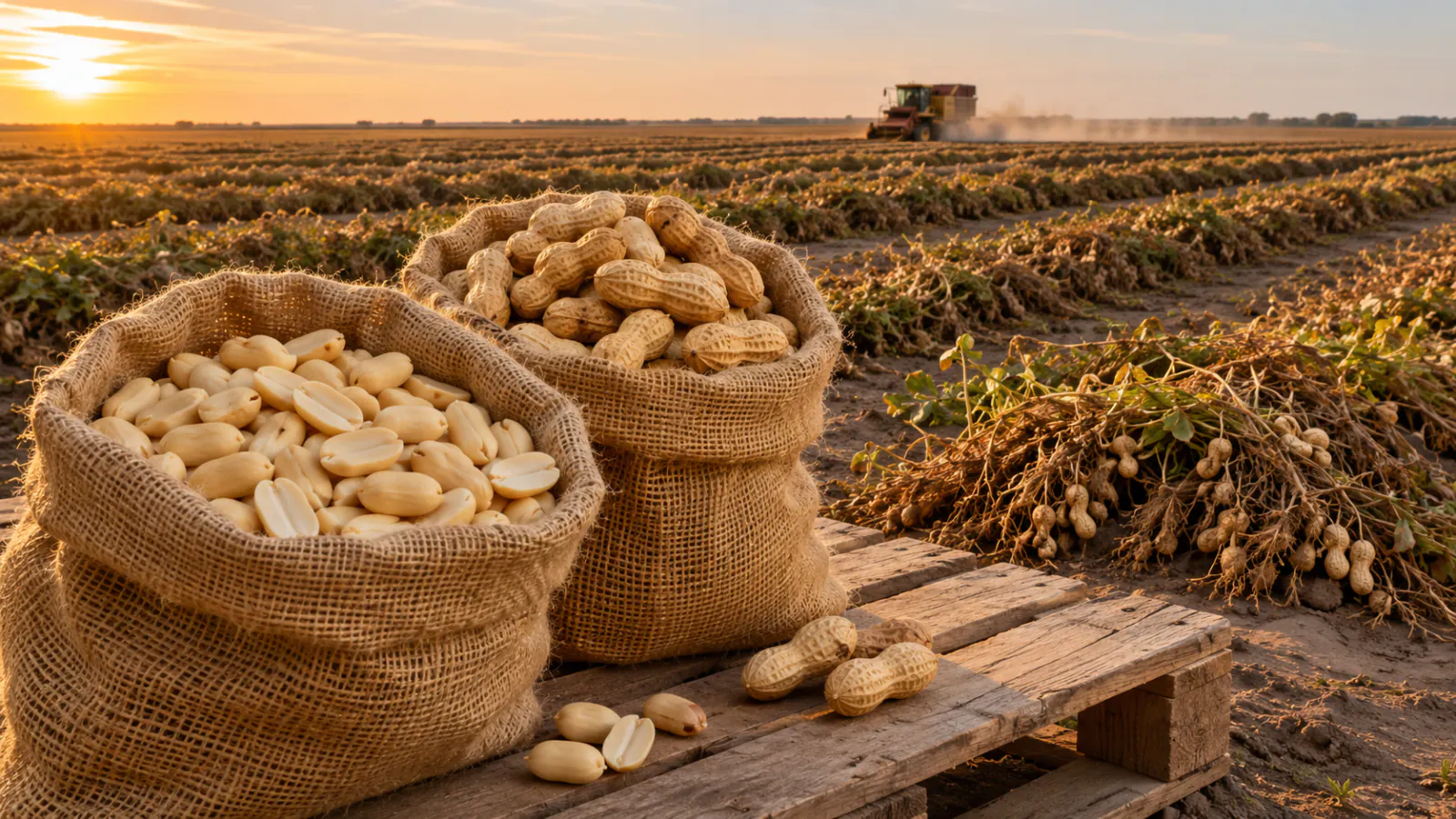
Where they grow. The province of Córdoba accounts for 75.4 % of Argentine production and 90 % of processing, according to the Córdoba Grain Exchange, followed by Buenos Aires (12.9 %) and La Pampa (5.1 %). Half of the planting takes place in the first weeks of November, and digging runs from late March to May (into June in wet years such as 2026).
What is grown. Argentina grows two types of peanut: regular Runner and high-oleic Runner (Argentine Peanut Chamber). High-oleic peanuts have more oleic than linoleic acid, which slows oxidation and extends the shelf life of roasted peanuts. INTA's varieties have a predominant count of 40/50 or 50/60 kernels per ounce.
How they are exported. According to the USDA attaché, in a normal year the vast majority of Argentina's peanut crop is blanched and exported for food and confectionery use, on the strength of its reputation for quality and low aflatoxin levels. Blanched and edible-grade peanuts are the sector's leading product: USD 488 million on average over the last five marketing years, according to the Córdoba Grain Exchange. Since January 2025 (Decree 38/2025), blanched peanuts have paid a 0 % export duty.
What happened to the 2026 crop. The USDA attaché describes a difficult 2025/26 season: rain in May, June and August delayed digging, at least 10 % of production was lost, and the moisture left part of the crop below the standards of European buyers. Crush for oil rose to 350,000 t, 40 % more than previously estimated, to absorb those lower-quality peanuts. Even so, peanut exports reached USD 651 million in the first half of 2026, up 2 % year on year.
What to expect for 2027. The attaché forecasts 430,000 ha planted and 1.56 million t, with processors competing for acreage after the poor season. Planting was due to start in the first weeks of October 2026, with persistent rain in the growing areas, so the figure may be revised; the Córdoba Grain Exchange also recorded lower planting intentions in Córdoba in August: the figure is not a consensus.
4. India: the largest volume, sold to Asia
India is the world's second-largest producer (7.5 million t in 2025/26) and the exporter that moves the most tonnes on average over recent years. Almost all of its peanuts go to Asia: Indonesia buys 28.1 % of the export value, the EU-27 just 1.5 %. Its average customs value (USD 1,007/t in 2025) is the lowest of the four origins.
To enter the EU, Indian peanuts are listed in Annex II of Implementing Regulation (EU) 2019/1793: each consignment must arrive with an official certificate and the results of sampling and analysis carried out by the Indian authorities, and 50 % of consignments undergo physical checks at the border. It is the strictest regime of the four origins in this article.
5. The United States: the other high-quality peanut
The Argentine Peanut Chamber puts it this way: unlike China, India, Nigeria, Brazil or Senegal, Argentina and the United States compete in the market for high-quality peanuts for human consumption. The United States produced 3.22 million t in 2025/26, but its natural market is next door: Mexico and Canada take 72.5 % of its export value, the EU-27 14.5 %.
Two figures for 2026/27: the USDA expects U.S. production to fall to 2.23 million t (−31 %, with 550,000 ha harvested against 767,000), while still forecasting exports of 646,000 t. And U.S. peanuts, like Argentine ones, are in Annex I of Regulation 2019/1793, with 20 % checks for aflatoxins.
6. Brazil: the fastest-growing origin over two seasons
Brazil is the fastest-growing of the four origins between 2024/25 and 2026/27 (in 2025/26 the United States grew faster): its exports rose from 430,000 t in 2024/25 to 475,000 t in 2025/26, and the USDA forecasts 520,000 t for 2026/27. In customs data, reported volume grew 37 % in 2025, to 311,525 t. Its leading destinations are Russia, China and Algeria; the Netherlands, in fourth place, takes 9.7 %, and the EU-27 as a whole 17.5 % of the value.
In the consolidated version of Regulation 2019/1793 as of 30 June 2026, peanuts from Brazil are not listed in Annex I or II: they enter under ordinary controls.
7. Aflatoxins: what the EU requires and how it treats each origin
The EU limit depends on what the lot will be used for. Regulation (EU) 2023/915 sets the following for peanuts:
| Use of the lot | Aflatoxin B1 | Sum of aflatoxins (B1, B2, G1, G2) |
|---|---|---|
| Peanuts to be sorted or otherwise physically treated before sale to the final consumer or use as an ingredient (point 1.1.4) | 8.0 µg/kg | 15.0 µg/kg |
| Peanuts for the final consumer or for use as a food ingredient (point 1.1.5) | 2.0 µg/kg | 4.0 µg/kg |
And Implementing Regulation (EU) 2019/1793, in its consolidated version of 30 June 2026, places peanuts from several origins under increased controls for aflatoxins:
| Origin | Status | Identity and physical checks at the border |
|---|---|---|
| Argentina | Annex I since 30 June 2026 | 20 % of consignments |
| United States | Annex I | 20 % |
| China | Annex I | 10 % |
| India | Annex II: official certificate and analysis in the country of origin | 50 % |
| Brazil | Not listed for peanuts | Ordinary controls |
Why Argentina was added. Implementing Regulation (EU) 2026/1206 cites RASFF notifications and Member State controls in the second half of 2025, which pointed to new risks from aflatoxins. The EU's Alert and Cooperation Network 2025 annual report places Argentina among the five most frequently notified origins for nuts and seeds, and links it mainly to aflatoxins in groundnuts. Some came from importers' own checks in the Netherlands; for example, notification 2025.9141 recorded 14 µg/kg of B1 against a limit of 2.0.
What changes for the importer:
- The consignment must be pre-notified in TRACES with the Common Health Entry Document (CHED-D), and one in five consignments undergoes a physical check with sampling at the border control post. That time and cost need to be built into planning.
- Official sampling and analysis follow Implementing Regulation (EU) 2023/2782. The pre-shipment analysis should use the same method, in an accredited laboratory.
- The contract must state which limit applies: whether the peanuts are for direct consumption or use as an ingredient (2.0/4.0) or whether the buyer will sort them first (8.0/15.0).
- England has applied its own list since 1 January 2026: there, Argentine peanuts are in Annex II, with 5 % physical checks (S.I. 2025/1162).
Mycotoxin limits and border controls for nuts are covered in more detail in quality standards for walnut imports into the EU, and pesticide residues in peanuts in how to read EU MRLs in a lot analysis.
8. Calendar: when to buy Argentine peanuts
| Stage | Months | Source |
|---|---|---|
| Planting | October – early January (half of it in the first weeks of November) | Córdoba Grain Exchange; USDA attaché |
| Digging and harvest | Late March – May (June in wet years) | Córdoba Grain Exchange; INTA |
| New crop on the market | From June | Raíz Andina calendar |
| Marketing year | March – February | USDA (PSD) |
Argentine peanuts are available all year round because they are stored and processed throughout the marketing year. But the quality of each lot depends on the crop it comes from, and the 2026 crop had the problems described above. In practice:
- Until June 2027, buy lot by lot, with the aflatoxin analysis of that specific lot rather than a generic certificate for the season.
- Ask for 2027 new-crop samples in May and June and book new-crop shipments for July and August, in time for the European Christmas season.
- Follow the forecasts: the 1.56 million t figure was published before planting and will be revised during the southern summer.
The other Southern Hemisphere products, month by month, are in our 2027 harvest calendar.
9. What this means for the European buyer
- Argentina is Europe's structural supplier, with three quarters of its sales going to the EU. The United States and Brazil are the alternatives for diversification; in practice, India is not.
- Argentina's average price sits between Brazil's and the United States' (USD 1,336/t against 1,178 and 1,396 in 2025, average customs values), and above India's.
- Increased border checks no longer separate Argentina from the United States: both are in Annex I at 20 %. What makes the difference is the lot analysis, not the origin.
- Specify the product precisely: type (regular or high-oleic Runner), presentation (red skin or blanched; whole or splits), count in kernels per ounce (38/42, 40/50, 50/60…), maximum moisture, applicable aflatoxin limit and Incoterm.
Frequently Asked Questions
Which country is the largest peanut exporter in the world?
It depends on the year and the measure. By volume, Argentina leads the 2025/26 marketing year with 1.15 million t according to the USDA, while India led 2024/25 with 1.15 million. By value, Argentina was first in 2024 and 2025 according to UN Comtrade, with USD 906 million in 2025. The USDA forecast for 2026/27 puts Argentina first again, with 1.10 million t against India's 1.05.
How many peanuts does Argentina export, and where to?
According to the USDA, 1.15 million t in the 2025/26 marketing year and a forecast 1.10 million for 2026/27. In customs data, Argentina reported 678,016 t of unroasted peanuts worth USD 905.6 million in 2025. 74 % of the value went to the EU-27, led by the Netherlands (41.9 %), followed by Poland and the United Kingdom.
Why does Argentina export so many peanuts if it is not one of the largest producers?
Because it consumes very few of them. Argentina is the world's sixth-largest producer, with 2.6 % of output, but it exports the vast majority of its crop, mostly as blanched and edible-grade peanuts. China and India produce far more, but they use most of it in their domestic markets and for crushing into oil.
What are the EU aflatoxin limits for peanuts?
Regulation (EU) 2023/915 sets 2.0 µg/kg of aflatoxin B1 and 4.0 µg/kg of total aflatoxins for peanuts sold to the consumer or used as an ingredient, and 8.0 and 15.0 µg/kg for peanuts that will be sorted or otherwise physically treated first. The contract should state which of the two applies.
What checks do Argentine peanuts face when entering the EU?
Since 30 June 2026 they are listed in Annex I of Implementing Regulation (EU) 2019/1793: the consignment is pre-notified in TRACES, and 20 % of consignments undergo a physical check with aflatoxin sampling at the border. They do not need the prior official certificate required for Indian peanuts, which are in Annex II.
When are peanuts harvested in Argentina?
They are planted between October and early January and dug between late March and May, or into June in wet years. The new crop reaches the market from June, and the marketing year runs from March to February. The 2027 crop is the first after the difficult 2026 season.
What do blanched peanuts and a 40/50 count mean?
Blanched peanuts are shelled peanuts that have also had their skin removed; red-skin (edible-grade) peanuts are sold shelled with the skin on. The count is expressed in kernels per ounce (28.35 g): a 40/50 has between 40 and 50 kernels per ounce, and the lower the number, the larger the kernel.
We are looking for peanut distributors in Europe
We export Argentine peanuts from Córdoba, high-oleic Runner type, red skin or blanched, in the counts listed in our technical sheet (from 38/42 to 70/80). We work with importers, roasters and manufacturers of snacks, peanut butter and confectionery who need to know what is in each lot before it ships.
Before closing, we send you the technical sheet and a sample; the lot's aflatoxin analysis against Regulation (EU) 2023/915 is delivered before shipment, and we agree whether the lot is for direct consumption or for sorting. Peanuts can be combined by the pallet with Argentine Chandler walnuts or raisins in the same container, with a minimum of 1 pallet (~2,100 kg) per item.
Tell us the count, presentation, volume, destination port and Incoterm (FOB, CFR or CIF), and we will send you a sample and a quote. Request a quote or write to us from contact.
Production, export and import figures come from the USDA (PSD Online, 10 November 2026 update, and report AR2026-0016 from the attaché in Buenos Aires), UN Comtrade and the Córdoba Grain Exchange, accessed on 24 November 2026. USDA marketing years and Comtrade calendar years are not comparable with each other. Limits and controls correspond to Regulations (EU) 2023/915 and 2019/1793 in the versions cited; the list of increased controls is reviewed at least every six months. This article does not constitute legal advice.