If you buy nuts or dried fruit for the EU, the pesticide residue report for each lot is a document you need to be able to read yourself, not just your laboratory. Most problems don't come from a high result, but from comparing the result with the wrong limit.
The short answer: a residue report is read in four steps.
- Look up the maximum residue level (MRL) for each substance detected for your product in the Commission's database. If no MRL is set, 0.01 mg/kg applies (Article 18 of Regulation (EC) 396/2005).
- Check which part of the product it applies to. For walnuts and almonds, the nut without shell; for peanuts, the kernel.
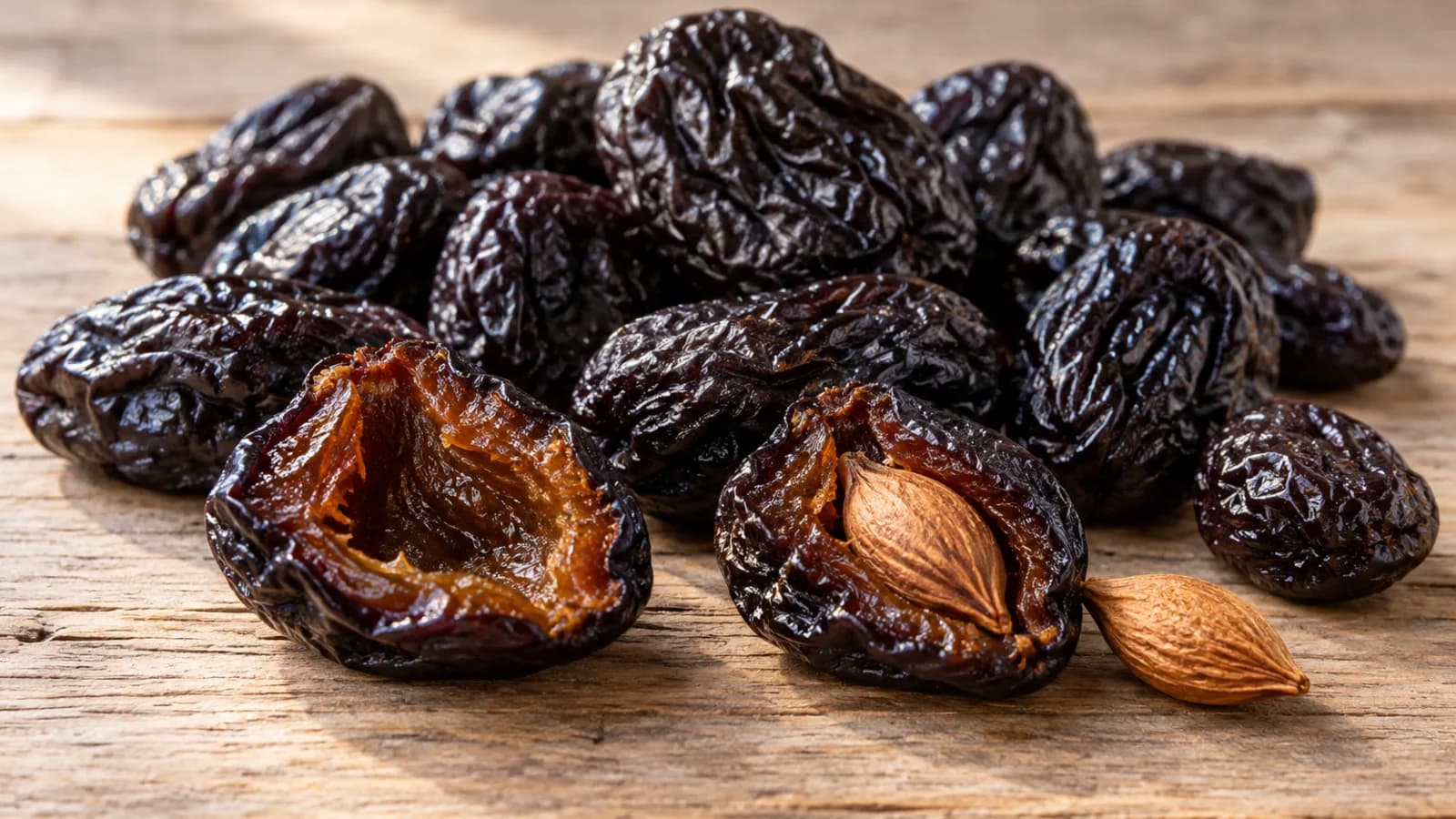
- For dried fruit (raisins, prunes), adjust the MRL of the fresh fruit with a processing factor: the regulation sets no MRLs of its own for dried fruit.
- Deduct the measurement uncertainty. With the default uncertainty of 50 %, a result is only non-compliant when it exceeds twice the MRL.
This article walks through those four steps with the products we export from Argentina and Chile —walnuts, almonds, peanuts, raisins and prunes— and ends with what to ask your supplier before you sign.
1. What an MRL is and where 0.01 mg/kg comes from
Regulation (EC) 396/2005 sets the maximum residue levels of pesticides in food of plant and animal origin sold in the EU, whether fresh, processed or composite. The limit applies from the moment the product is placed on the market: it does not matter where it was grown.
For each combination of substance and product there are three possible situations:
| Situation | Applicable MRL | Where to find it |
|---|---|---|
| The substance has a specific MRL for that product | The value set (for example 0.03 mg/kg) | Annexes II and III of the regulation |
| The substance has no specific MRL for that product | 0.01 mg/kg by default (Art. 18(1)(b)) | — |
| The substance is exempt from MRLs | No limit applies | Annex IV |
Regulation (EC) 396/2005, consolidated version on EUR-Lex. Accessed in September 2026.
In practice, 0.01 mg/kg is the limit of quantification of analytical methods: it amounts to saying the substance must not be detected. That is why a pesticide approved in Argentina or Chile, but with no EU MRL for that product, can stop a lot even if the grower applied it correctly under local law.
Current values are published in the EU Pesticides Database, which is updated several times a year. Three examples, checked on 27 September 2026:
| Substance (use) | Walnut, almond | Peanut | Plum | Table grape |
|---|---|---|---|---|
| Glyphosate (herbicide) | 0.1* | 0.1* | 0.1* | 0.5 |
| Chlorantraniliprole (insecticide) | 0.03 | 0.06 | 1 | 1 |
| Acetamiprid (insecticide) | 0.07 | 0.01* | 0.04 | 0.08 |
In mg/kg. The asterisk means the MRL is set at the limit of quantification. Glyphosate: Regulation (EU) 293/2013; chlorantraniliprole: Regulation (EU) 2024/1355; acetamiprid: the database cites Regulation (EU) 2026/876, applicable from 12 May 2026. Source: EU Pesticides Database.
The table shows two things. First, the same insecticide has very different limits depending on the product: acetamiprid is allowed at 0.07 mg/kg in walnuts and only 0.01 in peanuts. Second, MRLs change. A lot that met last year's limit may not meet this year's, so the comparison is always made against the MRL in force on the date of import.
2. Which part of the product the MRL applies to
Annex I of the regulation, replaced by Regulation (EU) 2018/62, gives each product a code and states which part the residue is measured on. It is the detail most often overlooked when reading a report:
| Product | Code | Part of the product the MRL applies to |
|---|---|---|
| Almond | 0120010 | Whole product after removal of shell |
| Hazelnut | 0120060 | Whole product after removal of shell |
| Macadamia | 0120070 | Whole product after removal of shell |
| Pecan | 0120080 | Whole product after removal of shell |
| Pistachio | 0120100 | Whole product after removal of shell |
| Walnut | 0120110 | Whole product after removal of shell |
| Peanut | 0401020 | Kernel (without pod) |
| Plum | 0140040 | Whole product after removal of stems, fresh |
| Table grape | 0151010 | Whole product after removal of stems, fresh |
Two practical consequences:
- For tree nuts, the analysis is done on the kernel. If you buy in-shell walnuts or pistachios, ask the laboratory to shell the sample and say so in the report. A result on in-shell product cannot be compared directly with the MRL.
- The plum and grape in the annex are fresh. There is no code for prunes or raisins: their MRL is derived from the fresh fruit, as explained in the next section.
3. Dried fruit: the processing factor
When a plum or a grape is dried, it loses water and the residue becomes more concentrated. Article 20 of Regulation 396/2005 deals with it like this: if there is no MRL of its own for the processed product, the MRL of the fresh product applies, taking into account the change caused by processing.
The regulation foresaw an official list of processing factors (an Annex VI), but the Commission never adopted it. Its own guidance note SANTE/10704/2021, revision 1, from March 2025, says so, and ranks the factors that can be used:
- The substance-specific factor, taken from the European processing factors database of EFSA and the German BfR, when it is flagged as reliable.
- If there is none, a generic drying factor: the dry matter of the dried product divided by that of the fresh product.
- As a last resort, a yield factor.
The two examples the note itself gives are precisely our products:
| Dried product | Substance | Fresh-fruit MRL | Factor | MRL for the dried product |
|---|---|---|---|---|
| Prunes with stone | Penthiopyrad | 1.5 mg/kg (plum) | 1.4 | 2.1 mg/kg |
| Raisins | Fludioxonil | 5 mg/kg (table grape) | 1.1 | 5.5 mg/kg |
Source: European Commission, SANTE/10704/2021 rev. 1, 19 March 2025.
The note adds two rules that affect the importer:
- If there is no suitable factor, it is up to the operator to justify why their product complies. One way is to show that the fresh fruit it came from was compliant.
- If nobody provides information, the authority may apply a factor of 1, meaning the fresh-fruit MRL with no adjustment. For the exporter, that is the worst case.
What to ask for: for raisins and prunes, a report showing the substance, the result on the dried product and the factor proposed by the laboratory or the supplier, with its source. If the supplier also has the analysis of the fresh fruit from the same lot, even better.
4. The 50 % uncertainty: when a result is non-compliant
No analysis is exact. The Commission document that governs the analytical control of residues, guidance SANTE/11312/2021 in its 2026 version, applicable from 1 January 2026, sets:
- A default expanded uncertainty of 50 % (point E12), derived from EU proficiency tests. A laboratory may use it if it shows its own uncertainty is lower.
- The decision rule (point E14): the sample is non-compliant if the result minus the uncertainty exceeds the MRL.
With a 50 % uncertainty, that rule amounts to a result above twice the MRL. Three cases with an MRL of 0.01 mg/kg:
| Result | Result − 50 % | Exceeds the MRL? | Non-compliant? |
|---|---|---|---|
| 0.008 mg/kg | 0.004 | No | No |
| 0.015 mg/kg | 0.0075 | Yes | No: within the uncertainty |
| 0.025 mg/kg | 0.0125 | Yes | Yes |
That is the difference between "exceeds the MRL" and "non-compliant", and official reports count them separately. But a lot being legally compliant does not mean your customer will accept it: many buyers, especially in retail and private label, reject any result above the MRL or apply margins of their own. Ask about that policy before you sign, not when the report arrives.
5. How to read the laboratory report, line by line
A residue report that is useful for a container has to make seven things clear:
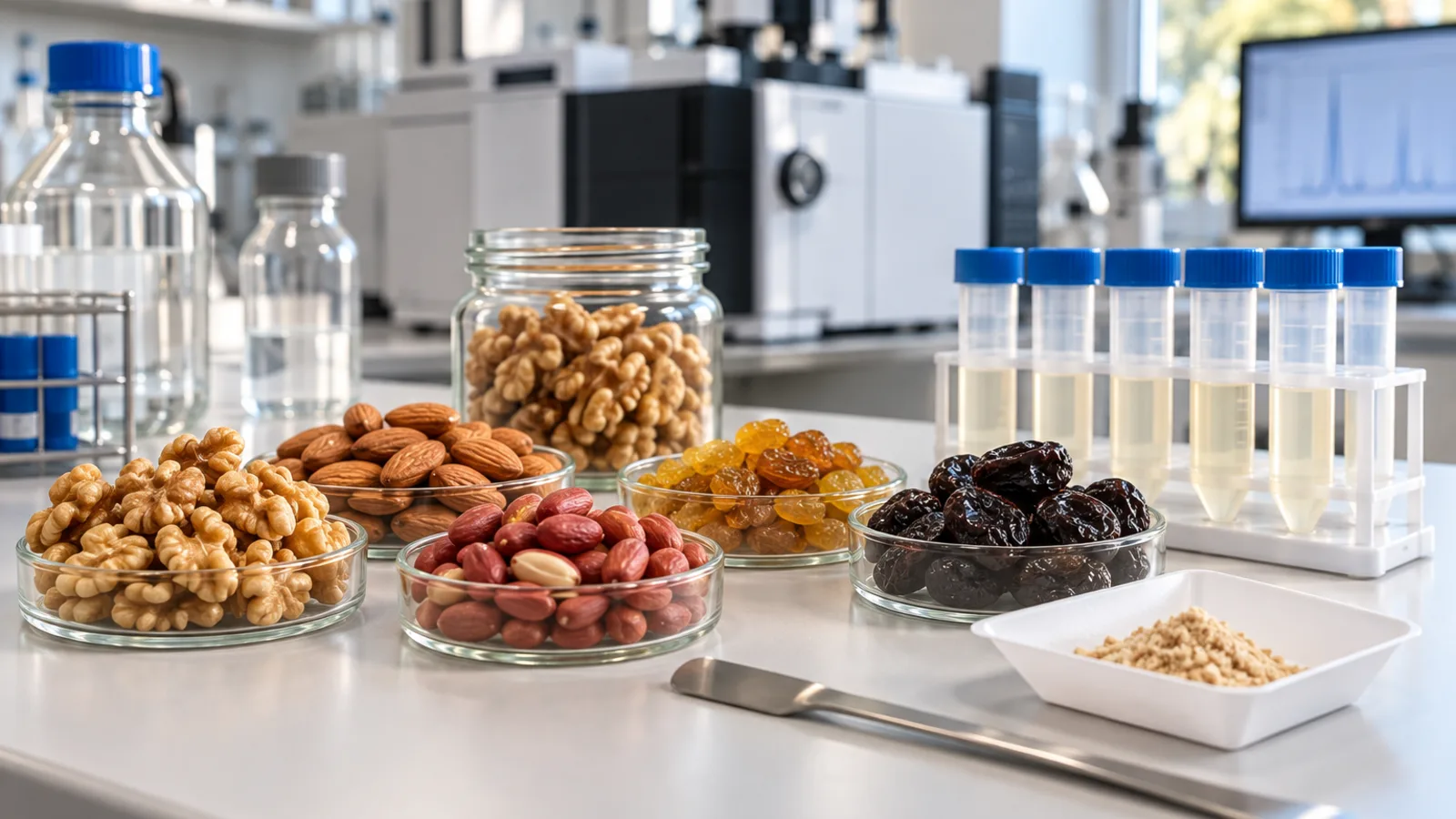
- ISO/IEC 17025 accreditation and scope. The laboratory must be accredited for that method and that matrix. Multi-residue analyses from accredited laboratories cover, according to their own offering, between 500 and 600 substances.
- Method. Usually QuEChERS extraction under standard EN 15662:2018, with gas and liquid chromatography coupled to tandem mass spectrometry (GC-MS/MS and LC-MS/MS).
- Limit of quantification (LOQ) for each substance. It must be equal to or below 0.01 mg/kg. If the LOQ is 0.05, a "not detected" does not prove compliance with an MRL of 0.01.
- "n.d." and "< LOQ" do not mean zero. They mean the substance was not found above the limit the method can measure.
- The part of the product analysed. Walnuts and almonds without shell; peanuts as kernels (section 2).
- The residue definition. Some substances are expressed as the sum of several compounds or metabolites. The result must be calculated the same way as the MRL it is compared with.
- The sample and the lot. Lot number, sampling date and sample weight. For official controls, Directive 2002/63/EC sets a minimum laboratory sample of 1 kg for tree nuts, 0.5 kg for peanuts and 0.5 kg for dried fruit. An analysis of 200 g taken from one carton does not represent a container.
One substance deserves special mention in dried fruit: chlorate. It appears when fruit is washed or processed with chlorinated water, and the EU treats it as a pesticide residue, with MRLs of its own. If you buy washed raisins or prunes, ask for chlorate and perchlorate to be included in the panel: not every standard multi-residue screen covers them.
How a representative sample is taken from a lot, and which documents come with the specification sheet, is explained in samples, spec sheets and first order.
6. What the data say: EFSA, RASFF and border controls
How many lots exceed the MRL
EFSA publishes the results of Member States' official controls every year. The latest report, with 2024 data, was published on 5 May 2026:
| Origin of the sample | Samples | Exceed the MRL | Non-compliant (after uncertainty) |
|---|---|---|---|
| Total (national programmes) | 86,449 | 3.3 % | 1.8 % |
| Produced in the EU | 57,574 | 2.1 % | 1.0 % |
| Imported from third countries | 18,184 | 8.3 % | 5.2 % |
Source: EFSA, "The 2024 European Union report on pesticide residues in food", EFSA Journal 24(5):e10054, 2026. The two origins do not add up to the total because some samples do not state an origin.
Imported food exceeds the MRL four times as often as EU-produced food. The report does not break down tree nuts or South American countries, but it notes that raisins were the product with the most samples carrying multiple residues (160).
Recent RASFF alerts from Argentina and Chile
In the EU Rapid Alert System (RASFF) we found two notifications for pesticide residues in dried fruit from these origins between 2024 and September 2026, both in raisins:
- 2024.7316, 4 October 2024: phosmet, a substance not approved in the EU, at 0.022 mg/kg, in raisins from Chile. Alert notified by Norway after an official control.
- 2025.0317, 17 January 2025: chlorate at 1.2 mg/kg in raisins from Argentina. Found in a company's own checks, in the Netherlands.
We found no notifications for pesticides in walnuts, almonds, peanuts or prunes from Argentina or Chile in that period. For those products, what does appear is aflatoxins in Argentine peanuts and sorbic acid in Chilean prunes. The search was run by country and product in the public RASFF Window search; a notification with a different subject line might not show up.
Increased border controls
Implementing Regulation (EU) 2019/1793, which sets increased controls on imports, has a single entry for Argentina: peanuts, for aflatoxins, with physical checks on 20 % of consignments. Chile is not listed, and neither country has entries for pesticide residues (consolidated version of 30 June 2026).
The practical takeaway: for South American nuts, the border risk is the mycotoxin, not the pesticide. Aflatoxin limits and controls are covered in our guide to EU quality standards. For raisins, on the other hand, pesticide residues are a documented risk.
7. The chlorpyrifos case: banned at origin
Chlorpyrifos was for years one of the most widely used insecticides in orchards and the cause of many rejections. This is where it stands today:
| Where | Status | Legal basis |
|---|---|---|
| EU | MRL lowered to the limit of quantification, 0.01 mg/kg, for chlorpyrifos and chlorpyrifos-methyl in fruit, tree nuts and oilseeds (peanuts included) | Regulation (EU) 2020/1085, applicable from 13 November 2020 |
| Argentina | Import, manufacture, sale and use of chlorpyrifos-ethyl and -methyl banned, with staggered deadlines; the last one, 455 days for sale and use, has already expired | SENASA Resolution 414/2021, published on 6 August 2021 |
| Chile | All chlorpyrifos-ethyl registrations cancelled in December 2022; use in orchards allowed only until 12 December 2024 | SAG Exempt Resolution 5810/2022 |
The EU regulation's application date has a catch: the original text said 6 August 2020, but a correction published a few days later moved it to 13 November.
What it means for the buyer: from the 2025 harvests onwards, chlorpyrifos should no longer be used in Argentina or Chile. Even so, ask for it to be included in the panel and for the supplier to declare the field's crop protection programme. That is how you check it, rather than assume it.
8. What to ask your supplier before you sign
A short list to include in the specification or the contract:
- A multi-residue report per lot, from an ISO/IEC 17025 accredited laboratory, with the stated scope (list of substances) and an LOQ of ≤ 0.01 mg/kg for each.
- Results on the part of the product set by Annex I: walnuts and almonds without shell, peanuts as kernels.
- For raisins and prunes: chlorate and perchlorate in the panel, and the proposed processing factor for each substance detected.
- The field's crop protection programme: substances applied and pre-harvest intervals. That tells you what to look for and confirms nothing without an EU MRL was used.
- A sealed counter-sample of the lot, so the analysis can be repeated if there is a dispute.
- A clause requiring compliance with Regulation 396/2005 as in force on the date of import, not on the date of the quote. If your customer applies a stricter policy than the MRL, put it in writing in the specification.
If you sell into more than one country, remember that EU MRLs are not the only ones: the Gulf, the United Kingdom and Brazil have limits of their own. A lot that complies in the EU does not automatically comply elsewhere.
Frequently Asked Questions
Which MRL applies if a pesticide has no limit set for that product in the EU?
The default value of 0.01 mg/kg, under Article 18 of Regulation (EC) 396/2005. In practice it is the limit of quantification of analytical methods: the substance should not be detected.
Does the walnut MRL apply to in-shell or shelled nuts?
Shelled. Annex I of the regulation (Regulation (EU) 2018/62) applies the tree nut MRL to the whole product after removal of the shell, except for chestnuts. For peanuts it applies to the kernel.
What MRL do raisins and prunes have?
They have no MRLs of their own. The MRL of fresh grapes or plums applies, adjusted with a processing factor, under Article 20 of Regulation 396/2005. The Commission gives two examples: fludioxonil in raisins, 5 × 1.1 = 5.5 mg/kg; penthiopyrad in prunes, 1.5 × 1.4 = 2.1 mg/kg.
Does a result above the MRL mean the lot is rejected?
Not necessarily. With the default 50 % uncertainty in guidance SANTE/11312/2021, the sample is non-compliant only if the result minus that uncertainty exceeds the MRL, that is, if the result is more than twice the limit. But many private buyers reject any result above the MRL.
What does "< LOQ" or "n.d." mean in a residue report?
That the substance was not detected above the method's limit of quantification. For it to count as evidence of compliance, that limit has to be equal to or below the applicable MRL, usually 0.01 mg/kg.
Are there increased pesticide controls on nuts from Argentina or Chile?
No. Implementing Regulation (EU) 2019/1793 has a single entry for Argentina, peanuts for aflatoxins, with physical checks on 20 % of consignments. Chile is not listed, and neither country has entries for pesticide residues.
Is chlorpyrifos still allowed in Argentina and Chile?
No. Argentina banned it with SENASA Resolution 414/2021, and Chile cancelled its registrations in 2022 with SAG Exempt Resolution 5810/2022, allowing use in orchards until 12 December 2024. In the EU, its MRL has been 0.01 mg/kg since November 2020.
We are looking for nut and dried fruit distributors in Europe
We work with importers, distributors and food manufacturers who need to know what is in each lot before shipment, not after. We supply Argentine and Chilean walnuts, Chilean almonds, Argentine peanuts, raisins from San Juan and prunes from Mendoza.
Before you sign, we send you the specification sheet and the analysis available for the lot, and we agree with you on the residue panel your customer needs, including chlorate in dried fruit and the required LOQ. Clear terms from the start: a minimum of 1 pallet (~2,100 kg), 1–5 kg samples and FOB, CIF, CFR or DDP quotes. Products can be combined by pallet in the same container, so you don't tie up 20 tonnes of a single item. What sets each prune origin apart is covered in our prune buying guide.
Tell us the product, the destination and your customer's residue policy, and we will send the samples and analyses that make sense for that case. Request samples and a quote or write to us via contact.
The MRLs, processing factors, uncertainty criteria and controls cited come from Regulation (EC) 396/2005, Regulation (EU) 2018/62, Regulation (EU) 2020/1085, Implementing Regulation (EU) 2019/1793, Directive 2002/63/EC, guidance documents SANTE/10704/2021 and SANTE/11312/2021 and the EU Pesticides Database, in the versions checked on 27 September 2026. MRLs change several times a year: always check the value in force on the date of import. This article is not legal advice and does not replace the judgement of an accredited laboratory.