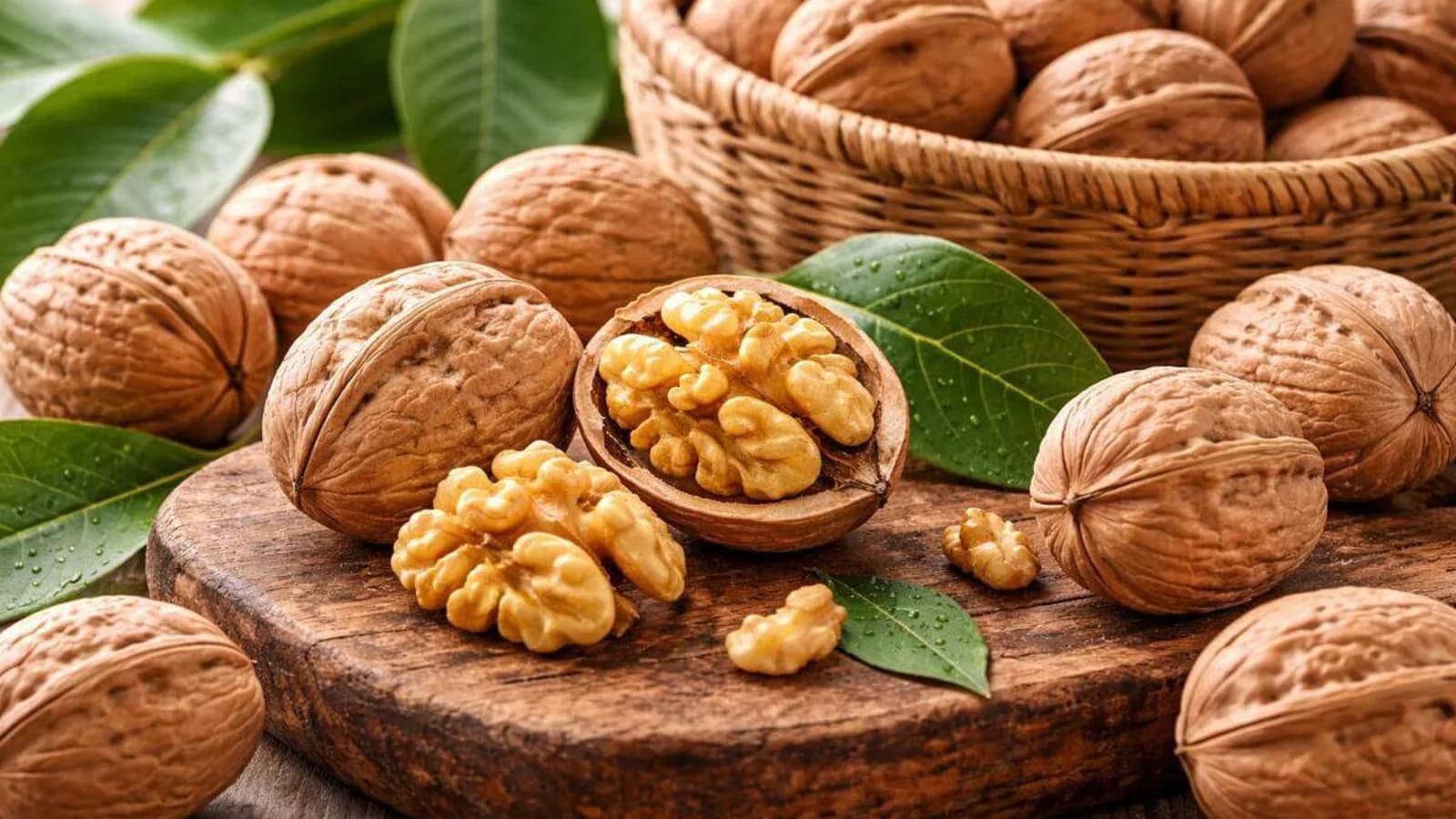
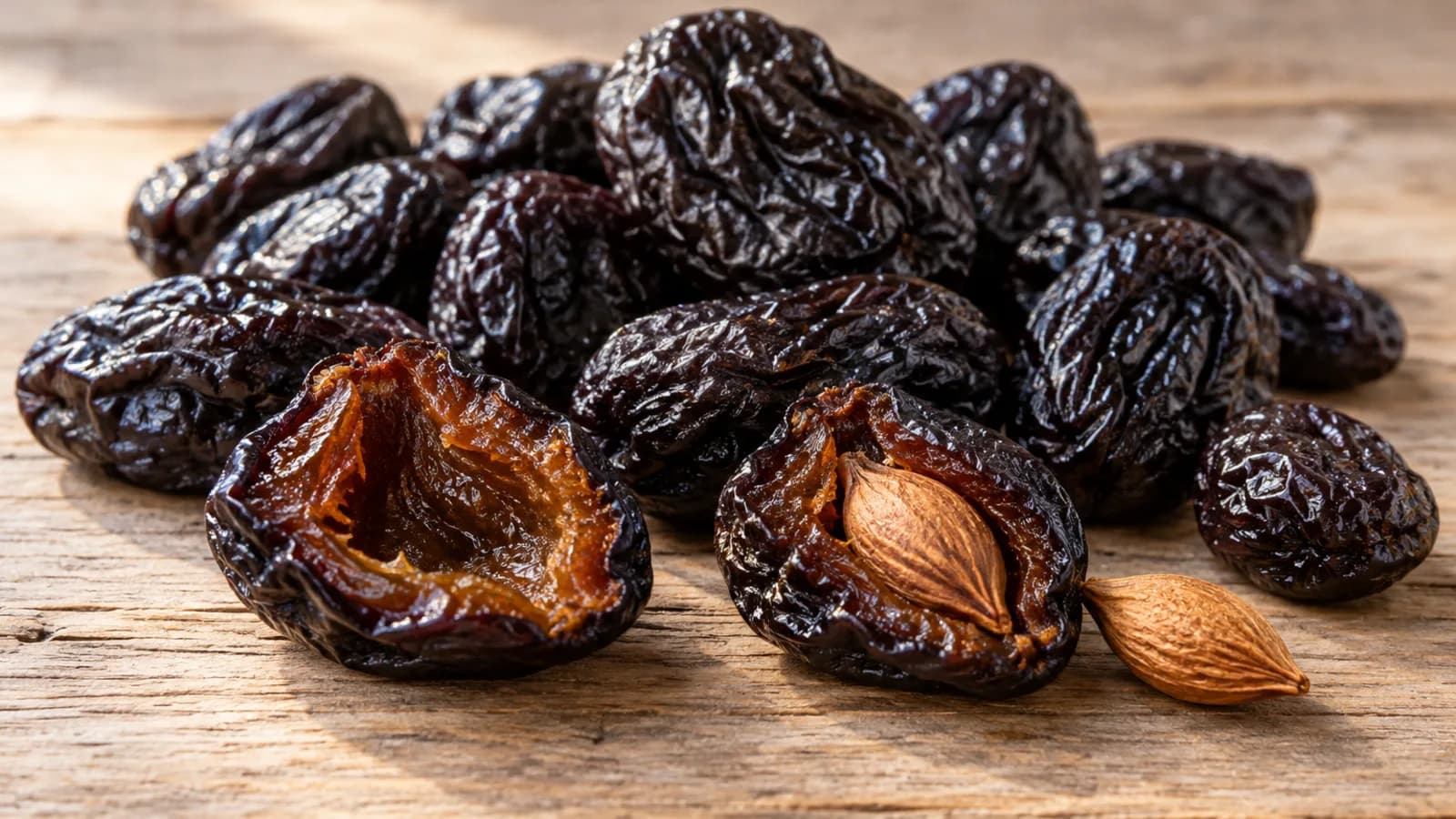
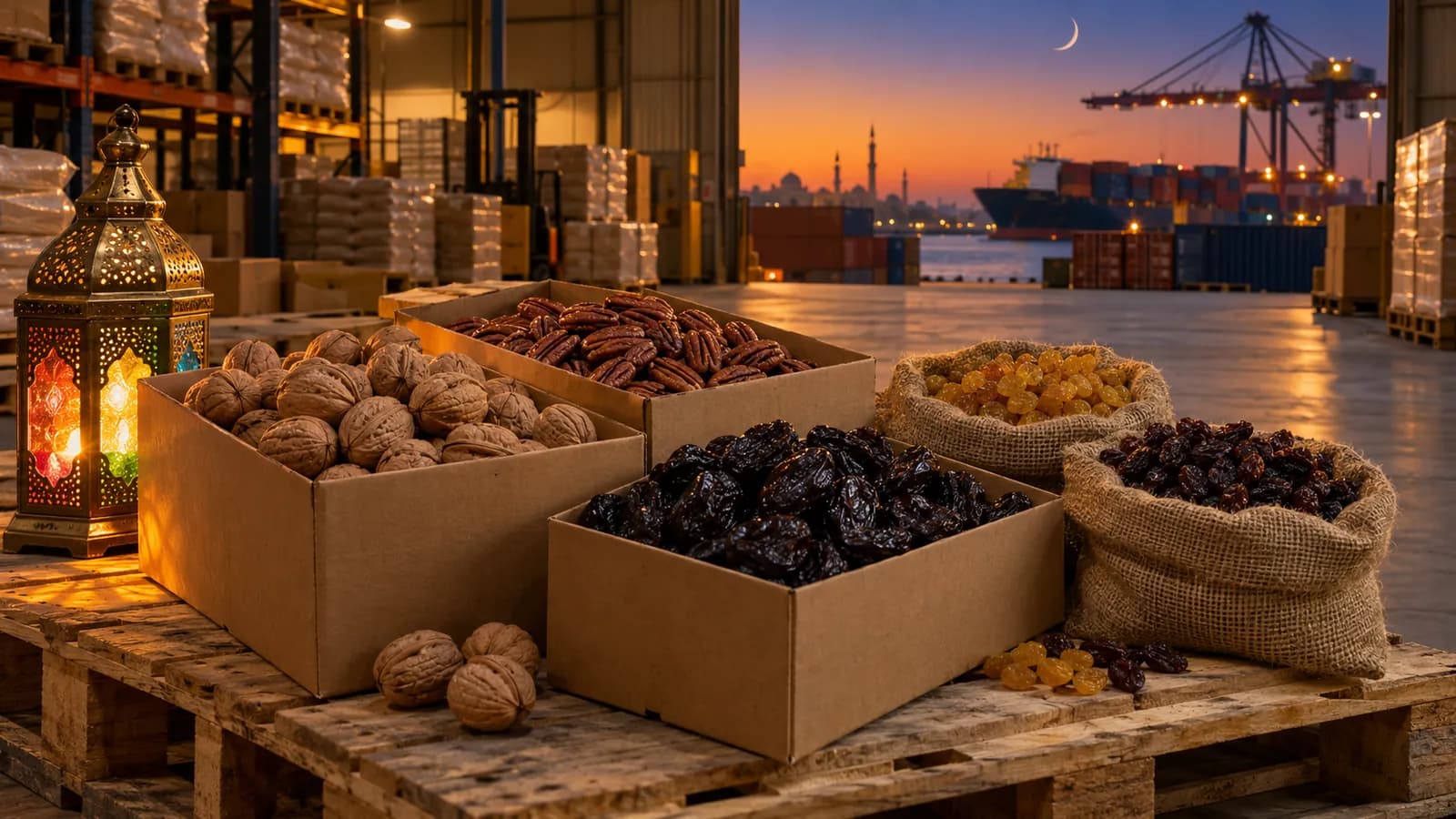
The Southern Hemisphere harvests almost everything it exports between January and July: prunes open the year in January and February, Chilean almonds and walnuts come in between February and April, Argentine walnuts and pecans between March and July, and Argentine peanuts are dug from April to June. New-crop product is available for shipment from March for Chilean walnuts and almonds, from April for Argentine walnuts, pecans and prunes, from May for raisins and from June for peanuts. Contracts for the European Christmas season are closed between June and August; those for Ramadan 2028, in September and October 2027.
There are already first figures for 2027, all from the USDA's agricultural attachés in Santiago and Buenos Aires: 170,000 t of in-shell walnuts in Chile (+3 %), 11,000 t of shelled almonds and 1.56 million t of peanuts in Argentina. For prunes, raisins, pecans and macadamias, no forecast has been published yet.
This article brings together in one table the calendars of the products we trade, goes through them month by month and points out what can change between now and harvest.
1. The year in one table: harvest, availability and first figures
Harvest and availability months are those in the technical data sheets of our catalog. Figures are the latest published as of 9 November 2026.
| Product | Origin | Harvest | New crop available | Latest published figure | First 2027 forecast |
|---|---|---|---|---|---|
| Prunes | Argentina (Mendoza) | January – March | April – December | 52,020 t of fresh fruit for processing, final adjusted forecast for the 2025/26 season (Government of Mendoza) | Not published |
| Almonds | Chile | February – April | March – November | 10,250 t shelled, 2026 crop, estimate by the USDA's agricultural attaché (USDA, report CI2026-0010) | 11,000 t (USDA attaché) |
| Raisins | Argentina | February – April | May – January | 43,542 t exported in 2025, provisional figure (INV) | Not published |
| Chandler, Serr and Howard walnuts | Chile | February – April (Howard: March – April) | March – November (Howard: April – December) | 165,000 t in-shell, 2026 crop, according to the USDA's agricultural attaché; the official USDA figure is 155,000 t (USDA, report CI2026-0010) | 170,000 t (USDA attaché) |
| Chandler walnuts | Argentina | March – May | April – December | 6,636 t exported in 2025, in-shell and shelled (INDEC, in the CFI federal plan) | Not published |
| Pecans | Argentina | March – May | April – December | Around 3,000 t, industry estimate cited by the Argentine Government | Not published |
| Macadamias | South Africa | February – June | April – December | 107,212 t of dry nut-in-shell, SAMAC's third-quarter estimate for 2026, as cited by Standard Bank | Not published |
| Peanuts | Argentina | April – June | All year; new crop from June | 1.1 million t in the 2025/26 season according to the USDA's agricultural attaché; 1.3 million according to the official USDA figure and Argentina's Agriculture Secretariat (USDA, report AR2026-0016) | 1.56 million t (USDA attaché) |
| Prunes (market reference, not in our catalog) | Chile | February – April | Strong exports from May – June | 29,704 t exported in January – June 2026 (Chileprunes) | Not published |
Four notes on reading the table:
- The USDA attaché and the official USDA are not the same thing. The 2027 forecasts come from the USDA's agricultural attachés in each country (Post), who usually publish before the official figure and sometimes differ from it: for Chilean walnuts in 2026, 165,000 t against 155,000 t; for Argentine peanuts in 2025/26, 1.1 against 1.3 million t.
- In Chile, the USDA's 2026/27 season is the 2027 crop. For walnuts and almonds, the Chilean marketing year starts in January; the "2026/27" forecast published in September is, in practice, the first estimate of the March and April 2027 harvest.
- Two windows are longer in industry sources. According to SENASA, in Entre Ríos the pecan harvest starts in April and the bulk comes in June and July, after the window in our data sheet. According to the USDA, the 2025 South African macadamia season ran from March to mid-August.
- The figures are not comparable across products. Mendoza prunes are measured as fresh fruit, walnuts as in-shell weight, almonds as shelled and macadamias as dry nut-in-shell. They show the trend for each origin; they are not meant to be added up.
2. Month by month: what happens in the South and what to do
January. The prune harvest begins in Mendoza. Argentine raisins from the previous crop are in their last weeks of availability. In Europe, Northern Hemisphere product dominates, such as Californian walnuts harvested between September and November. This is the month to ask for samples and data sheets for the coming season, not to buy Southern product.
February. The almond and prune harvests begin in Chile: for 2026, Chileprunes expected the start in the first week of February. In San Juan and Mendoza, grapes are dried for raisins. Chilean walnuts ripen. It is the weakest month of the year for Southern new-crop availability.
March. The walnut harvest starts in Argentina, Chile's moves ahead and macadamias begin in South Africa. In our catalog, Chilean Chandler and Serr walnuts and Chilean almonds already have new crop available. For walnuts, it is worth waiting for the harvest to finish before committing large calibers.
April. Argentine Chandler, Chilean Howard, pecans, prunes and macadamias become available. ChileNut starts counting its export season on 1 April. From here until the summer, the new Southern crop and the previous Californian walnut crop coexist on the market, so it is a good time to compare the two hemispheres with samples and analysis in hand.
May. Peanut digging becomes widespread in Argentina (the Agriculture Secretariat reported it as widespread on 21 May 2026). New-crop raisins become available. Chilean almond exports start to concentrate, which the USDA places between May and December.
June. Peak pecan harvest in Entre Ríos, according to SENASA. New-crop peanuts reach the market. Chilean prune exports accelerate: 10,623 t were shipped in June 2026, about 36 % of the first half of the year. This is the month to start closing the European Christmas season, especially in large calibers.
July and August. The export peak for Chilean walnuts begins, which the USDA places between July and October. August is the last reasonable month to close Christmas product. In the North, the Californian almond harvest begins (mid-July in 2026). In Chile, raisins hit their export peak between August and November, according to the USDA.
September and October. Shipments are contracted for Ramadan 2028, which begins in late January 2028; the detail of that window is in the Ramadan 2027 buying calendar, which follows the same logic one year earlier. In the South, flowering ends: what happens in these weeks — frost, rain, hail — decides the 2028 crop, not the 2027 one. In California the walnut harvest begins, and Northern Hemisphere pistachios are harvested between August and October (in California the 2026 harvest started on 11 August).
November and December. Last months of Southern availability for almost every reference in the catalog. The new Californian walnut crop reaches the market. Whatever is negotiated now for the Gulf serves to restock, not for the main Ramadan campaign.
3. What could move 2027
The forecasts above were published at the start of the Southern spring, when much of the crop is decided. There are three documented risks.
The 7 September 2026 frost in Mendoza. It struck with stone fruit trees in full bloom, and the prunes in our catalog come from Mendoza. The provincial government opened the window for damage claims from 28 September to 9 October, and as of 9 November we have not found an official damage figure. Several districts in the province were already under agricultural emergency until 31 March 2027 because of frost and hail in the previous season (Decree 125/2026). In Chile, the October industry report on almonds and walnuts records the same cold spell and says its effects are "being assessed".
El Niño in Chile. The USDA warns that a strong El Niño can bring heavy rain, frost and abnormal temperatures during the September and October 2026 bloom, with the main risk being walnut blight in walnut orchards. The 170,000 t walnut forecast was published on 18 September, at the start of that period.
Mixed signals on peanuts. The USDA's agricultural attaché and the Agriculture Secretariat expect around 430,000 ha; the attaché also forecasts 1.56 million t. The Córdoba Grain Exchange, by contrast, recorded in August lower peanut planting intentions in Córdoba than in the previous cycle. The 1.56 million t figure runs counter to that first planting intention: it is not a consensus.
There is a fourth factor, a market one rather than a weather one: the South African macadamia industry magazine reports fears that 2027 will arrive with heavy carry-over stock, after a record 2026 crop and weak demand. For the buyer, that points to more previous-crop supply early in the year (our inference).
On top of this is the underlying trend: walnut acreage in Chile has fallen for four seasons in a row, from 46,232 ha in 2022/23 to a projected 40,323 ha in 2026/27, according to the USDA. Production is holding up thanks to yield improvements (mechanization, irrigation, higher planting density); the shift of orchards towards the south may add, according to the same report, more volatility from disease and frost.
4. From orchard to destination port
The harvest date is not the date the product reaches your warehouse. In between come processing, sizing, lot analysis and transit.
| Route | Sailing days | Source |
|---|---|---|
| Valparaíso → Rotterdam | 25 | Maersk, Chile Express service |
| Buenos Aires → Tanger Med | 20 on the most direct services (NEO SAMBA, SAFRAN, ESE) | Tanger Med Port Authority, maritime connections |
With those transit times and a few weeks of processing, a March harvest does not reach a European port before May, and new-crop product usually arrives at the plant between June and July (our estimate, not the carrier's). How the year is split between the two hemispheres, using walnuts as the example, is explained in counter-season: why to buy Southern Hemisphere walnuts between April and December.
5. How to use this calendar to plan your 2027 purchases
- Ask for new-crop samples in March and April, not in June. With the sample and the lot analysis in hand, the June negotiation is about price and dates, not quality.
- Close Christmas between June and August, and Ramadan 2028 in September and October. These are the windows in which large calibers run out first.
- Combine products with similar calendars in the same container. Argentine walnuts, Chilean Howard, pecans, prunes and macadamias are available from April to December; a mixed container lets you cover several new-crop references with a single shipment. The minimum is one pallet (~2,100 kg) per reference.
- Do not buy on the September forecast. The 2027 figures will be revised before and during the harvest. Before closing large volumes, ask for the updated estimate and the harvest date of each lot.
- For Mendoza prunes, wait for the frost damage figure. If the 2027 crop is short again, the comparison with the other origins is in prunes: Chile, Argentina or California.
Frequently Asked Questions
When are walnuts harvested in Chile and Argentina?
In Chile, between February and April; the new crop is available from March. In Argentina, between March and May, with availability from April. Argentine pecans follow the same window in our data sheet, although in Entre Ríos the harvest peak comes in June and July, according to SENASA.
How many walnuts will Chile produce in 2027?
The first forecast, from the USDA's agricultural attaché in Santiago (September 2026), is 170,000 t in-shell: 3 % more than the 165,000 t the attaché itself estimates for 2026 (the official USDA figure for 2026 is 155,000 t). It is an estimate published at the start of bloom, with a risk of rain and frost due to El Niño, so it may be revised.
In which month should you buy Southern Hemisphere dried fruit?
Mendoza prunes are harvested between January and March and are available from April; Argentine raisins, from May to January. For the European Christmas season, the prudent approach is to close the contract between June and August.
When are new-crop Argentine peanuts available?
Digging takes place between April and June and the new crop reaches the market from June. Argentine peanuts are available all year round because they are stored and processed throughout the marketing year, which runs from March to February.
Which months of the year does the Southern Hemisphere cover?
All year, if peanuts are counted. For the other references in our catalog, Southern crop is available from March to January. February is the weakest month: that is when it makes sense to complement with Northern Hemisphere product, such as Californian walnuts.
When will we know whether the September 2026 frost affected the 2027 crop?
In Mendoza, the official forecast for processing prunes is published at the end of the year and adjusted during the harvest, between January and February. For Chilean walnuts, industry estimates usually come in March, at the start of the harvest.
We are looking for distributors
We trade the products in this table on our own calendar: Argentine Chandler walnuts and pecans, Chilean Chandler, Serr and Howard, Chilean almonds, Argentine dried prunes and raisins, Argentine peanuts and South African macadamias. They can be combined in the same container.
The terms, clear from the start: minimum 1 pallet (~2,100 kg) per reference, 1 to 5 kg samples for evaluation, quotes FOB, CIF, CFR or DDP, payment by wire transfer or letter of credit, and a technical sheet with lot analysis before any shipment.
Tell us which months of 2027 you need to cover and we will propose the origin and the shipment date. Request a quote or write to us from contact.
Harvest and availability months come from the technical data sheets in our catalog and are subject to stock. Production, export and forecast figures correspond to the sources cited, accessed on 9 November 2026; the 2027 forecasts are estimates and will be revised. Sailing days are those published by the carrier and the port for the services cited and do not replace confirmation for a specific shipment.