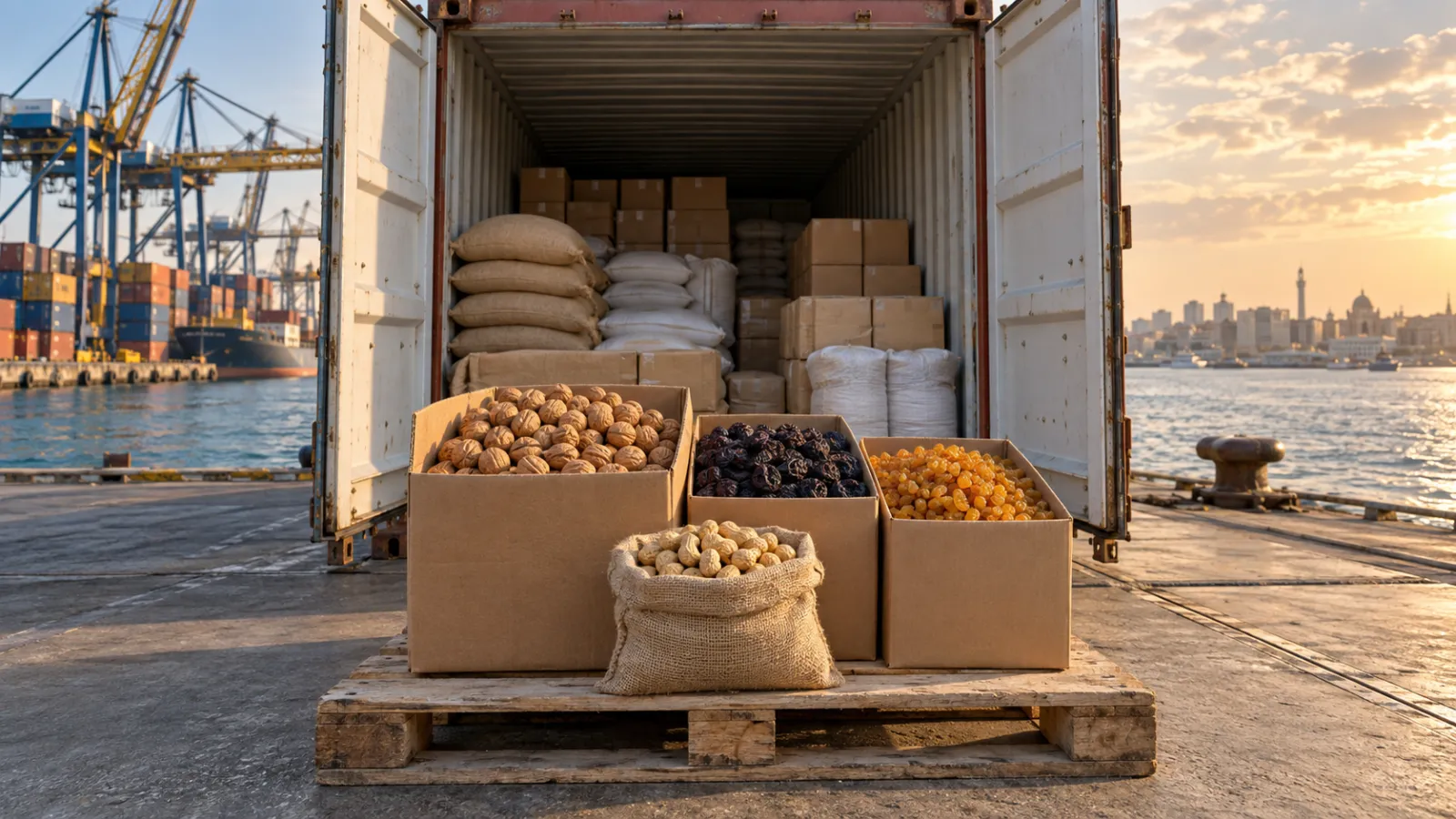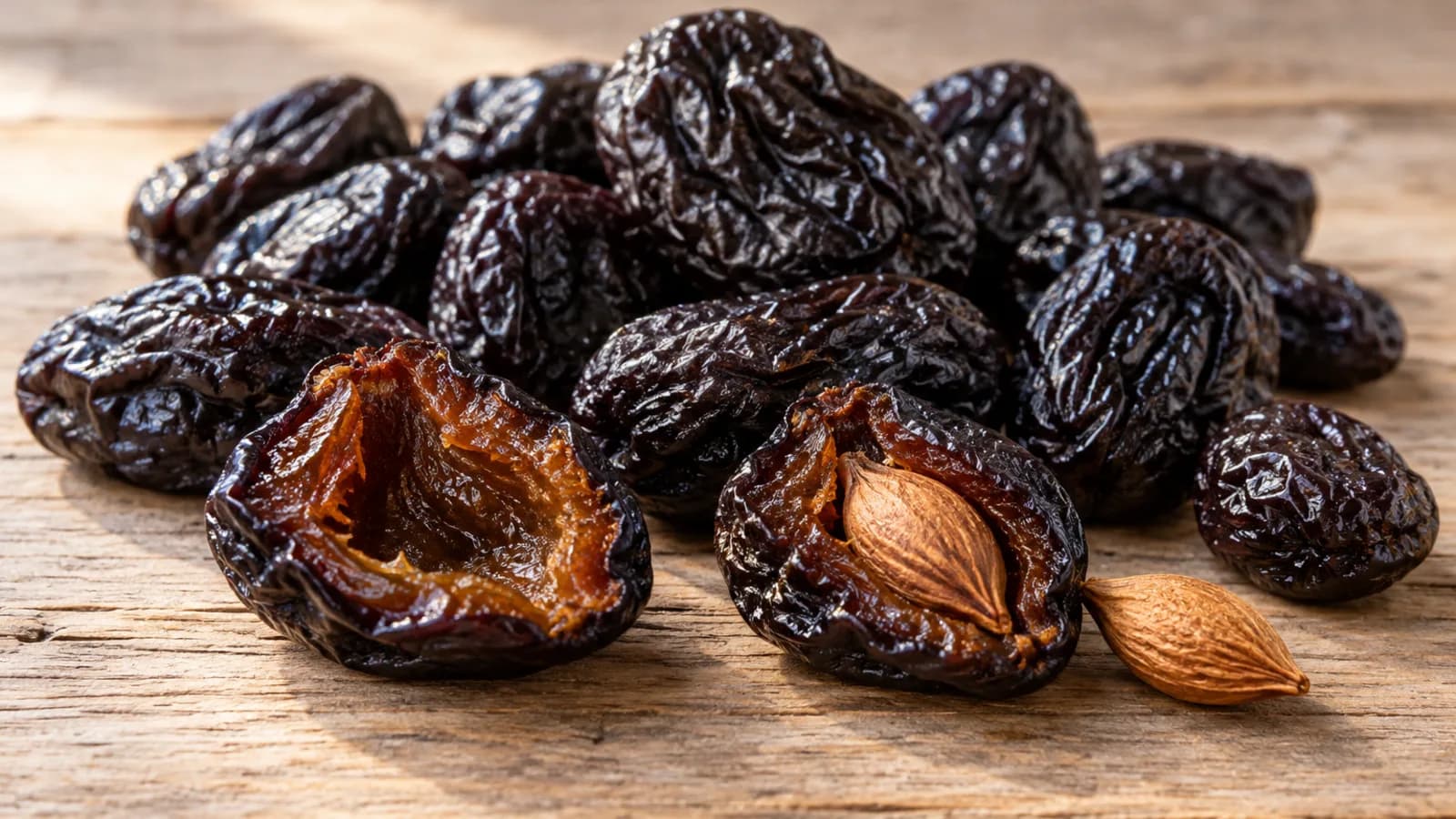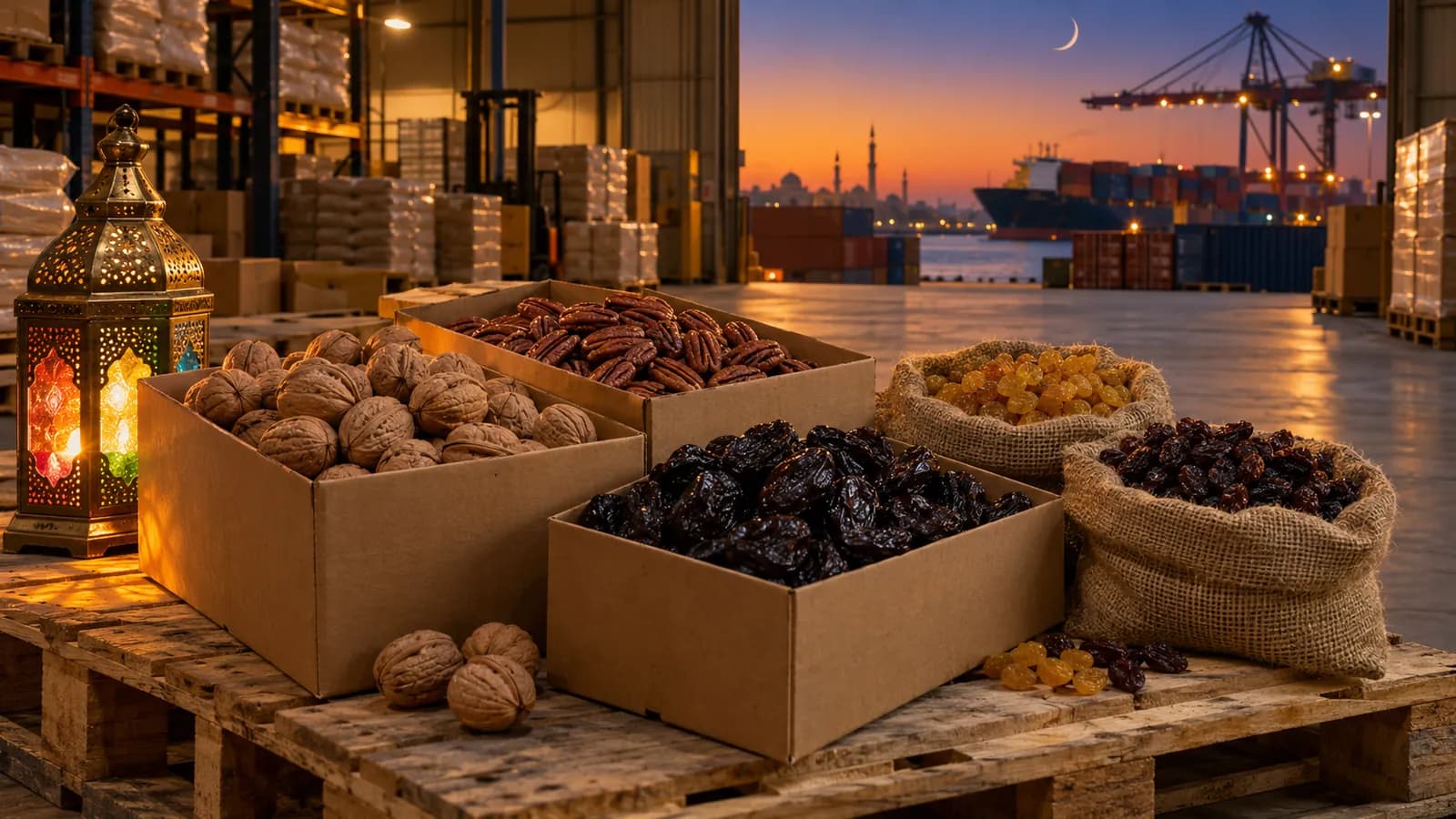
Ramadan 2027 is expected to begin on Monday 8 February, according to Saudi Arabia's Umm al-Qura calendar, with Eid al-Fitr on 9 or 10 March. Gulf and Egyptian importers do not buy in January: they want the goods in their warehouse six to eight weeks before the first day of fasting. That puts arrival at destination between mid and late December 2026, and shipment from South America now.
The short answer:
- Contracts: in October 2026. In Saudi Arabia, Ramadan orders are locked in between November and January; in Egypt, 80% of the 2025 yamish had cleared customs eight weeks before Ramadan.
- Last sailing from Buenos Aires to arrive by mid-December: around 14 October for Jeddah, 17 October for the UAE east-coast ports and 24 October for Alexandria. With two more weeks of slack, the deadline stretches to late October or early November.
- From Chile to the Gulf it is already too late to arrive eight weeks ahead: transit to the UAE is over 60 days.
- What arrives from the southern hemisphere is the 2026 crop, harvested between February and July. It is not "new crop" in February: it competes on price, availability, origin and duty.
- Ramadan 2028 starts around 28 January. That is the window for the southern 2027 crop, with contracts in September and October 2027.
This article brings together the dates, buying lead times, logistics with the Strait of Hormuz closed, which products make sense in each market and the full calendar to Ramadan 2028.
1. The dates: Ramadan 2027 and 2028
Hijri calendar dates are calculated and can shift by a day depending on moon sighting in each country. The calendar moves forward about eleven days every solar year, so each season starts earlier than the last.
| Milestone | Expected date | Source |
|---|---|---|
| 1 Ramadan 1448 | Monday 8 February 2027 | Umm al-Qura calendar; The National, 9 Sep 2026; Egypt's National Research Institute of Astronomy (NRIAG) |
| Eid al-Fitr | 9 March (10 March if the month runs to 30 days) | Umm al-Qura; The National |
| Eid al-Adha | 16 May 2027 | Umm al-Qura |
| 1 Ramadan 1449 | Around 28 January 2028 | Moonsighting.com |
For a nut buyer there are two peaks a year: Ramadan and Eid al-Fitr, the big one, and Eid al-Adha, a smaller one. The season's sweets use exactly what South America exports: khoshaf (a compote of prunes, raisins, dried apricots and dates), kunafa and qatayef with walnuts, and in Egypt the Eid kahk, filled with a paste of honey, sesame and walnuts.
2. When importers buy
There is no official lead time, but import data and traders themselves agree:
- Saudi Arabia. "The season starts in November and lasts until January; during it the order is completely closed," a Riyadh wholesale importer told Asharq Al-Awsat. Supermarket chains stock up six to eight weeks before the month begins.
- Egypt. On 5 January 2025, for a Ramadan starting on 1 March, 80% of the yamish had already cleared customs and was in importers' warehouses, according to the Cairo Chamber of Commerce (Al-Dostor). For Ramadan 2026, yamish imports rose 20% and wholesale distribution began in mid-January, according to the same chamber (Amwal Al Ghad, 18 Jan 2026).
UN Comtrade monthly statistics show the same pattern. This is how raisins reached Saudi Arabia ahead of Ramadan 2025 (11 March) and Ramadan 2026 (18 February):
| Period | Tonnes per month | Versus summer |
|---|---|---|
| July to September 2024 (trough) | ~870 | — |
| October 2024 to February 2025 | 1,542 · 2,479 · 1,766 · 1,796 · 2,064 | ×2.2 |
| July to September 2025 (trough) | ~710 | — |
| October to December 2025 | 1,702 · 2,053 · 2,107 | ×2.7 |
In Egypt, prunes arrived in December 2024 and January 2025 (174 and 178 t) and almost none between April and June. In 2025 arrivals came earlier and were spread from July to December (171 to 269 t a month), just as Argentine prunes leave the processing plant.
In practice: a buyer without a signed contract by the end of October is too late for this Ramadan. Whatever is negotiated in November and December is for restocking, for Eid al-Adha or for next year.
3. Logistics in 2026: Hormuz closed
This is a year when the route matters as much as the price. As of 4 October 2026:
- The Strait of Hormuz remains closed to regular container traffic, as it has been since 28 February. On 27 September a single vessel crossed it, against around 85 a day before the crisis (IMF PortWatch). The major carriers do not enter the Persian Gulf.
- The United Arab Emirates is served via the east coast. According to Maersk's operational updates of 23 and 29 September, Jebel Ali only receives cargo overland from Khor Fakkan, which has berthing problems, and some cargo is diverted to Fujairah with trucking under customs transit. Sohar, in Oman, remains open.
- Saudi Arabia is reached via Jeddah, on the Red Sea. Bookings to Dammam and Jubail, on the Persian Gulf, are suspended. Jeddah is congested and, since 20 July, the Houthis have maintained a declared naval blockade of Saudi Arabia. The sensible route from South America is via the Mediterranean and the Suez Canal, without crossing Bab el-Mandeb.
- Egypt is unaffected by any of this: Buenos Aires–Alexandria runs across the Atlantic and through Gibraltar.
Surcharges (late September 2026): Maersk charges an emergency freight surcharge of USD 1,800 per 20-foot container and USD 3,000 per 40-foot, plus a USD 1,000 Hormuz fee; Hapag-Lloyd applies a USD 1,500 per TEU war risk surcharge for the Gulf. Ask for freight quotes with short validity and itemised surcharges.
3.1 Transit times and last useful sailing
Transit times are those of the fastest published transhipment services (Fluent Cargo, October 2026); they are schedules, not quotes. We add one week of margin, and two for Jeddah because of congestion.
| Route | Transit | Arrival 14 Dec (8 weeks ahead) | Arrival 28 Dec (6 weeks ahead) |
|---|---|---|---|
| Buenos Aires → Alexandria | 39-42 days | Sail around 24 Oct | Around 7 Nov |
| Buenos Aires → Jeddah | 38-45 days | Around 14 Oct | Around 28 Oct |
| Buenos Aires → Khor Fakkan or Fujairah | ~51 days | Around 17 Oct | Around 31 Oct |
| San Antonio (Chile) → Alexandria | 42-45 days | Around 20 Oct | Around 3 Nov |
| San Antonio (Chile) → Jeddah | ~50 days | Around 1 Oct (passed) | Around 15 Oct |
| San Antonio (Chile) → UAE | ~63 days | Around 5 Oct (passed) | Around 19 Oct |
The rule for this Ramadan: Argentine origin out of Buenos Aires, shipped in October. Chilean origin only just reaches Alexandria in time, where it also pays the general tariff (§6). For the Gulf, preferential Chilean walnuts in the UAE are an argument for the rest of the year and for Ramadan 2028, not for February 2027.
4. Which crop arrives for Ramadan
It is worth being clear: the South American 2027 crop is harvested after Ramadan and does not even arrive in time for Eid al-Adha. What the southern hemisphere offers for February 2027 is the 2026 crop, harvested and processed between February and July 2026 and kept in cold storage. The northern hemisphere arrives with a more recent crop.
| Product | Southern hemisphere (2026 crop) | Northern hemisphere (2026 crop) |
|---|---|---|
| Prunes | Mendoza and Chile: February-March | California and Agen (France): mid-August to mid-September |
| Raisins | San Juan: mid-January to March, with 20 to 60 days of drying | Turkey: mid-August to early September |
| Walnuts | Chile: Chandler from late March; Argentina: March-April | California: September to November |
| Pecans | Argentina: April to July, mostly June-July | USA and Mexico: northern autumn |
| Peanuts | Córdoba: April to June | — |
So where does southern origin compete in this window?
- Where it is already the reference supplier. Argentina was Saudi Arabia's No. 1 prune supplier in 2023, 2024 and 2025, and Egypt's No. 1, with 70% of the value in 2025 (§5).
- On duty. In Egypt, Argentine origin enters at 0% under the Mercosur–Egypt FTA; US, Chilean or Turkish product pays the general tariff.
- On price and availability. With Dubai's re-export channel to Iran broken and the Gulf route more expensive, a second supplier with stock available in October is worth more than in a normal year.
- On documented quality. A lot tested against EU aflatoxin limits enters markets with less demanding standards without friction.
What makes no sense is selling a Gulf buyer "fresh crop for Ramadan". Where the south wins on freshness is between June and October, when the northern crop is eight to twelve months old: we explain this in our UAE and GCC guide.
5. Which product, in which market
Import data reported to UN Comtrade (CIF value), retrieved on 4 October 2026. The UAE has not yet published its 2024 and 2025 figures.
| Market · product | Year | Total imports | Argentina | Chile |
|---|---|---|---|---|
| Saudi Arabia · prunes | 2025 | USD 2.14 M (641 t) | 1st: USD 1.10 M (296 t) | 2nd: USD 0.49 M |
| Egypt · prunes | 2025 | USD 6.41 M (1,685 t) | 1st: USD 4.49 M (1,181 t), 70% | — |
| UAE · prunes | 2023 | USD 3.31 M | 2nd: USD 0.64 M (268 t) | 1st: USD 0.69 M |
| Saudi Arabia · raisins | 2025 | USD 41.9 M | — | 4th: USD 5.30 M (1,263 t) |
| Saudi Arabia · shelled walnuts | 2025 | USD 42.4 M | 8th: USD 0.13 M | 4th: USD 1.39 M |
| Egypt · in-shell walnuts | 2025 | USD 7.37 M | 3rd: USD 0.47 M (152 t) | — |
| UAE · in-shell walnuts | 2023 | USD 140.9 M | 4th: USD 1.98 M (860 t) | 3rd: USD 3.95 M (1,705 t) |
Three takeaways for this season:
- Prunes: the most open door. The market is small, but in 2025 it almost doubled in Saudi Arabia and grew 2.5-fold in Egypt, with Argentina leading in both. It is the khoshaf fruit. We compare sizes, pits and origins in our prune guide.
- Raisins: large volume and zero duty in the GCC. Saudi Arabia imports more than USD 40 million a year, led by Uzbekistan. Argentine raisins compete on price and on ochratoxin A control.
- Walnuts: the big market, but dominated by China and the US. In Egypt, Argentine walnuts have zero duty against 20% for the competition. In the Gulf, shelled walnuts are for suppliers who already have a customer; for this window, Argentine in-shell walnuts and pecans from the 2026 crop are the realistic option.
6. Duties and documents at a glance
| Saudi Arabia and UAE (GCC) | Egypt | |
|---|---|---|
| Duty on walnuts, pecans, prunes and peanuts | 5% (GCC common external tariff) | 0% for Argentine origin with a Mercosur certificate of origin; without preference, 20% walnuts, 30% prunes and 5% peanuts |
| Duty on raisins | 0% | 0% for Argentine origin; 40% without preference |
| Origin preferences | Chile, under the UAE–Chile CEPA in force since 24 Nov 2025 (check the tariff line) | Mercosur origin only: Chilean product pays the general tariff |
| Aflatoxins | GSO 193:2021, common to all six GCC states | Egyptian standard; lot tested against EU limits as a benchmark |
| Labelling | Arabic, with production and expiry dates printed on the original packaging, not on a sticker | Arabic for retail packs; bulk goes to a repacker |
| Registration | Importer and product registration with the food authority (SFDA in Saudi Arabia; ZAD in the UAE) | ACI on Nafeza and exporter registration on CargoX |
In Egypt, the agreement's last basket, which includes tree nuts, was liberalised in September 2026 according to the news agency of the Arab-Brazilian Chamber of Commerce. We go through it line by line in our Egypt export guide. Always confirm the applicable rate with your customs broker before shipping.
Payment. With a new buyer, in Egypt and in the Gulf, the sensible options are a confirmed irrevocable letter of credit or an advance payment with the balance against documents. The Egyptian pound has hovered around 52 to the dollar since March.
7. The full calendar: October 2026 to Ramadan 2028
| When | What happens | What to do |
|---|---|---|
| October 2026 | Last contract window for Ramadan 2027 | Agree price, size and sailing date using 2026-crop stock |
| Mid-October to early November | Last useful sailings from Buenos Aires (§3.1) | Book freight with itemised surcharges; documents ready before departure |
| 3 to 5 November | Gulfood Manufacturing, Dubai | Meet snack processors and repackers |
| 23 to 25 November | Foodex Saudi, Jeddah | Saudi importers and retail chains |
| 7 to 10 December | Food Africa, Cairo | Yamish importers and wholesalers; first conversations for 2028 |
| Mid to late December | Goods in importers' warehouses | Track arrival and clearance |
| 8 February 2027 | Ramadan begins | Buyers do not negotiate new origins during the month |
| 9-10 March | Eid al-Fitr | — |
| 15 to 19 March | Gulfood 2027, Dubai | Offer the southern 2027 crop for June-September delivery, and open Ramadan 2028 |
| February to July 2027 | South American 2027 harvest | New-crop samples to trade-show contacts |
| 16 May | Eid al-Adha | Second, smaller consumption peak |
| June | The Saudi Food Show, Riyadh | Meetings with Saudi importers |
| June to October | Counter-seasonal window | Southern crop 2 to 5 months old versus northern crop 8 to 12 months old |
| September and October 2027 | Ramadan 2028 contracts | Repeat orders with the 2027 crop |
| ~28 January 2028 | Ramadan 2028 begins | — |
8. Checklist for a Ramadan 2027 order
- Contract signed in October, with a specific sailing date.
- 2026-crop product with documented harvest and processing dates, and enough shelf life on arrival.
- Lot analysis (aflatoxins, moisture and, for raisins, ochratoxin A) before shipment.
- Argentine origin and a Mercosur certificate of origin if the destination is Egypt.
- A destination port operating today: Alexandria, Jeddah or the UAE east coast (Khor Fakkan, Fujairah or Sohar). Nothing inside the Persian Gulf while Hormuz stays closed.
- Freight with war-risk and emergency surcharges itemised and short validity.
- Arabic label with printed dates for retail packs; otherwise bulk for a repacker.
- Confirmed letter of credit or advance payment; never open account with a new customer.
- Two weeks of margin over the published transit time, for congestion at destination.
Frequently Asked Questions
When does Ramadan 2027 start?
According to Saudi Arabia's Umm al-Qura calendar, on Monday 8 February 2027, with Eid al-Fitr on 9 or 10 March. The final date depends on moon sighting and may differ by a day between countries.
How far in advance do importers buy for Ramadan?
They want the goods in their warehouse six to eight weeks before the month begins. In Egypt, 80% of the 2025 yamish had cleared customs eight weeks ahead. For Ramadan 2027, that means arrival by mid-December 2026 and contracts closed in October.
What is the last sailing from Argentina for Ramadan 2027?
To arrive by mid-December: around 14 October for Jeddah, 17 October for the UAE east-coast ports and 24 October for Alexandria. If the importer accepts arrival in late December, you gain one or two weeks.
Can you ship to Jebel Ali or Dammam with the Strait of Hormuz closed?
Not by direct sea route. As of October 2026, Jebel Ali receives cargo overland from Khor Fakkan or Fujairah, and bookings to Dammam and Jubail are suspended. Saudi Arabia is served via Jeddah, on the Red Sea.
Does the South American crop arrive fresh for Ramadan?
No. What reaches Ramadan 2027 is the southern hemisphere's 2026 crop, harvested between February and July 2026. The northern hemisphere crop is more recent. South American origin competes in this window on price, availability, duty and documentation; its freshness advantage is between June and October.
Which nuts and dried fruits are eaten during Ramadan?
In the Gulf and Egypt: walnuts, almonds, pistachios, hazelnuts, prunes, raisins, dried apricots and dates. They go into khoshaf, kunafa, qatayef, kahk and ma'amoul. In Egypt this assortment is called yamish.
We are looking for importers in the Gulf and Egypt
We work with importers, yamish wholesalers and repackers who want a second origin for Ramadan and for the rest of the year. For this season we offer, subject to available 2026-crop stock, prunes from Mendoza, raisins from San Juan, Argentine Chandler walnuts, Argentine pecans and Argentine peanuts; for the UAE outside this window, also Chilean Chandler walnuts.
We quote CFR or CIF Alexandria, Jeddah or the UAE east coast, with lot analysis against EU limits. Products can be combined by pallet in the same container: minimum order 1 pallet (~2,100 kg) and samples from 1 to 5 kg. If your Ramadan 2027 window has already closed, let's talk about the 2027 crop for the counter-season and for Ramadan 2028.
Tell us the product, volume and destination port, and we will confirm availability, sailing date and price. Egyptian importers can request a quote for Egypt; for the Gulf, request samples and a quote or write to us via our contact page.
Ramadan dates: Umm al-Qura calendar and The National (9 Sep 2026). Trade data: UN Comtrade, retrieved 4 Oct 2026. Hormuz, port status and surcharges: Maersk operational updates (23 and 29 Sep 2026), Hapag-Lloyd (week 38) and IMF PortWatch. Transit times: Fluent Cargo, schedules published in October 2026. Buying lead times: Asharq Al-Awsat, Al-Dostor and Amwal Al Ghad. The situation in the Strait of Hormuz and the Red Sea changes every week: confirm route, transit time and surcharges with the carrier, and duties and requirements with your customs broker, before shipping. This article does not constitute legal or customs advice.