Chilean walnuts have entered the United Arab Emirates at 0% duty since 24 November 2025, both in-shell (subheading 0802.31) and shelled (0802.32). That is what the Chile–UAE Comprehensive Economic Partnership Agreement (CEPA) sets out: both lines sit in category E(0), immediate elimination, from a base rate of 5%. Walnuts from the United States, China or Argentina still pay that 5% on the CIF value.
The catch is paperwork. The UAE importer has to present a CEPA certificate of origin, issued in Chile before or at the time of shipment, and the goods have to arrive without being worked on in a third country.
The short answer:
- Duty: 0% on Chilean walnuts, in-shell and shelled, from the day the agreement entered into force. No phase-in. Without the certificate, the 5% GCC common external tariff applies, as for any other origin. The UAE's 5% VAT is payable either way.
- Rule of origin: walnuts grown and harvested in Chile are wholly obtained (Article 3.3 of the agreement). On the certificate this is declared with the "WO" criterion. Walnuts from another country that are only dried, graded or packed in Chile do not qualify.
- Certificate: the Annex 3B form, in English, stamped by the competent authority. In Chile it is issued by the bodies to which ProChile delegates origin certification; for walnuts, according to the allocation ProChile publishes, that is UCCO. It is valid for one year from issue.
- Self-certification: not yet available. The agreement requires both countries to put in place, within its first year in force, recognition of origin declarations by "approved exporters", but each exporter will also need individual authorisation. At the time of writing we could not find that scheme in operation.
- Transshipment: allowed, as long as the cargo stays under customs control at the intermediate port and is only unloaded and reloaded.
- Re-export within the GCC: the preference applies only to the UAE. If walnuts enter under the CEPA and move on to Saudi Arabia, Oman or Qatar, duty is charged at that border.
1. What the agreement says about walnuts: subheadings and duty
The CEPA sets the UAE's rate for each tariff line in Annex 2B (Schedule of Tariff Commitments of the UAE). For walnuts, the annex uses the HS 2022 subheading plus two further digits (0802.3100 and 0802.3200); the UAE's integrated tariff breaks it down to 12 digits:
UAE duty on Chilean walnuts, as of 30 October 2026
| Subheading (HS 2022) | Product | UAE MFN rate (GCC) | CEPA rate for Chilean origin | Category | From |
|---|---|---|---|---|---|
| 0802.31 | In-shell walnuts | 5% | 0% | E(0) | 24 Nov 2025 |
| 0802.32 | Shelled walnuts (kernels) | 5% | 0% | E(0) | 24 Nov 2025 |
Sources: Annex 2B of the Chile–UAE CEPA, Spanish text published by Chile's National Customs Service (lines 0802.3100 and 0802.3200, base rate 5%, category E(0), 0.00% at every stage); MFN rate: correlation table of the 12-digit integrated tariff published by Dubai Customs (080231000000 and 080232000000, 5%). Accessed 30 October 2026.
Three points worth knowing:
E(0) means duty-free from day one. The annex's general notes define it as full elimination of the duty, with the goods duty-free immediately from the date of entry into force. There is no intermediate step for walnuts.
The base rate is the MFN rate on 1 January 2023. The annex starts from the unified customs tariff in force on that date, which was 5% for both subheadings. It is still 5% today, according to Dubai Customs' tariff table.
Not every nut line went to zero at once. In the same annex, shelled almonds (0802.12) and shelled cashews (0801.32) are in category E(3): 3.33% on entry into force, 1.67% from 1 January of Year 1 and 0% from 1 January of Year 2. The annex notes require reduced rates to be applied rounded to the first decimal place: 3.3% and 1.7%. On our reading of those notes, Year 1 began on 1 January 2026, so as of this writing (October 2026) Chilean shelled almonds pay 1.7% (the annex's 1.67%, rounded under its note 5) and go to 0% on 1 January 2027. If you combine walnuts with Chilean almonds, check which stage applies on the day of clearance.
The dates that matter
| Milestone | Date | Source |
|---|---|---|
| Signed in Abu Dhabi | 29 Jul 2024 | SUBREI; UAE Ministry of Economy and Tourism |
| International entry into force (the UAE's 0% applies from here) | 24 Nov 2025 | MoET; Chilean Customs (agreement text and Decree 142 of 2025) |
| Published in Chile's Official Gazette (domestic effect in Chile) | 22 Dec 2025 | Chilean Customs |
| Deadline for both countries to put in place recognition of origin declarations by approved exporters (does not by itself authorise any exporter) | 24 Nov 2026 | Article 3.23 of the agreement |
The gap between 24 November and 22 December 2025 only affects imports into Chile. For walnuts entering the UAE, the date is 24 November 2025.
2. The rule of origin: why Chilean walnuts qualify
Chapter 3 of the CEPA gives three routes to originating status. The one that applies to walnuts is the simplest: wholly obtained goods. Article 3.3(a) covers "plants and plant products grown, collected and harvested there". A walnut grown and harvested in a Chilean orchard is Chilean-origin, with no value calculation and no change of tariff heading required.
Annex 3A, the product-specific rules, confirms it for Chapter 8 (edible fruit and nuts): all Chapter 8 materials used must be wholly obtained.
On the certificate, this goes in box 9 as "WO" (wholly obtained).
What breaks origin
- Mixing walnuts from another country into the lot. If the lot includes Argentine or US walnuts, that part is not originating. Each origin goes on its own line with its own documents.
- Operations that never confer origin. Article 3.8 lists operations that, alone or combined, do not confer origin: drying and other preservation steps, simple classifying or sorting (which, on our reading, covers sizing), cleaning, packing, repacking and labelling. A walnut imported into Chile and only sized and repacked there is not Chilean under the CEPA.
- Cracking foreign in-shell walnuts in Chile. Annex 3A has an alternative rule for "processed nuts" (change of subheading or 40% regional value content). But Article 3.8 lists cutting and slitting among the operations that do not confer origin, and defines "simple" as an activity that needs no special skills and no machinery specially produced or installed for it. Whether cracking foreign in-shell walnuts in Chile falls under the annex rule or under that list is a technical question we do not treat as settled. If a supplier relies on it, have the certifying body confirm it before shipment.
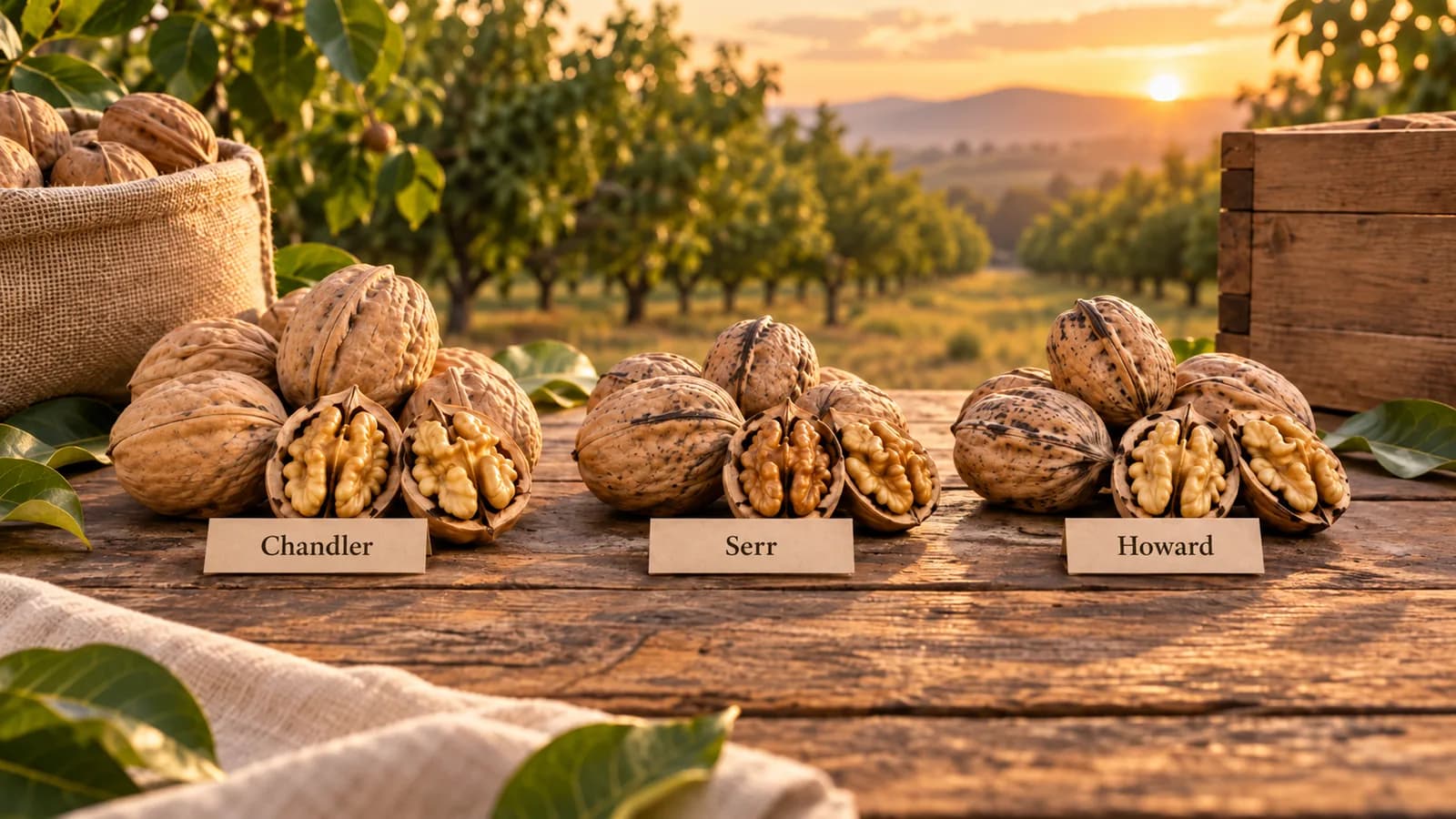
For the walnuts Raíz Andina sells, origin is on the product page: the Chandler, Serr and Howard are Chilean walnuts.
3. The certificate of origin: who issues it, format and validity
The agreement accepts four proofs of origin (Article 3.20), but only one works today:
| Proof of origin | Status in October 2026 |
|---|---|
| Paper or scanned certificate of origin issued by the competent authority (Art. 3.21) | Operational. This is the route in use |
| Electronic certificate exchanged between the two countries (Art. 3.22) | The Parties "shall endeavour to develop" it. No evidence it is running |
| Origin declaration by an approved exporter (Art. 3.23) | Both countries must put recognition in place within the first year in force, i.e. by around 24 Nov 2026. Even then, each exporter will need prior authorisation from ProChile, which will share or publish a list of approved exporters; today ProChile grants that status only under the agreements with the United Kingdom, EFTA and Türkiye. Abu Dhabi Customs describes it as applying "should" the system be adopted |
| Exporter self-certification (Art. 3.24) | The Parties "shall endeavour" to create it, subject to Joint Committee approval. Not yet in place |
Who issues it in Chile
The competent authority is the General Directorate of Export Promotion (ProChile) at the Ministry of Foreign Affairs. For this agreement, SUBREI classifies the regime as "certification by entity": ProChile delegates issuance to certifying bodies.
- UCCO (the Central Origin Certification Unit of the National Chamber of Commerce and the Chilean Fruit Exporters Association): according to the chapter-by-chapter allocation ProChile publishes, it handles agricultural products and, within Chapter 8, headings 0801 to 0810, which include walnuts (0802). That table does not yet name the UAE, so confirm with the body before the first shipment.
- SOFOFA handles industrial products (in Chapter 8, everything except headings 0801 to 0810). It publishes the certificate form for the UAE and runs a lookup system so the UAE authorities can verify certificates.
The certificate is applied for by the Chilean exporter or its customs agent, with the invoice and the lot's documents.
What it must include
- The Annex 3B form, on A4 or letter paper, completed in English.
- A unique serial number and the competent authority's seal, which may be electronic. If the seal is electronic, the certificate carries a QR code or a verification website.
- The HS code at six digits or more (0802.31 or 0802.32), a description matching the invoice, and origin criterion "WO".
- Issued before or at the time of shipment. Retroactive issue is an exception, for involuntary errors or omissions or other valid causes, marked Issued Retroactively and valid for no more than one year from the date of shipment.
Validity and other useful details
- One year from the date of issue (Article 3.20.3). A certified true copy after loss, or a replacement certificate, keeps the original's validity.
- Third-party invoicing (Article 3.19): UAE customs cannot reject a certificate just because the invoice to the importer was issued by a company other than the Chilean exporter. The third party invoice box is ticked with the invoicing company's name and country.
- Consignments up to USD 500 (Article 3.31): the UAE may waive the certificate. Useful for samples.
- If the importer did not claim the preference at clearance, it has one year from importation to claim a refund of the excess duty, on presentation of the proof of origin (Article 3.32).
What the importer does in the UAE
According to Abu Dhabi Customs, the importer or its broker submits the certificate and supporting documents electronically, keeps the originals in case customs asks for them, and claims the exemption in the declaration using code 67.
The CEPA does not replace any food-safety requirement. Product registration (ZAD and, in Dubai, FIRS), Arabic labelling and the SAG phytosanitary certificate are still needed. We cover them in our guide to the UAE and the GCC.
4. Direct shipment and transshipment
Article 3.17 requires the walnuts to reach the UAE without passing through the territory of a non-Party. Since few routes from Chile to the Gulf are direct, the same article allows transit or temporary storage in one or more intermediate countries on two conditions:
- The goods remain under customs control in the intermediate country.
- They undergo nothing there beyond unloading, reloading, labelling or splitting from bulk, or what is needed to keep them in good condition.
If UAE customs asks, the importer must provide "appropriate evidence" that both conditions were met. The agreement does not say which document is enough. In practice, ship on a bill of lading covering the whole route to the UAE port and ask the forwarder for the transshipment port's records.
What does break origin is taking the goods out of customs control in the intermediate country (releasing them for consumption there) or reprocessing them. Devanning or storing under customs control is allowed.
We follow the 2026 route to the UAE (east-coast ports, war-risk surcharges and reefer availability) in our guide to the UAE and the GCC.
5. What if the walnuts move on to Saudi Arabia or another GCC country?
This is the most common trap. The UAE, Saudi Arabia, Kuwait, Qatar, Bahrain and Oman form a customs union: duty is collected once, at the first point of entry, and duty-paid goods then circulate without paying again. But the CEPA is bilateral: it was signed by Chile and the UAE, not by the GCC.
The UAE customs authority (ICP) says so on its GCC customs union page: goods "exempted under free trade agreements are subject to duty upon re-entry at the border".
For the importer, that means:
- Walnuts for consumption in the UAE: 0% with the certificate.
- Walnuts entering the UAE under the CEPA and sold in Saudi Arabia, Oman, Qatar, Kuwait or Bahrain: that country's duty is charged on entry (for walnuts, the 5% common tariff; check the line in the destination country's tariff).
- Walnuts for Saudi Arabia: no origin has a preference. Chile, Argentina and the US all pay the same 5%, plus 15% VAT. See our Saudi Arabia guide.
The commercial takeaway: the CEPA only saves duty on walnuts that are released for consumption and stay in the UAE (the country's repackers, processors, retail chains and food service). It does nothing for re-exporters, and re-export weighs heavily in the UAE, kernels included. In 2023 the UAE's walnut kernel re-exports were equivalent to 91% of the tonnes imported (9,290 of 10,151 t), led by Iran, India, Saudi Arabia, Iraq and Oman; and 56% of the tonnes of in-shell walnuts shipped out of the country went to Iran (UN Comtrade). The UAE has not reported 2024 or 2025, so there are no statistics showing what happened to those flows after the Strait of Hormuz closed on 28 February 2026.
6. Chilean walnuts versus the US, China and other origins
| Origin | UAE duty on walnuts (0802.31 and 0802.32) | Basis |
|---|---|---|
| Chile, with a CEPA certificate | 0% | Chile–UAE CEPA, in force since 24 Nov 2025 |
| Chile, without a certificate | 5% | GCC common external tariff |
| United States | 5% | No trade agreement with the UAE |
| China | 5% | No trade agreement with the UAE |
| Argentina | 5% | No agreement in force: Mercosur has been negotiating a CEPA with the UAE since 2024, and Argentina announced bilateral talks on 24 Sep 2026 |
| Other origins with a CEPA in force (e.g. Türkiye since 2023, Australia since 1 Oct 2025 and Ukraine since 1 Jul 2026) | Per each agreement's schedule | We did not check their walnut lines one by one |
Sources: Annex 2B of the Chile–UAE CEPA; Dubai Customs integrated tariff; the UAE Ministry of Economy and Tourism page for each agreement (Türkiye, Australia); Dubai Customs Notice 11/2026 (Ukraine); Argentine Foreign Ministry (Argentina). Accessed 30 October 2026.
What the 5% is worth. Duty is charged on the CIF value at the UAE port, so the saving is 5% of the goods plus freight and insurance. We do not quote price figures, because they move with the crop, size and colour. What can be said is that in a thin-margin product, 5% often decides between two similar offers.
Duty is not everything. In 2023, the last year the UAE reported to UN Comtrade, China and the US supplied 95% of the value of in-shell walnut imports and 80% of the value of kernel imports. The CEPA does not change that scale. It gives Chile a cost advantage in the same window where it already has a freshness advantage: from June to October, Chilean walnuts, harvested between February and April, are current-season crop; in September they are about six months from harvest, against eleven for Californian walnuts. More on that in our counter-season article.
7. What the trade data show
Chilean walnut exports to the UAE
| Period | In-shell (0802.31) | Shelled (0802.32) |
|---|---|---|
| 2023 | USD 4.37 M · 1,904 t | USD 5.43 M · 923 t |
| 2024 | USD 3.26 M · 1,258 t | USD 5.74 M · 603 t |
| 2025 | USD 53.55 M · 14,206 t | USD 5.56 M · 553 t |
| January–August 2025 | USD 26.79 M · 7,071 t | USD 2.27 M · 214 t |
| January–August 2026 (CEPA in force) | USD 0.36 M · 95 t | USD 2.50 M · 276 t |
Source: UN Comtrade, exports reported by Chile (FOB value), annual and monthly data accessed 30 October 2026. September 2026 was not yet published.
UAE walnut imports by origin, 2023
| Origin | In-shell (0802.31) | Shelled (0802.32) |
|---|---|---|
| Total | USD 140.9 M · 77,089 t | USD 40.7 M · 10,151 t |
| China | USD 98.5 M | USD 17.7 M |
| United States | USD 35.4 M | USD 15.0 M |
| Chile | USD 3.9 M (3rd) | USD 6.6 M (3rd) |
| Argentina | USD 2.0 M | USD 0.18 M |
Source: UN Comtrade, imports reported by the UAE (CIF value). The UAE had not reported 2024 or 2025 as of 30 October 2026.
Three readings:
Chilean in-shell walnuts surged in 2025 and collapsed in 2026. They went from USD 3.3 million in 2024 to USD 53.5 million in 2025, 17% of the value of all Chile's in-shell walnut exports that year. Between January and August 2026, with the duty already at zero, they fell to USD 0.36 million, all of it in January and February: there were no in-shell shipments at all from March, whereas May to August 2025 had brought USD 26.8 million. The drop coincides in time with the closure of the Strait of Hormuz on 28 February 2026. That is a coincidence of dates, not a proven cause: the statistics do not show where those walnuts went after reaching the UAE.
Kernels held up and grew. Between January and August 2026, Chile sold the UAE USD 2.50 million and 276 tonnes of walnut kernels, 29% more volume than in the same period of 2025. That does not tell us how much stays in the country: in 2023 the UAE re-exported the equivalent of 91% of the walnut kernel tonnes it imported, including to Saudi Arabia, Oman and Qatar, where the CEPA does not apply. Nor does the in-shell/kernel split separate re-export from consumption: Dubai has industry that cracks in-shell walnuts. The CEPA only saves duty on the share released for consumption in the UAE.
Chile was already the number-three supplier before the agreement. In 2023 it ranked third in both subheadings, behind China and the US. The CEPA does not open a new market, but it gives a cost advantage to an origin that was already there.
8. Checklist for a first container of Chilean walnuts under the CEPA
- Subheading confirmed: 0802.31 (in-shell) or 0802.32 (kernels), and its 12-digit line in the UAE tariff.
- Lot 100% Chilean origin, with no walnuts from other countries mixed in.
- CEPA certificate of origin (Annex 3B), in English, criterion "WO", issued before or at the time of shipment by the certifying body (for walnuts, UCCO under ProChile's allocation; confirm with the body).
- If a third party invoices, the third party invoice box completed.
- Route checked: if there is transshipment, a bill of lading through to the UAE port and records from the intermediate port for the importer.
- The importer claims the preference (in Abu Dhabi, with code 67; in other emirates, under their customs' own procedure) and files the certificate electronically.
- Final destination in the UAE. If the goods move on to another GCC country, the CEPA does not help.
- Everything else in order: ZAD/FIRS registration, Arabic label, SAG phytosanitary certificate and lot analysis.
- Certificate still valid: one year from issue.
Frequently Asked Questions
What duty do Chilean walnuts pay in the United Arab Emirates?
0%, in-shell and shelled, since 24 November 2025, provided the importer presents the CEPA certificate of origin. Without it, they pay 5% of the CIF value, like any other origin. The 5% VAT applies in both cases.
Is the tariff cut for walnuts immediate or phased?
Immediate. Subheadings 0802.31 and 0802.32 are in category E(0) of Annex 2B, which removes the duty from entry into force. Shelled almonds and cashews, by contrast, are phased out in three steps (category E(3)): on our reading of the annex, Chilean shelled almonds pay 1.7% (the annex's 1.67%, rounded under its note 5) in 2026 and 0% from 1 January 2027.
Who issues the CEPA certificate of origin in Chile?
The competent authority is ProChile, which delegates issuance to certifying bodies. According to the chapter-by-chapter allocation ProChile publishes, walnuts (heading 0802) are certified by UCCO; SOFOFA handles industrial products and publishes the form and the lookup system for the UAE. The Chilean exporter or its customs agent applies for it. The certificate is completed in English, carries the authority's seal and is valid for one year.
Can origin be self-certified for walnut exports to the UAE?
Not yet. The agreement requires both countries to put in place, within the first year in force (by around 24 November 2026), recognition of origin declarations by approved exporters, and leaves self-certification as a future goal. That deadline does not authorise anyone automatically: each exporter will need prior authorisation from ProChile. As of October 2026, the working route is a certificate issued by the certifying body.
Is the preference lost if the container is transshipped?
No, as long as the cargo stays under customs control at the intermediate port and is only unloaded and reloaded. If UAE customs asks, the importer has to prove it with the transport documents.
Can walnuts that entered the UAE under the CEPA be sold duty-free in Saudi Arabia?
No. The CEPA is a bilateral agreement between Chile and the UAE. According to the UAE customs authority, goods exempted under a free trade agreement pay duty on entering another GCC country. In Saudi Arabia, walnuts pay 5% whatever their origin.
We are looking for importers of Chilean walnuts in the UAE
We are looking for importers, repackers and processors who release goods for consumption in the UAE: that is the part of the market where the CEPA saves the 5%. If you re-export to Saudi Arabia, Oman or elsewhere, the CEPA does not change your duty, but the counter-season still counts: current-season Chilean walnuts between June and October, as a second origin alongside the northern hemisphere.
We offer Chilean walnut kernels in three varieties: Chandler, for size and extra-light colour; Serr, for yield and early availability; and Howard, for stability on long transits and in hot climates. If you are weighing them up, read Chandler, Serr or Howard: which walnut variety to order.
They can be combined with Chilean almonds in the same container, on their own CEPA stage: shelled almonds pay 1.7% (the annex's 1.67%, rounded under its note 5) in 2026 and 0% from 1 January 2027, on our reading of the annex.
We quote CFR or CIF to a named UAE port (while transit through Hormuz remains restricted, Khor Fakkan or Fujairah on the east coast), with lot analysis against EU limits. The CEPA certificate of origin is issued in Chile by the certifying body at the exporter's request. Minimum order 1 pallet (~2,100 kg) and samples of 1 to 5 kg.
Tell us the variety, size, volume and destination port, and we will confirm availability, shipping date and price. Request samples and a quote or write to us from our contact page.
Duties and rules of origin: text of the Chile–UAE CEPA and its Annexes 2B, 3A and 3B, in the Spanish version published by Chilean Customs (Decree 142 of 2025, Official Gazette of 22 December 2025), and the Dubai Customs integrated tariff, accessed 30 October 2026. Certification: ProChile, UCCO, SOFOFA, SUBREI and Abu Dhabi Customs. Customs union: ICP. Trade: UN Comtrade, accessed 30 October 2026. The deadline to put the approved-exporter origin declaration in place falls on 24 November 2026, but it does not authorise anyone automatically: each exporter will need ProChile's authorisation and, until then, the proof of origin is the certificate. Confirm the proof of origin in force with the certifying body, and the classification and duty with your customs broker and importer, before shipping. This article does not constitute legal or customs advice.