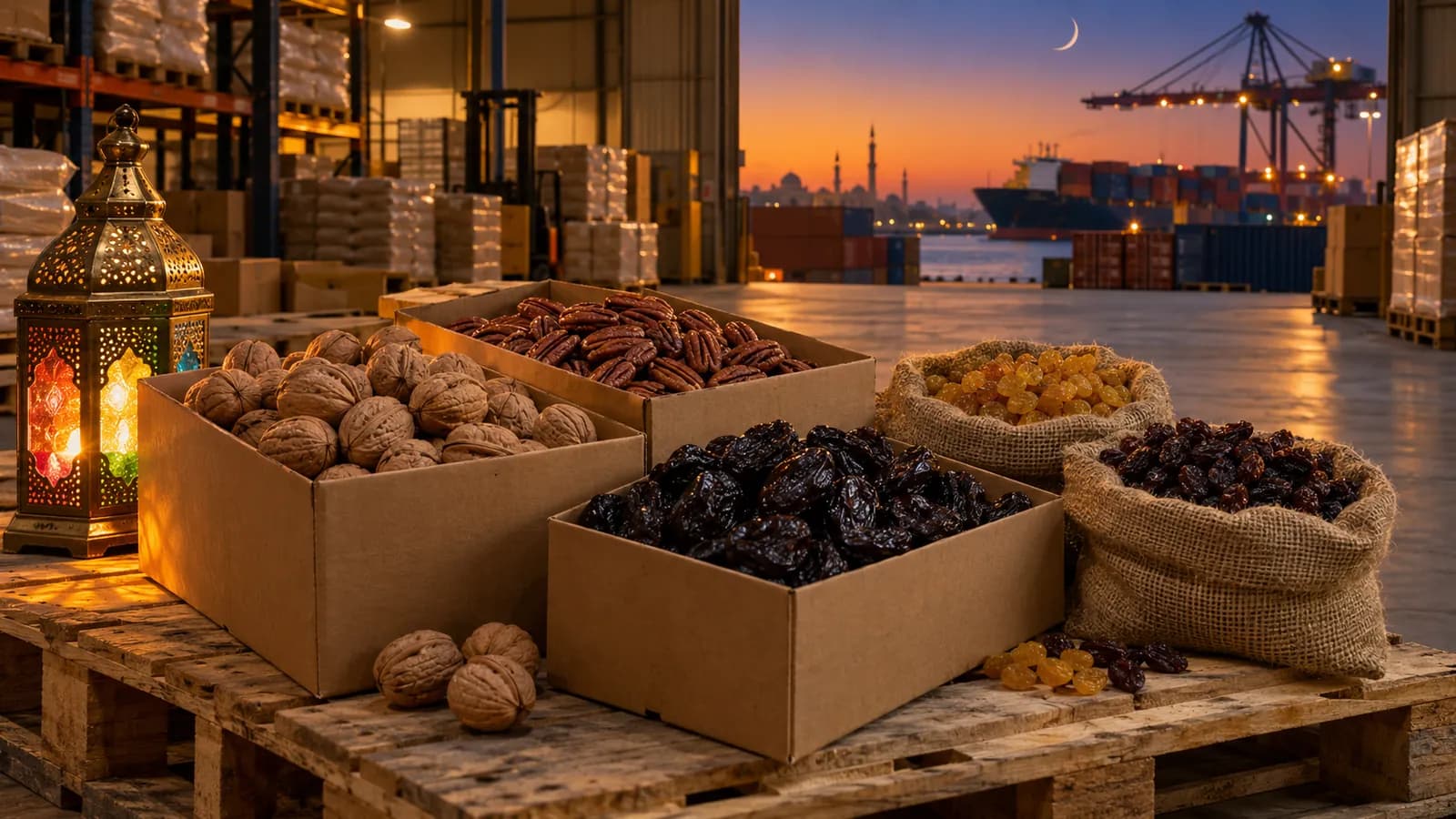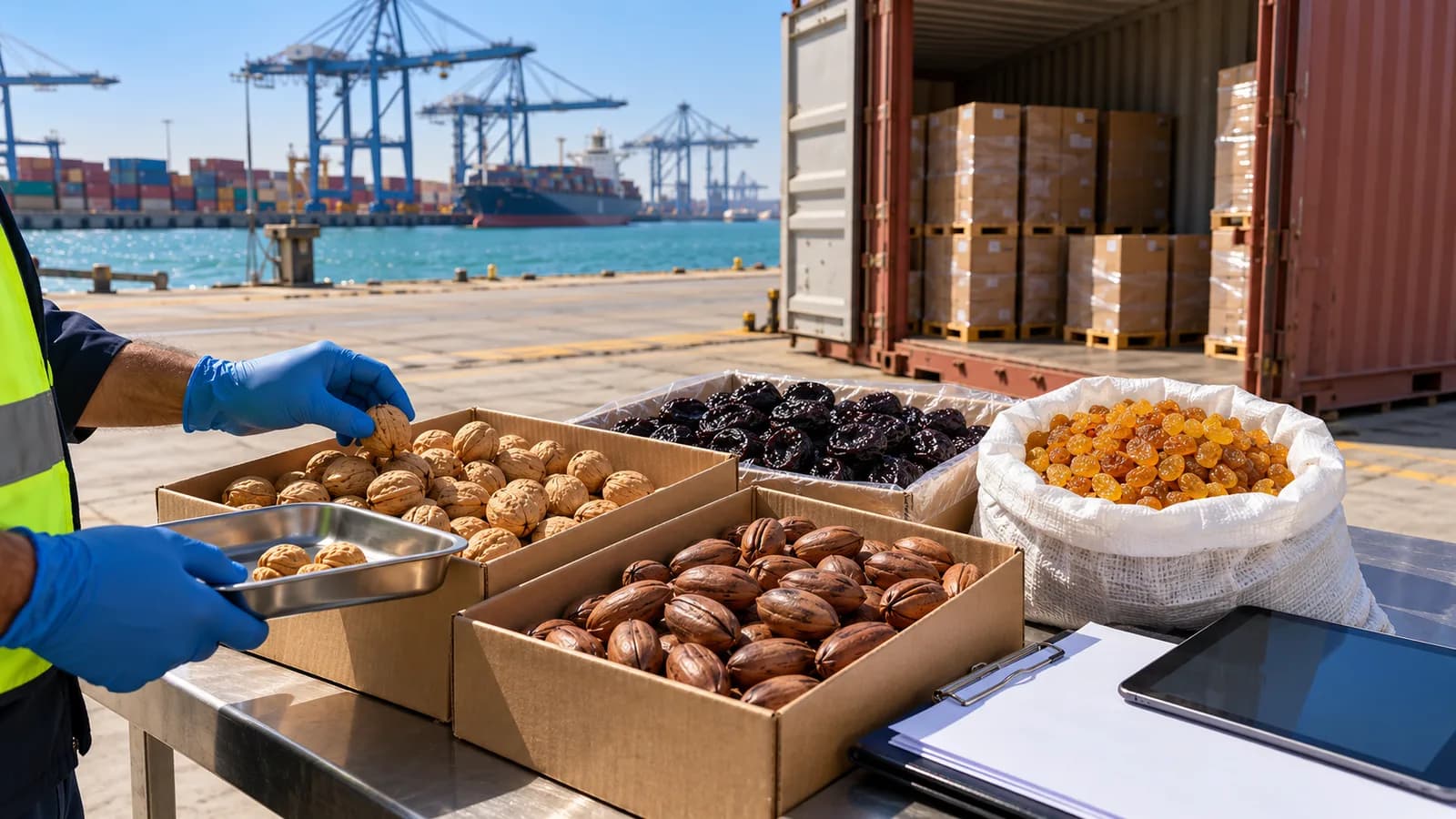
Saudi Arabia imported USD 322.7 million of tree nuts in 2025, with the United States as its leading supplier (53%), according to the USDA Retail Foods report of August 2026. The Kingdom grows almost no nuts and is the largest consumer market in the Gulf. Yet South American exporters tend to see it from behind the United Arab Emirates, which used to be its gateway.
In 2026 that gateway is shut: with the Strait of Hormuz blocked, all cargo bound for Saudi Arabia enters through Jeddah, on the Red Sea. Now is the time to treat the Kingdom as a market in its own right.
The short answer:
- Duty: 5% of CIF value on walnuts, pecans, prunes and peanuts; 0% on raisins. No origin enjoys a preference: Argentina, Chile and the US all pay the same. On top of that comes 15% VAT.
- Registration: done by the importer, who registers the company and every product in the SFDA's FIRS system. The exporter supplies the documents. Plant-based products do not need the origin facility to be registered; honey does.
- Label: in Arabic, with the production and expiry dates printed on the pack. Dates on stickers are rejected.
- Port: Jeddah. Bookings to Dammam and Jubail are suspended, and cargo for Riyadh and the Eastern Province continues by truck from Jeddah. Transit from Buenos Aires: 36 to 38 days with one transhipment, plus congestion at destination.
- Channel: six chains account for over 80% of retail. You do not sell to them directly: you go through importers, repackers and roasters.
- Where South America competes: Argentina is the Kingdom's No. 1 prune supplier and No. 2 pecan supplier. Chile ranks 4th in raisins and in walnut kernels.
1. The market: what Saudi Arabia buys, and from whom
The USDA lists tree nuts among the best prospects for the Saudi market. Food retail sales were around USD 57 billion in 2025 (USDA, SA2026-0013). In nuts, the Kingdom relies almost entirely on imports.
Saudi imports by product, 2025
| Product (HS) | Imports 2025 | Leading supplier | Argentina | Chile |
|---|---|---|---|---|
| Shelled almonds (0802.12) | USD 114.8 M | US (92%) | — | — |
| Shelled pistachios (0802.52) | USD 81.5 M | US (71%) | — | — |
| Walnut kernels (0802.32) | USD 42.4 M · 6,700 t | China (43%), US (42%) | 8th: USD 0.13 M | 4th: USD 1.39 M |
| Raisins (0806.20) | USD 41.9 M · 17,941 t | Uzbekistan (35%) | — | 4th: USD 5.30 M (1,263 t) |
| Shelled peanuts (1202.42) | USD 18.8 M · 8,615 t | Vietnam | 5th: USD 1.36 M (751 t) | — |
| Other nuts, incl. pecans (0802.99) | USD 3.7 M · 525 t | US (53%) | 2nd: USD 0.66 M (18%) | — |
| Prunes (0813.20) | USD 2.14 M · 641 t | Argentina (52%) | 1st: USD 1.10 M (296 t) | 2nd: USD 0.49 M |
Source: UN Comtrade, imports reported by Saudi Arabia (CIF value), accessed 7 October 2026.
Four commercial takeaways:
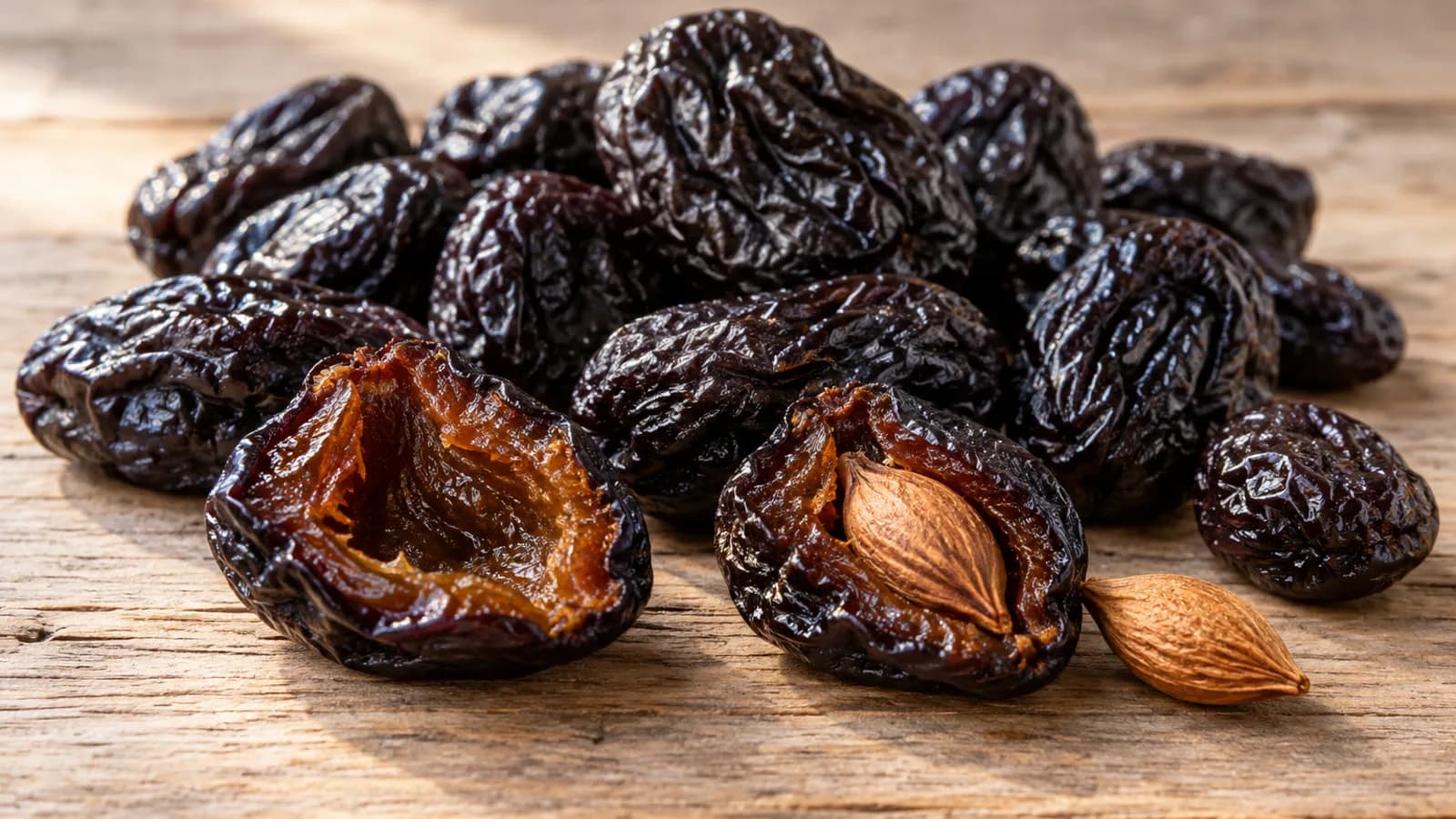
Prunes are the most open door. The market is small, but it almost doubled in a year, from USD 1.15 million in 2024 to USD 2.14 million in 2025. Argentina already supplies half of it. It is a Ramadan product, the base of khoshaf. We compare sizes, pits and origins in our prune guide.
Argentine pecans already have a foothold. Saudi Arabia has no dedicated subheading for pecans: they sit under "other nuts". In that group, Argentina is the second supplier, behind the United States. SENASA confirmed in December 2025 that Saudi Arabia was among the destinations of the 920 tonnes of pecans exported in 2025 up to that date.
Walnuts are bought shelled. Saudi Arabia imports USD 42 million of walnut kernels and less than USD 2 million of in-shell walnuts. That is the opposite of the UAE, whose in-shell walnut imports were mostly re-exported to Iran. In the Kingdom, the customer is the roaster, the repacker and the snack industry. China and the US compete there, and the southern hemisphere's opening is seasonal: between June and October, when the northern crop is eight to twelve months old.
Raisins are volume with no duty. It is a USD 42 million market led by Uzbekistan and Afghanistan, where Chile is already the fourth supplier. Argentine raisins compete on price and on ochratoxin A control.
Where it makes no sense to compete is almonds and pistachios: the US holds between 70% and 92% of the market.
2. Duties and taxes
Saudi Arabia applies the Gulf Cooperation Council (GCC) common external tariff, with its own exceptions. These are the rates in the integrated tariff of ZATCA, the Saudi customs and tax authority, for the products in our catalogue:
| Product | HS code | Duty | Who clears it |
|---|---|---|---|
| In-shell walnuts | 0802.31 | 5% | MEWA (prior approval and plant quarantine) |
| Walnut kernels | 0802.32 | 5% | SFDA |
| Pecans, in-shell and shelled | 0802.99.91 / .92 | 5% | MEWA in-shell, SFDA shelled |
| Prunes | 0813.20 | 5% | SFDA |
| Raisins | 0806.20 | 0% | SFDA |
| Raw peanuts | 1202.41 / 1202.42 | 5% | SFDA |
| Roasted peanuts | 2008.11.10 | 6% | SFDA |
| Roasted nuts and mixes | 2008.19.19 / 2008.19.20 | 10% | SFDA |
Source: ZATCA integrated tariff, accessed 7 October 2026. The rates for roasted peanuts, roasted nuts and mixes apply from 27 November 2025.
What you need to know to quote:
- Duty is charged on CIF value, and customs requires the invoice on those terms (USDA FAIRS, SA2025-0013). 15% VAT is then charged on the customs value plus duty.
- Raw product pays less than roasted. Since November 2025, roasted nuts and mixes pay 10%, twice the rate for raw. Saudi Arabia favours roasting and packing in the Kingdom, which is why the natural buyer of raw material is the local roaster or repacker.
- No one has a preference. The GCC has no trade agreement with Mercosur or with Chile. The UAE–Chile CEPA, in force since November 2025, is bilateral: it gives zero duty in the Emirates, not in Saudi Arabia.
- Tariff revisions are frequent. In June 2026, ZATCA raised 51 agri-food lines from 5% to 15% (EY, 20 July 2026). None affects the products in this table, but check the exact code in the ZATCA search tool before every offer.
3. The SFDA: what the importer does and what the exporter does
The Saudi Food and Drug Authority (SFDA) regulates imported food; SASO's Saber platform, which certifies industrial products, is not used for food. The split of tasks is clear:
| Requirement | Who does it | Detail |
|---|---|---|
| Registering the importing company and each product | Importer | In the SFDA's FIRS (Food Import Registration System), before the first shipment. The tariff code is entered at 8 digits |
| SFDA-licensed warehouse | Importer | Exempt: factories importing raw materials and small importers (up to 5 shipments and 2,000 kg a year) |
| Registering the origin facility | — | Not for plant products. Yes for honey, dairy and other animal products |
| Halal | — | Not required for nuts or dried fruit without animal-derived ingredients |
| Commercial invoice and certificate of origin | Exporter | Original invoice certified by a chamber of commerce; in Argentina, usually the Argentine-Arab Chamber of Commerce |
| Phytosanitary certificate | Exporter | Issued by SENASA in Argentina or SAG in Chile |
| Health certificate, packing list and bill of lading | Exporter | With lot, production date and expiry date consistent with the label |
| Customs declaration | Importer or its broker | On the FASAH platform |
Sources: SFDA, "Food Clearance Conditions and Requirements"; USDA FAIRS Saudi Arabia (SA2025-0013, July 2025) and Exporter Guide (SA2026-0009, July 2026).
Three facts that save surprises:
- No consular legalisation is needed. Saudi Arabia has been party to the Apostille Convention since 7 December 2022 (HCCH). What is still required is chamber of commerce certification. Some letters of credit still ask for legalisation: check the wording before you accept the credit.
- Clearance takes about 4 days without testing and up to 15 if the SFDA samples. Each product tested costs in the order of USD 1,333, and demurrage on a dry container runs at about USD 220 a day (USDA FAIRS, 2025). A lot tested before shipment reduces those risks, though it does not remove them.
- In-shell walnuts and pecans go through the Ministry of Environment, Water and Agriculture (MEWA), with prior approval and plant quarantine. Shelled, they are cleared by the SFDA. The importer must know which route each product takes before signing.
4. Labelling and shelf life
The standard in force is SFDA.FD/GSO 9:2022, with the May 2024 amendment. It is the same basis as in the UAE, but Saudi Arabia applies it less flexibly:
- Arabic is mandatory. A single sticker with the Arabic information is accepted, provided the manufacturer applies it.
- Dates cannot go on a sticker. According to the SFDA, they are engraved or printed in indelible ink on the pack, and adding stickers with the production and expiry dates is not allowed. If shelf life is three months or less, the format is day/month/year; if longer, month/year.
- There is no clear exemption for bulk. The UAE exempts institutional-use product from Arabic; we did not find that exemption in the Saudi rules. The prudent course is for the importer to validate the label artwork for the 10 or 25 kg carton before shipment.
- Shelf life is set by the manufacturer. The mandatory standard (SFDA.FD 150-1) only covers perishables. Nuts and dried fruit fall under the voluntary part (GSO 150-2): the manufacturer declares the date on a technical basis. Do not declare 12 months for walnut kernels at ambient temperature if your product will not last that long in the Gulf climate.
5. Aflatoxins and ochratoxin A
The Saudi mycotoxin standard (SFDA.FD 193) sets limits for total aflatoxins, with no specific B1 limit as in the EU. Compared with Regulation (EU) 2023/915:
| Product | Saudi Arabia | European Union |
|---|---|---|
| Walnuts and pecans, ready to eat | 4 µg/kg total aflatoxins under the GSO 193 draft; 20 µg/kg (general limit) if that line does not apply | 2.0 µg/kg B1 · 4.0 µg/kg total |
| Dried fruit (prunes, raisins), ready to eat | 4 µg/kg total | 2.0 µg/kg B1 · 4.0 µg/kg total |
| Peanuts for processing | 15 µg/kg total | 8.0 µg/kg B1 · 15.0 µg/kg total |
| Ochratoxin A in raisins | 10 µg/kg | 8.0 µg/kg |
Sources: SFDA.FD 193:2019 and the GSO 193 draft notified to the WTO (2019); Regulation (EU) 2023/915.
The practical conclusion does not depend on which version the inspector applies: a lot tested against EU limits also meets the Saudi ones, for every product in the table. The European analysis works here as a sales argument. In our guide to pesticide MRLs we explain how to read a lot's lab report.
6. Logistics in October 2026: everything through Jeddah
Before the crisis, around 70% of the food Saudi Arabia imported already came in through Jeddah (USDA FAIRS, 2025). Today it all does. According to Maersk's operational update of 2 October 2026:
- Jeddah and King Abdullah Port (KAP), both on the Red Sea, accept dry cargo bookings.
- Dammam and Jubail, on the Persian Gulf, still have bookings suspended because Hormuz is closed.
- Cargo for Riyadh and Dammam enters through Jeddah and continues by truck, using the carrier's inland haulage service. The Jeddah–Riyadh rail landbridge does not exist yet: rail only links Riyadh and Dammam.
- Reefer bookings are suspended to Dammam, Jubail and KAP. Walnut kernels that need refrigeration must go to Jeddah.
- Surcharges: USD 1,800 per 20-foot dry container, USD 3,000 per 40-foot and USD 3,800 per reefer, plus USD 1,000 if the vessel transits Hormuz. Ask the carrier to confirm in writing which surcharges apply to cargo bound for Jeddah.
| Final destination | Port | Last leg |
|---|---|---|
| Jeddah, Mecca, Medina | Jeddah | Local |
| Riyadh and the central region | Jeddah | Truck, about 950 km |
| Dammam, Jubail and the Eastern Province | Jeddah | Truck, about 1,350 km, or truck to Riyadh and then rail |
The Red Sea risk. On 20 July 2026, the Houthis declared a naval blockade of Saudi Arabia. The sensible route from South America reaches Jeddah via the Mediterranean and the Suez Canal, without passing the Bab el-Mandeb strait.
Transit and congestion. The fastest published service from Buenos Aires to Jeddah takes 36 to 38 days, with one transhipment and sailings every one or two weeks (Fluent Cargo, October 2026). Jeddah has been congested since the summer: Kuehne+Nagel reported yard occupancy close to 90% and productivity 20–25% lower (Kuehne+Nagel). Allow two weeks of buffer on the published transit.
Palletise anyway. The ports authority (Mawani) was going to require palletised cargo from 1 June 2026 and postponed it indefinitely (circular 13/2026, according to the USDA). In a congested port, pallets speed up discharge and inspection.
The Incoterm. Quote CFR Jeddah or CIF Jeddah with the named port, never "CFR Saudi Arabia". The truck to Riyadh or Dammam is for the buyer's account unless a DAP is agreed. We explain how costs and the war-risk surcharge are split in our Incoterms guide.
7. The six chains and how to reach them
The USDA sums it up in its August 2026 report: Othaim, LuLu, Danube, Panda, Tamimi and Farm, together with their affiliated chains, account for more than 80% of Saudi food retail revenues (SA2026-0013).
That does not mean you should sell to them directly. The chains buy from local importers and distributors, who register the product with the SFDA, apply the Arabic label and absorb retail payment terms. According to the USDA, large retailers pay at 60 to 120 days, terms an exporter should not be financing.
The four buyer profiles for a raw-material exporter:
- Wholesale importer. Buys full containers, especially before Ramadan, and distributes to chains and traditional wholesalers.
- Roaster and repacker. Buys raw in bulk, roasts and packs under its own brand or the chain's. The 10% duty on imported roasted product works in its favour.
- Snack, bakery and confectionery industry. Buys walnut kernels, raisins and peanuts to technical specification.
- Chains' private label. Sourced through local consolidators who apply the Arabic label.
Payment. The USDA recommends an irrevocable letter of credit or advance payment for first transactions, and open account or documentary collection once there is a relationship.
8. The Saudi calendar
- Ramadan 2027 starts around 8 February. Importers lock in their orders between November and January and want the goods in the warehouse six to eight weeks before. From Buenos Aires, the last useful sailing leaves in mid-October 2026. We go into detail in our Ramadan 2027 buying calendar.
- Foodex Saudi: 23 to 25 November 2026, at the Jeddah exhibition centre (foodexsaudiexpo.com).
- Gulfood 2027: 15 to 19 March, in Dubai. It is the show where the southern hemisphere's 2027 crop and counter-season contracts are sold.
- Counter-season, June to October: this is when South American walnuts, pecans and prunes arrive two to five months after harvest, against eight to twelve for the northern hemisphere.
9. Checklist for the first container to Saudi Arabia
- The importer has the company and every product registered in FIRS before shipment, and an SFDA-licensed warehouse unless exempt.
- HS code confirmed in the ZATCA search tool, with the clearance route (MEWA or SFDA) clear.
- Arabic label artwork validated by the importer, and dates printed on the pack, never on a sticker.
- Lot tested against EU limits (aflatoxins, moisture and, for raisins, ochratoxin A).
- Invoice and certificate of origin certified by the chamber of commerce; phytosanitary certificate from SENASA or SAG.
- CFR or CIF Jeddah, with the named port; truck to Riyadh or Dammam agreed separately.
- Routing via Suez, surcharges itemised, short offer validity (7 to 10 days) and two weeks of buffer on transit.
- Palletised cargo.
- Irrevocable letter of credit or advance payment; never open account with a new customer.
Frequently Asked Questions
What import duty do walnuts pay in Saudi Arabia?
5% of CIF value, in-shell and shelled, plus 15% VAT. Raisins pay 0%, and roasted nuts and mixes 10% since November 2025. No origin has a tariff preference in Saudi Arabia.
Who registers the product with the SFDA?
The importer. It registers its company and each product in the FIRS system before the first shipment. The exporter supplies the certified invoice and certificate of origin, the phytosanitary certificate, the health certificate and the label.
Do I need a halal certificate to export nuts to Saudi Arabia?
No. Nuts and dried fruit without animal-derived ingredients need neither a halal certificate nor registration of the origin facility. Honey and animal products do need an approved facility.
Can I ship to Dammam with the Strait of Hormuz closed?
Not by sea. As of 7 October 2026, bookings to Dammam and Jubail remain suspended, and cargo for Riyadh and the Eastern Province enters through Jeddah and continues by truck.
How long does a container take from Buenos Aires to Jeddah?
The fastest published service takes 36 to 38 days with one transhipment. Given congestion in Jeddah, allow two more weeks.
Can expiry dates go on a sticker?
No. The SFDA requires production and expiry dates to be printed or engraved on the pack. A single sticker with the Arabic information, applied by the manufacturer, is accepted, but not for the dates.
We are looking for importers and repackers in Saudi Arabia
We work with Saudi importers, roasters and repackers looking for a second origin for Ramadan and for the counter-season. We offer Mendoza prunes, Argentine pecans, San Juan raisins, Chandler walnuts from Argentina and from Chile, and Argentine peanuts.
We quote CFR or CIF Jeddah, with certified documents and lot analysis against EU limits. Products can be combined by pallet in the same container: minimum order 1 pallet (~2,100 kg) and samples of 1 to 5 kg. If you also operate in the UAE, read our guide to the Emirates and the GCC.
Tell us the product, volume and destination city, and we will confirm availability, shipping date and price. Request samples and a quote or write to us from our contact page.
Trade: UN Comtrade, accessed 7 October 2026. Duties: ZATCA integrated tariff, accessed 7 October 2026. Requirements: SFDA and USDA FAS (FAIRS SA2025-0013, Exporter Guide SA2026-0009, Retail Foods SA2026-0013). Logistics: Maersk operational update of 2 October 2026, Kuehne+Nagel and Fluent Cargo. The situation in the Strait of Hormuz and the Red Sea changes every week: confirm routing, transit and surcharges with the carrier, and duties and requirements with your customs broker and importer, before shipping. This article does not constitute legal or customs advice.