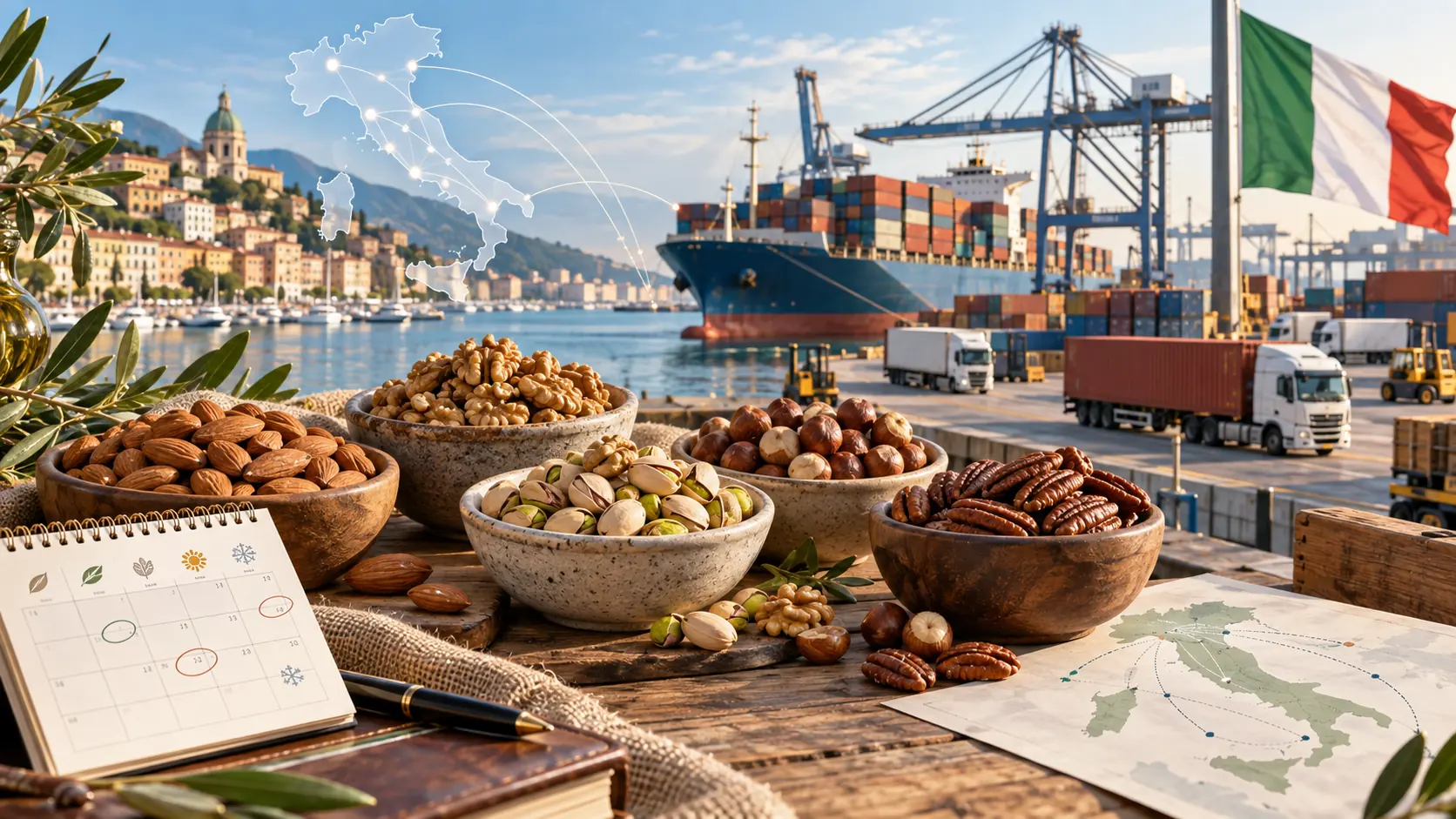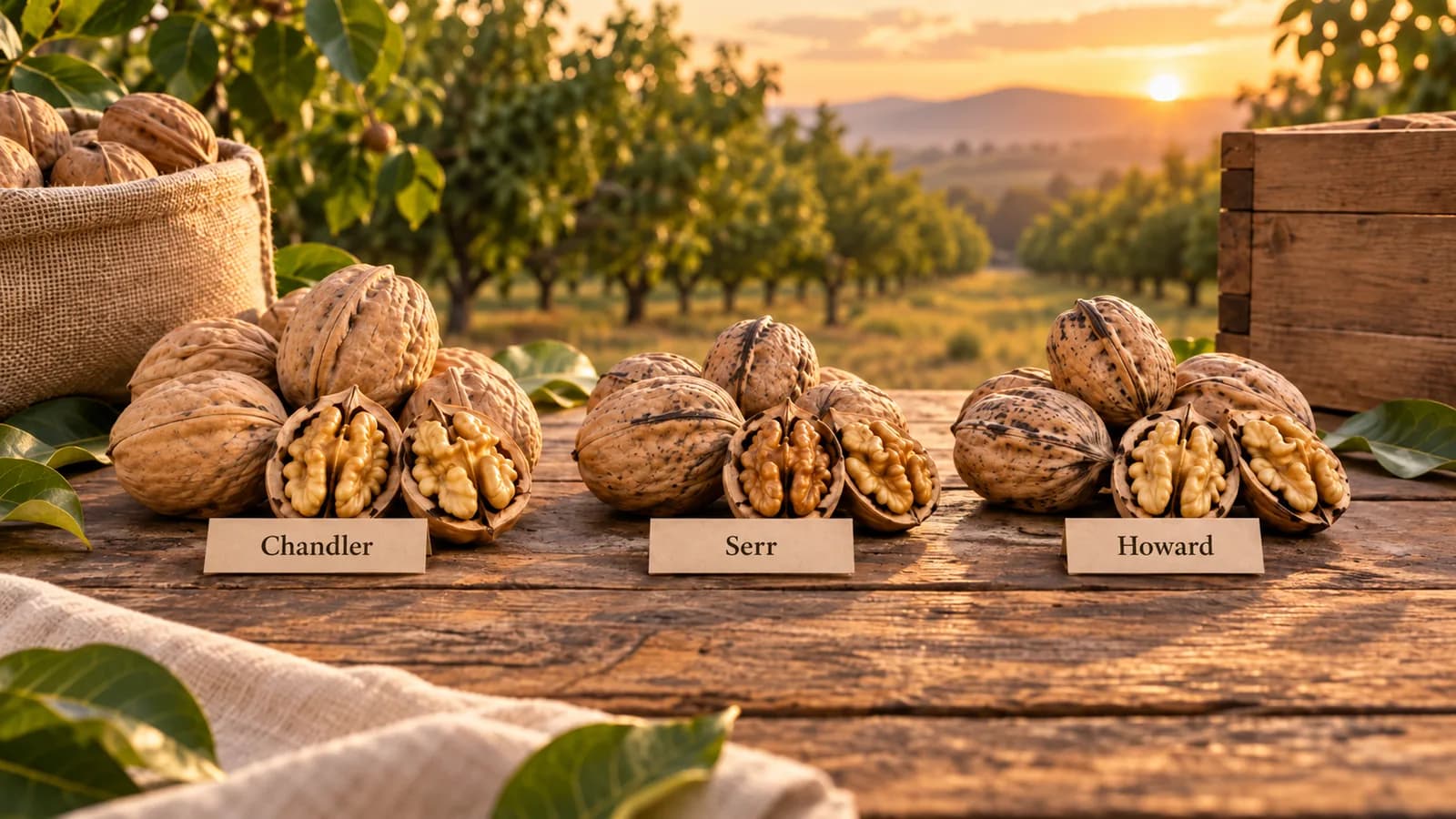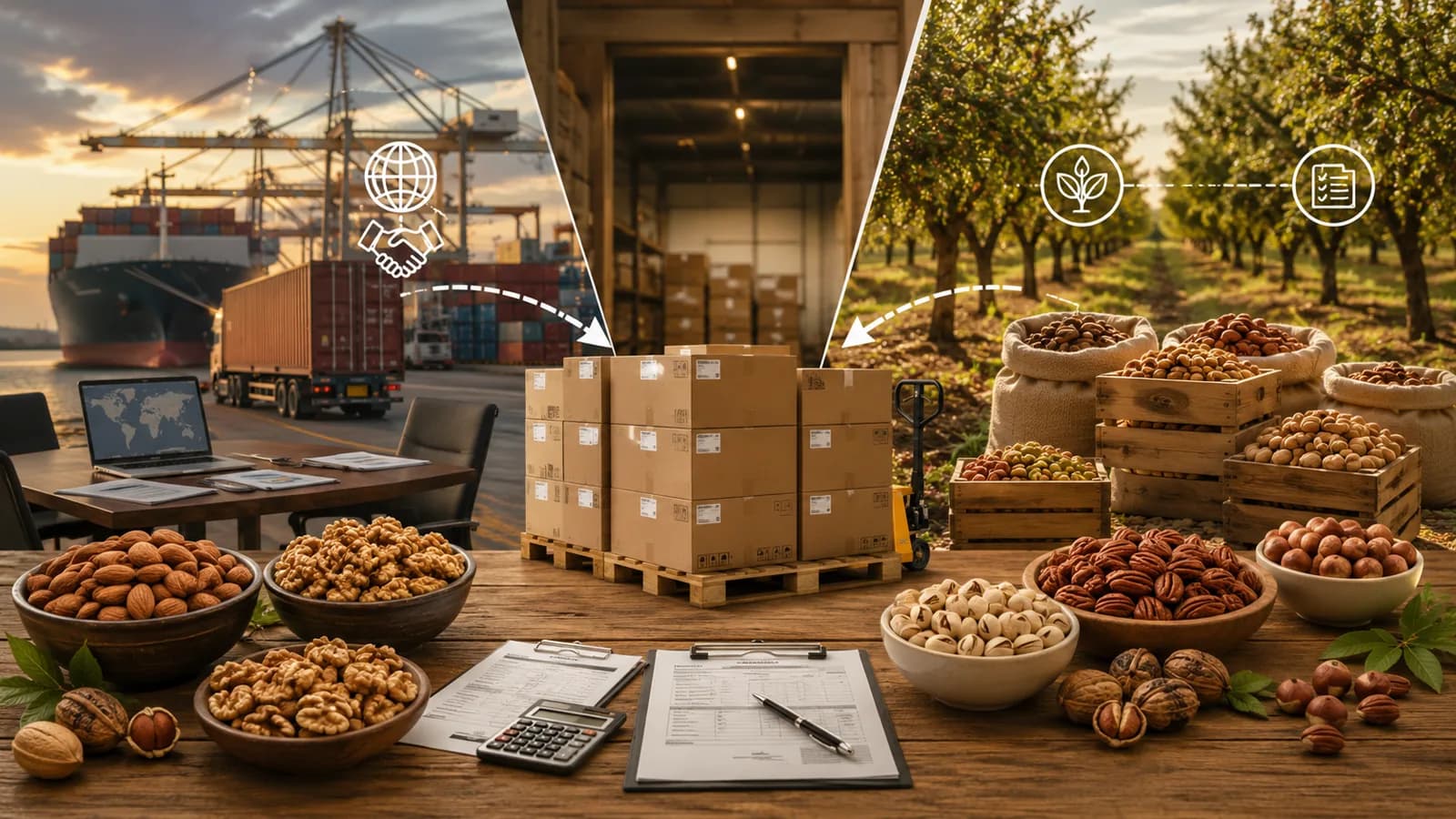
Spain is a particular case within Europe: it grows more tree nuts than almost any other country on the continent — almonds, above all — and still imports at scale. That is not a contradiction: it is a market that consumes more than it grows, with a confectionery industry that needs steady volume and a centuries-old exchange that still sets the reference price for half the Mediterranean.
This article explains how a distributor enters that market: what gets imported, why Reus still matters even though Spain is a producer, where the cargo lands, and which months the nougat campaign is negotiated in.
Why Spain imports despite producing
Spain harvested 373,000 tonnes of almonds in 2024 (campaign figures cited in trade press), one of the largest crops in Europe. But demand from its processing industry — nougat, marzipan, industrial confectionery, snacks — is not covered by the domestic harvest alone, especially in years when the Spanish almond price rises on exchange speculation or a short campaign.
The result is a country that is both grower and buyer at once. In 2025, Spain imported fruit and nuts worth €5.339 billion, 9 % of the country's total food imports, and almonds were the second most valuable line after avocado, at €401 million (data cited in agri-food press). Morocco, the United States and Peru are cited as the main suppliers for fruit and nuts overall, leaving real room for a South American supplier with product available in counter-season.
Reus: why it still shapes negotiation
Any Spanish almond buyer will mention Reus at some point in the conversation, and it pays to understand why before it comes up.
The Reus exchange (Lonja de Reus) is the successor to the historic "Mercat del dilluns" (Monday market), a privilege granted to the city by King James II in 1309 (documented history of the market). Seven hundred years later, it still meets periodically to set reference quotes for up to nine different almond varieties from the Tarragona area, and those quotes are the benchmark the rest of Spain's exchanges use to weight their own prices (Reus exchange's reference role).
For a distributor this has a very direct practical consequence: when a Spanish buyer says "the Reus price went up," they are not making small talk — they are naming the anchor they will use to negotiate any almond lot, domestic or imported. Knowing that reference, not just the origin FOB price, is part of negotiating on equal footing in this market. Our Chilean almond technical sheet includes caliber, color and availability, precisely to make that comparison easier.
Who actually buys
As in Italy, "the Spanish market" is not a single buyer:
1. The nougat (turrón) and marzipan industry. Historically concentrated in Jijona and Alicante (turrón) and Toledo (marzipan), it is the highest seasonal-volume buyer. Turrón remains the favourite Christmas sweet for 69 % of Spaniards, with average consumption of around 600 grams per person a year, and almonds can make up over 60 % of the product in premium turrón (consumption and industry data). It asks for steady supply continuity and a stable technical sheet, not just price.
2. Industrial confectionery and snacks. Bakery, bar and snack plants that buy year-round, not only in the Christmas campaign. It is a less seasonal channel and, for that reason, easier to open with a smaller first order.
3. Wholesale distribution and the horeca channel. Buys to resell to specialist retail, hospitality and artisan bakeries. It decides faster than industry and is the profile closest to the "first container" we have already described for other markets.
Where the cargo lands
The Port of Valencia is the reference logistics node for imported nuts in Spain: it concentrates specialised terminals, a network of nearby warehouses and a high concentration of operators dedicated to dried fruit and nuts, with Argentina and Chile already among the usual origins in its fruit and nut traffic (fruit and vegetable traffic at Valenciaport). It is not a port a newcomer has to discover: the import-export ecosystem for nuts is already built around it.
Barcelona is the natural alternative for anyone also supplying northern Italy or southern France from the same shipment, and it is also the home of Alimentaria, the sector's reference trade fair where we took part in 2026.
The calendar: same logic as Italy, with a twist
As in the Italian market, the Christmas campaign sets the pace of the year, but in Spain the nougat channel concentrates demand even more sharply than in Italy, because turrón — unlike panettone — has almost no consumption outside the season.
That means serious volume negotiations for the Christmas campaign also close between June and September, with the difference that Spain's turrón industry negotiates with more urgency in July-August, exactly when South American almonds and walnuts from the new harvest are already available to ship. It is the same counter-season window we describe for Argentine pecans, applied here to a buyer who needs to close before its European competitors.
What customs will ask for
Spain applies the same EU-wide framework as the rest of the Union:
- Aflatoxins, with the limits in Regulation (EU) 2023/915 as the leading reason for border rejection. The analysis must correspond to the lot actually travelling.
- Sizing and quality under UNECE standards, with the particularity that a Spanish almond buyer will usually compare directly against the Reus quote for that variety and size.
Full detail is in our guide to quality standards for nut imports into the European Union, and who carries freight and risk as far as Valencia or Barcelona is in the Incoterms guide.
Frequently asked questions
Why does Spain import nuts if it is one of Europe's largest almond producers?
Because its processing industry — turrón, marzipan, industrial confectionery — consumes more than the domestic harvest covers, especially in short-campaign years or when the Reus exchange price rises. Spain was one of Europe's largest fruit-and-nut importers by value in 2025, with almonds as its second most relevant line after avocado.
What is the Lonja de Reus and why does it matter to a South American exporter?
It is Spain's reference almond price exchange since 1309, with weekly quotes for up to nine varieties that the rest of the country's exchanges use to weight their own prices. A Spanish buyer will benchmark any import offer against it, so it pays to know it before negotiating.
What is the usual port of entry for nuts from South America?
Valencia, for its concentration of terminals, warehouses and specialised operators, with Argentina and Chile already among its usual traffic origins. Barcelona is the alternative for anyone also distributing into southern France or northern Italy.
Which months are right for negotiating the turrón campaign?
June to September, with the turrón industry closing volume more urgently in July-August, matching the availability of the new South American harvest.
What is the minimum volume to start?
One pallet, around 2,100 kg, same as in our other markets. From there it scales to a full container depending on buyer demand.
Can we buy in euros and on payment terms?
Yes. We operate in euros and the payment structure — advance transfer, cash against documents or letter of credit — is set according to volume and the history of the relationship.
We are looking for distributors in Spain
If you distribute nuts in Spain — turrón industry, industrial confectionery, wholesale or specialist channel — and want a stable counter-season source, let's talk.
The terms are the same as in our other markets: one pallet minimum (around 2,100 kg), FOB, CFR or CIF to a Spanish port, payment by transfer or letter of credit depending on volume, and a technical sheet plus sample before any shipment.
Write to info@raizandina.com or through the wholesale page, stating product, estimated annual volume and destination port. We answer with availability and pricing for your case, not with a generic catalogue.
Raíz Andina is a Milan-based trading company connecting growers in Argentina, Chile and South Africa with importers and distributors across Europe and the Middle East.
A note on the figures: production, import and consumption data come from the sources cited and refer to the periods stated in each case. Volumes and negotiation calendars are industry orders of magnitude, not contractual commitments from Raíz Andina.