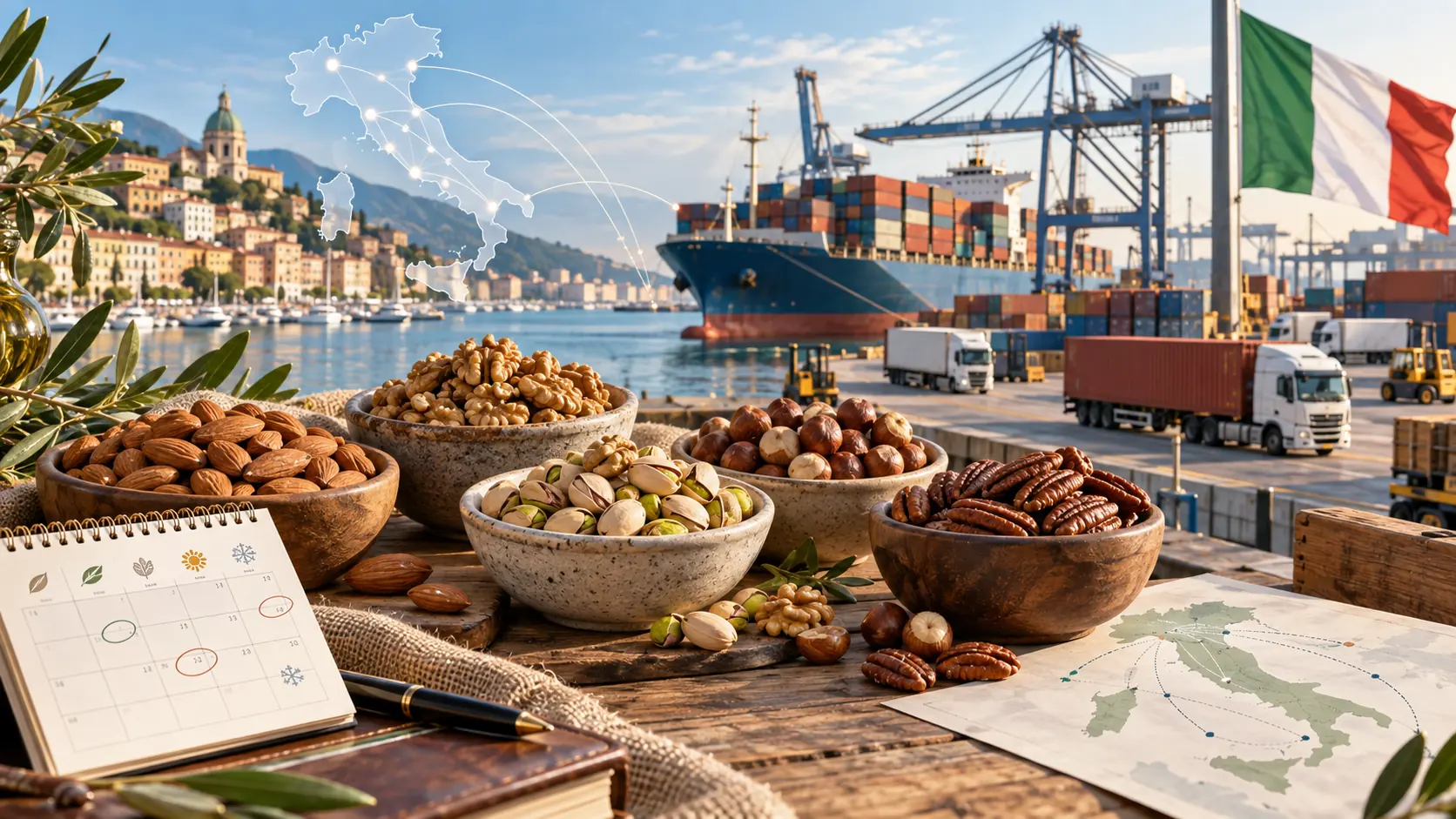
Raíz Andina is based in Milan, so this is not a market we watch from the outside: it is where we answer the phone. And what we see every day is an imbalance that surprises South American growers: Italy is one of Europe's largest nut consumers and its own crop does not come close to covering demand.
This article explains how that market works from the inside: what Italy imports, who exactly buys, which port the cargo lands in and — the thing that organises the whole year — the months when contracts actually close. It is written for the distributor who wants to understand the market before negotiating, and for the producer who wants to sell into it.
Why Italy imports
Italy produces roughly 300,000 tonnes of nuts a year — mostly hazelnuts, where it is a world power, plus almonds and walnuts — and imports remain structural anyway: domestic output does not cover what the industry needs (ICEX market study).
The gap widened in 2025. In the first half of the year nuts grew 12.9 % in volume and 23.9 % in value, and Italian imports of dried fruit and nuts rose 44.5 % in value, driven by tight global supply.
For 2026 the picture is tighter, not easier: the production crisis in hazelnut and almond makes those volumes hard to sustain from European supply. Translated into what matters to a buyer: anyone with available, traceable product has a conversation to be had in Italy.
Who actually buys
"The Italian market" is three different buyers with logics that have little in common. Confusing them is the most expensive mistake on entry.
1. The confectionery industry. Panettone, pandoro, torrone, gelato, pralines. It is the highest-volume buyer and the most demanding on specification: consistent sizing, controlled moisture and, above all, continuity — a plant that has planned a campaign cannot run out of raw material halfway through. Lombardy concentrates 12.8 % of Italy's confectionery industry, which is why so many deals close in Milan.
2. Wholesale distribution. Buys to resell to retail, horeca and small processors. This is the profile that fits a first container best: it decides faster than industry and asks for fewer system certifications.
3. Gourmet and specialist retail. Small volumes, high margins, very sensitive to origin and to the product's story. Here the argument is not price: it is where the walnut comes from and who harvested it.
The three buy different product. Industry wants halves and pieces at a stable price; gourmet wants butterfly halves and large in-shell calibres; the wholesaler wants whatever turns over.
Where the cargo lands
The western Mediterranean concentrates traffic from South America, and the route from Buenos Aires or Valparaíso has been established for decades: selling into Italy requires no logistical invention.
| Port | Region | What it is normally used for |
|---|---|---|
| Genoa | Liguria | The main one for containers from South America; strong links to Lombardy and Piedmont |
| La Spezia | Liguria | Alternative to Genoa, often less congested |
| Livorno | Tuscany | Natural gateway to central Italy |
| Vado Ligure | Liguria | Modern reefer terminal, useful when cold chain is required |
A warning from experience: Genoa has a history of congestion and the discharge schedule should not be taken for granted in peak season. If the contract is CIF Genoa and the delivery date is critical, it is worth agreeing an alternative port in writing.
Reference transit times from the Southern Cone to the Mediterranean run 25 to 35 days depending on origin, carrier and calls. That is an industry order of magnitude, not a promise: what governs the contract is the carrier's confirmation for that specific sailing.
The calendar: why Christmas runs the Italian year
This is the part a South American exporter usually discovers late, and it is what orders the commercial year in Italy.
Italian nut demand peaks hard in the final quarter, because Christmas confectionery — panettone, pandoro, torrone — is an industry in its own right. Panettone consumption grew 5 % in 2024, and large-format retail, which moves 66 % of those purchases, sets the procurement timetable: it starts buying in October and carries on into the early months of the following year.
But industry buys long before the consumer does. To have panettone on the shelf in November, the raw material must be contracted and in the warehouse months earlier. In practice, serious volume negotiations for the Christmas campaign happen between June and September.
And this is where the southern hemisphere fits, not by accident:
| Northern hemisphere | Argentina and Chile | |
|---|---|---|
| Walnut harvest | September-November | April-June |
| Product ready to ship | From November | From May-June |
| Arrival in Italy | December onwards | July-August |
In other words: South American walnuts reach Italy exactly in the window when industry is closing its Christmas campaign, with product from the current year's harvest, while northern hemisphere stock has been in storage for months. That is the commercial argument, and it is not marketing: it is calendar arithmetic. We develop it in the counter-season guide applied to pecans, where the effect is even sharper.
What customs will ask for
Italy applies EU rules, so the framework is the same as the rest of the Union, with two points where deals are won or lost:
- Aflatoxins. The limits in Regulation (EU) 2023/915 are the leading reason for border rejection of nuts. The analysis must come from an accredited laboratory and cover the lot that is actually travelling, not a previous one.
- Sizing and quality. UNECE standards define what each grade may be called. A sizing discrepancy rarely stops a container, but it does open a price negotiation on arrival, which is worse.
The full detail, with limits and documentation, is in our guide to quality standards for walnut imports into the European Union. And if the question is who pays freight and who carries risk as far as Genoa, that is in the Incoterms guide.
Frequently asked questions
Which port do nuts from South America normally enter through?
Genoa, by volume and by its links to the industrial north. La Spezia and Livorno are genuine alternatives, and in peak season it is worth naming them in the contract: Genoa has a history of congestion.
How long does a container take from Argentina or Chile to Italy?
Between 25 and 35 days in transit depending on origin, carrier and calls. That is an industry reference; the date that counts is the one the carrier confirms for that sailing.
Which months are right for negotiating the Christmas campaign?
June to September. Large retail starts buying Christmas confectionery in October, but industry needs the raw material contracted and warehoused well before that. A call in November is late for that campaign.
Why buy from the southern hemisphere if Italy grows hazelnuts?
Because Italy grows hazelnuts, not walnuts or pecans in sufficient volume, and because the South American campaign runs April to June. That means current-crop product exactly when northern hemisphere stock has been in storage for months.
What is the minimum volume to start?
One pallet, around 2,100 kg. That is the smallest quantity that makes logistical sense; from there it scales to a full container.
What certifications does an Italian buyer ask for?
It depends on the channel. Confectionery industry buyers usually ask for system certification and per-lot aflatoxin analysis; a wholesaler is satisfied with the technical sheet and the lot analysis. The gourmet channel asks more about origin than about paperwork.
Can we buy in euros and on payment terms?
Yes. We operate in euros and the payment structure is set in the contract: advance transfer, cash against documents or letter of credit depending on volume and the history of the relationship.
We are looking for distributors in Italy
If you distribute nuts in Italy — industry, wholesale or specialist retail — and want a stable counter-season source, let's talk.
The terms, clear from the start: one pallet minimum (around 2,100 kg), FOB, CFR or CIF to an Italian port, payment by transfer or letter of credit depending on volume, and a technical sheet plus sample before any shipment.
Write to info@raizandina.com or through the wholesale page, stating product, estimated annual volume and destination port. We answer with availability and pricing for your case, not with a generic catalogue.
Raíz Andina is a Milan-based trading company connecting growers in Argentina, Chile and South Africa with importers and distributors across Europe and the Middle East.
A note on the figures: production and import data come from the sources cited and refer to the periods stated in each case. Transit times are industry orders of magnitude and do not replace the carrier's confirmation for a specific sailing.