Most enquiries we get from new distributors do not start with price. They start with something more basic: where do you begin? How much do you have to buy as a minimum, does a pallet or a container make more sense, who books the vessel, when do you pay, what paperwork does customs want, and how long is it from "yes" to goods in the warehouse.
This guide answers those six questions in the order they come up in a real operation. It is written from the trader's side: it is exactly the path we walk with a buyer importing tree nuts from Argentina or Chile for the first time.
1. Before asking for a price: define three variables
No nut quotation can be issued without these three things. If they all arrive in the first email, the proposal goes out the same day; if they are missing, two weeks disappear into back-and-forth.
Product and specification. "Walnuts" is not enough. You need the variety (Chandler, Serr, Howard, Pecan), the presentation (in-shell or shelled kernel), the size or halves grade, and the colour against commercial grading (extra light, light, light amber). If your end customer is industrial bakery, the specification is not the same as for retail snacking.
Volume and frequency. A one-off pallet and an annual four-container programme are not quoted the same way, either on price or on payment terms. Say which one it is, even if the first shipment is small.
Destination and Incoterm. Port or warehouse of destination, and how far you want our responsibility to reach. If that is not clear yet, section 3 settles it.
At Raíz Andina the recommended minimum unit is 1 pallet, around 2,100 kg. Below that we can look at the case —samples and smaller quantities are handled separately— but freight per kilo stops being competitive.
2. Pallet or container: how much is "too little" and how much is "too much"
This is not a matter of taste, it is cost per kilo and stock rotation. These are the three usual entry points:
| Format | Indicative net weight | When it makes sense | Transport mode |
|---|---|---|---|
| 1 pallet | ~2,100 kg | First order, market test, new catalogue reference | Ocean groupage (LCL) or consolidated |
| 20' container | ~19,000–20,000 kg | Distributor with monthly rotation and own warehouse | FCL — full container |
| 40' container | ~24,000–26,000 kg | Annual programme, industry, or a mix of references | FCL — full container |
Raíz Andina operational data, August 2026. Final weight depends on packaging (10 kg cartons, big bags) and on the axle weight limits in force in the destination country.
Three practical criteria:
- Groupage (LCL) is dearer per kilo but far cheaper in total. To validate a variety with your end customer before committing capital, a pallet is the right call even if the unit price stings.
- A full container cuts cost per kilo but ties up stock. Twenty tonnes of shelled walnut is six to twelve months of sales for a mid-sized distributor; the product is stable, but the capital is idle.
- A 40' lets you mix references. You can load Chandler from Argentina and from Chile, or add pecan or almond, in a single shipment. It is the most efficient way to widen your catalogue without multiplying freight.
3. The Incoterm: how far each one reaches
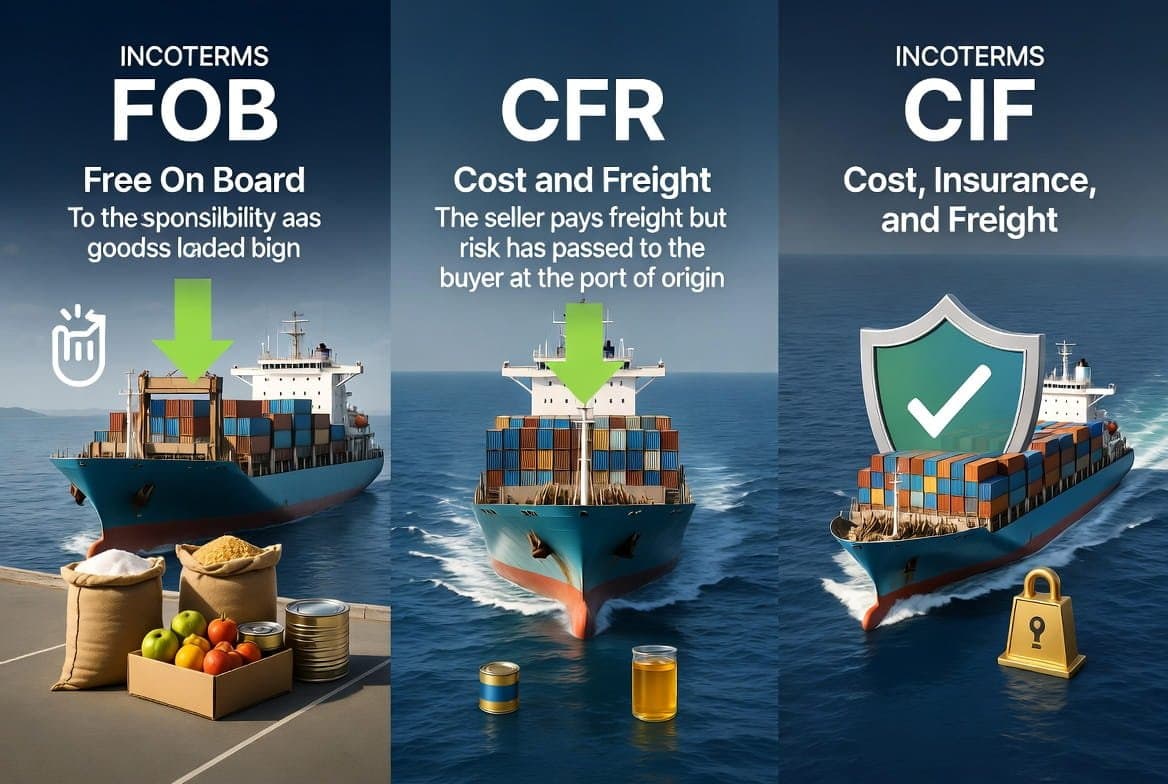
The Incoterm decides two different things that are often confused: who pays for each leg, and at what point risk transfers over the goods. These are the International Chamber of Commerce rules, in their Incoterms® 2020 version.
| Incoterm | Who books the freight | Who pays the insurance | Where risk passes to the buyer |
|---|---|---|---|
| FOB | Buyer | Buyer (optional) | On loading aboard the vessel, port of origin |
| CFR | Seller | Buyer (optional) | On loading aboard the vessel, port of origin |
| CIF | Seller | Seller (minimum cover) | On loading aboard the vessel, port of origin |
| DDP | Seller | Seller | At the agreed place of delivery at destination |
Source: Incoterms® 2020, International Chamber of Commerce (ICC). Consulted August 2026.
The detail that surprises nearly every new importer: under CFR and CIF the risk is already yours from the port of origin, even though the seller pays the freight. If the container is damaged in transit under CFR and you took out no insurance, the loss is yours.
Our recommendation by profile:
- First order, no trusted customs broker: CIF to the port of destination. It arrives at your port with insurance in place and you only handle clearance.
- Distributor with its own operation and a negotiated forwarder: FOB. If your volume gets you better freight rates than ours, use them.
- Buyer who wants a door-to-door price and no customs work: DDP, where the destination allows it.
If this part is new to you, the full breakdown is in our guide to FOB, CIF or CFR for food importers.
4. How payment works
Two instruments cover almost every tree nut transaction:
International wire transfer (T/T). The usual and fastest mechanism. The standard structure combines a down payment on order confirmation and the balance against shipping documents or before arrival. It works for pallets and containers alike, with no meaningful bank cost beyond the transfer fee.
Letter of credit (L/C). A bank guarantees payment against presentation of exact documents. It adds cost and time —opening, advising and discrepancy fees— but it is the right instrument when the amount is high, the relationship is new, or the buyer's exchange-control rules require it. Every word of the text matters: a minor documentary discrepancy can block collection.
In practice most first orders close by wire transfer, and the letter of credit appears once volume scales to recurring containers.
5. The paperwork that travels with the cargo
A food container is not cleared on the invoice alone. This is the pack we issue and that your broker will ask for:
- Commercial invoice and packing list (packages, net and gross weights, lots).
- Bill of Lading (B/L) — the ocean transport document.
- Phytosanitary certificate from the official body in the country of origin.
- Certificate of origin, essential where a tariff preference applies.
- Lot certificate of analysis: aflatoxins, moisture, pesticide residues.
- Additional certifications where applicable: EU organic, Kosher, Halal.
For entry into the European Union, the block that decides whether a container passes or is rejected is quality and contaminants. We cover it in detail in quality standards for walnut imports into the EU.
6. Real timelines
Order of magnitude for a standard South America to Europe operation, with no incidents:
| Stage | Indicative time |
|---|---|
| Enquiry → quotation | 24–48 h |
| Quotation → confirmation and down payment | Buyer's pace |
| Preparation, quality control and consolidation | 1–3 weeks |
| Ocean transit South America → Europe | 4–6 weeks |
| Clearance at destination | 2–10 days |
Indicative Raíz Andina timings, August 2026. They vary with stock availability, the route and the level of border control.
There is one commercial reading of that table: plan two months ahead. A distributor who calls once already out of stock is late for the next sailing.
7. When to buy: the southern hemisphere window
The Argentine and Chilean harvests run from February to May, with commercial availability extending from March–April into December depending on variety and origin. That means recent-crop product in the second half of the year, exactly when northern hemisphere stock has been months in storage.
For a European distributor that is the strongest rotation argument South American origin has: new crop at a point in the calendar where the alternative is last year's product. Chandler walnut from Argentina is the reference most of our new customers start with.
Frequently asked questions
What is the minimum order?
The recommended minimum unit is 1 pallet, around 2,100 kg. For smaller quantities or samples, ask us: they are looked at case by case depending on destination and product.
Do you send samples before the order?
Yes. We send samples and the lot technical sheet so your quality team can validate specification, size and colour before confirming a shipment.
Which Incoterm suits a first order?
CIF to the port of destination in most cases: freight and insurance are covered and the buyer only handles import clearance. If you already have your own forwarder on good rates, FOB usually works out better.
Can I pay by letter of credit?
Yes. We work with international wire transfer and with letters of credit. Transfer is standard for first orders; an L/C makes sense when the amount is high or the commercial relationship is new.
How long does a container take to reach Europe?
Six to ten weeks from confirmation, adding preparation, ocean transit and clearance at destination. Plan the purchase around two months ahead of the date you need the stock.
Can I mix several products in one container?
Yes. A 40' container can combine varieties and origins —Chandler from Argentina and Chile, or adding pecan and almond— in a single shipment and a single freight.
What documentation comes with each shipment?
Invoice, packing list, B/L, phytosanitary certificate, certificate of origin and lot certificate of analysis (aflatoxins, moisture and residues), plus any specific certifications the destination market requires.
Getting started
We are looking for distributors, importers and food industry buyers in Europe, the Middle East and the Americas. Entry conditions: from 1 pallet (~2,100 kg), quotations in FOB, CIF, CFR or DDP, and payment by international wire transfer or letter of credit.
If product, volume and destination are clear, write to us and we will prepare the proposal: request a quotation. If you would rather see how we work on volume, terms and process first, it is all on Wholesale.