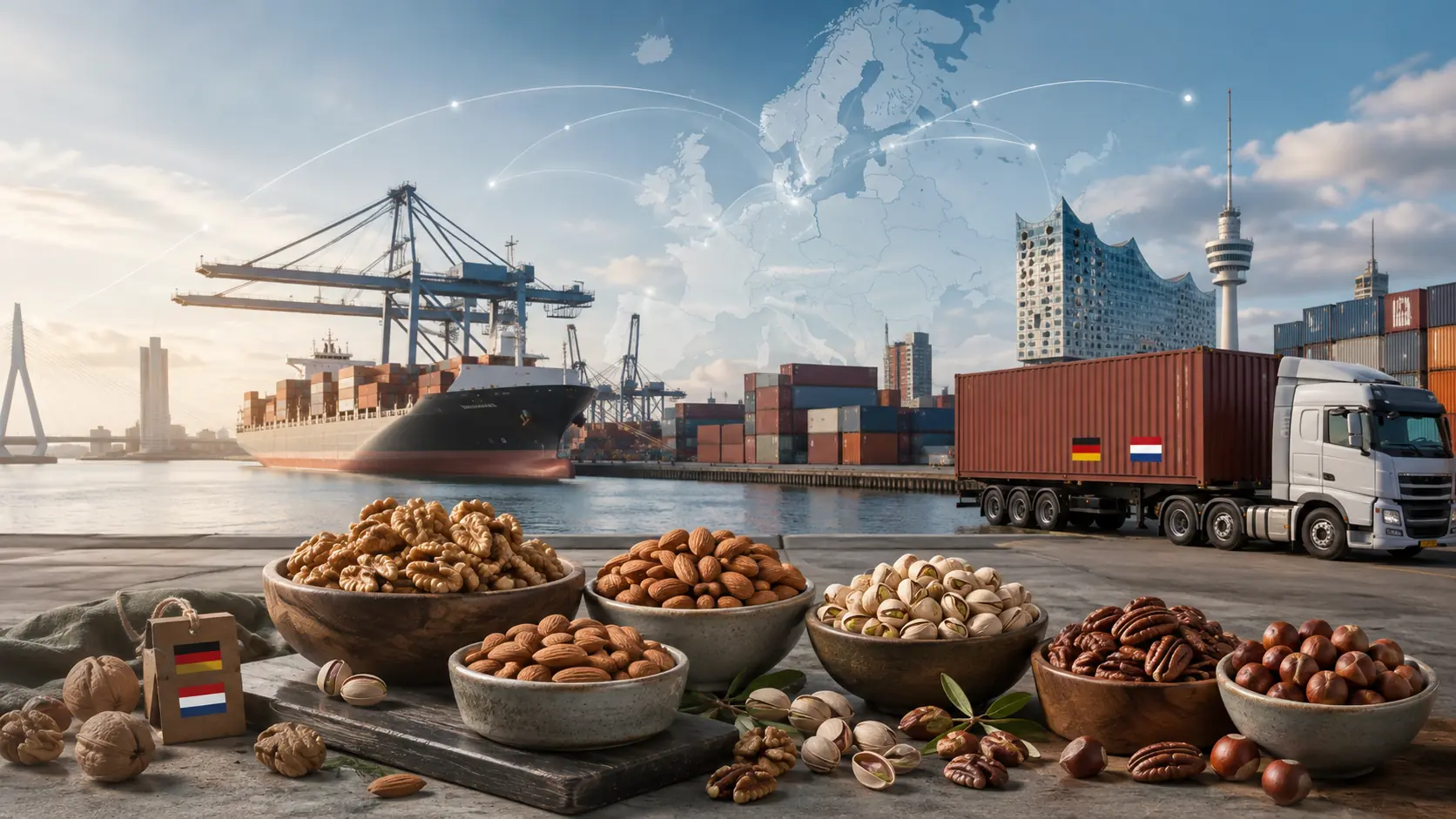
On the European tree nut map there is a pair of countries that works as a single system: Germany supplies the demand and the Netherlands supplies the door. The EU's largest consumer market has no great ocean port of reference for this category; the country with Europe's largest port has 18 million inhabitants and resells much of what it imports. Understanding how the roles are shared is worth more than analysing either country on its own.
This guide covers what an exporter or B2B buyer needs in practice: who buys what in Germany, how to read the Dutch statistics without fooling yourself, when to discharge in Rotterdam and when in Hamburg, what Europe's strictest market demands on quality, and in which windows of the calendar southern hemisphere origin competes best.
1. Germany: the largest — and most demanding — demand in the EU
The European Union imported around USD 7.1 billion in tree nuts in 2024, and Germany is its leading consumer market. Unlike southern Europe —where in-shell walnuts for direct consumption carry real weight, as we saw in the Italian case—, the German buyer is above all industrial and retail-driven: it buys kernel (shelled), in volume, against a closed specification and an annual programme.
Three traits define that demand:
First: it is a kernel market, not an in-shell market. Industrial bakery, muesli and cereal manufacturers, confectionery and snacking absorb most of the volume. That favours consistent sizes, light colour (extra light/light in commercial grading) and whole halves for the premium segment — exactly the profile of a Chandler walnut from Argentina or from Chile.
Second: retail is dominated by discount. Aldi, Lidl and the big groups (Edeka, Rewe) concentrate a share of food retail without equivalent in western Europe. For the supplier this means two things: genuine volume contracts under constant price pressure, and quality audits that do not forgive a single out-of-spec lot.
Third: Europe's largest organic market. Germany's organic food market runs at around €16 billion a year, according to the sector federation BÖLW. In tree nuts, the organic segment pays real premiums — but demands EU organic certification at origin and, in practice, compliance with the private standards of the BNN association, stricter than the public rules on residues and contaminants.
For the southern hemisphere, the commercial reading is direct: Germany does not buy "walnuts", it buys documented specification with continuity of supply. Price matters, but a weak certificate of analysis disqualifies you faster than a high price does.
2. The Rotterdam effect: how to read the Dutch statistics
Anyone looking at import figures by member state runs into an anomaly: the Netherlands, with 18 million inhabitants, ranks among Europe's largest importers of tree nuts. The explanation is logistical, not consumption-driven, and it has a name of its own in the trade literature: the Rotterdam effect.
A substantial share of what enters through Dutch ports does not stay in the country: it clears customs, gets processed or repacked, and is redistributed to Germany, Scandinavia, France and central Europe. The Netherlands also concentrates a unique density of specialised traders, roasters and processors in the Rotterdam–Zaandam corridor, the inheritance of centuries of overseas trade.
The operational implications for an exporter:
- The Dutch importer buys to resell. A professional client, fast to decide, who knows the product as well as the seller and benchmarks every origin at once. An excellent first door into the continent; thinner margins than selling direct to industry.
- "Destination Netherlands" statistics do not measure Dutch consumption. When sizing the real market, look at the re-export flow, not the raw customs figure.
- Selling to a Rotterdam trader and selling to a German industrial buyer are two different operations — in price, in documentation and in relationship. The first is transactional; the second is an annual programme with audits.
3. Logistics: Rotterdam, Hamburg and choosing the door
The two ports
| Criterion | Rotterdam | Hamburg |
|---|---|---|
| Annual traffic | Over 13 million TEU — Europe's largest | Close to 8 million TEU |
| Strength | Intercontinental connections, river barges up the Rhine | Direct rail access to southern Germany, Czechia, Austria and Poland |
| Natural hinterland | Benelux, Rhineland, the Ruhr basin | Northern and eastern Germany, central Europe |
| Product ecosystem | Nut traders and processors around the port | Northern Germany's food industry |
The practical rule: if the end client sits in the Rhine basin or the destination is a trader, Rotterdam; if the destination is industry in Bavaria, Saxony or central Europe, Hamburg usually saves the most expensive overland leg. The Port of Rotterdam moves containers into the German interior by river barge at per-tonne costs road transport struggles to match; Hamburg is historically central Europe's rail port.
Transit times from South America
- From the Atlantic (Buenos Aires, Montevideo, Santos): 18–24 days to Rotterdam or Hamburg.
- From Chilean ports (Valparaíso, San Antonio), via Panama: 25–32 days.
On who bears freight, insurance and risk on each leg —and why "CIF Rotterdam" with no small print is a source of disputes—, see our Incoterms guide for food importers.
4. Quality: the public bar and the private bar
The public framework is the EU-wide one — aflatoxin limits under Regulation (EU) 2023/915, pesticide MRLs, border controls — covered in detail in Quality standards for walnut imports into the European Union. What is specific to northern Europe is that the private bar sits above the public one:
- In-house or contracted laboratories. Large German buyers test the goods themselves on arrival. A certificate from origin does not replace their counter-sample; the match between the two builds (or destroys) the relationship.
- BNN for the organic segment. The association of organic food wholesalers publishes orientation values for residues stricter than public MRLs. Anyone targeting the German Bio channel must know them before quoting, not after the rejection.
- Lot-level traceability as an entry requirement. Lot code, season, drying process and a documented chain of custody. In discount retail, supplier audits include the ability to execute a selective recall within 24 hours.
- Sustainability on the rise. Carbon footprint questionnaires and supply chain due diligence (Germany's LkSG law applies to the large buyers) are already part of supplier onboarding.
5. Tariffs: the 2026 window
Two recent moves change the calculation for South American origin:
- Chilean walnuts: 0% for two decades under the EU–Chile agreement. It is the benchmark everything else competes against.
- Argentine walnuts: the gap is closing. With provisional application of the EU–Mercosur Interim Trade Agreement from 1 May 2026, tree nut tariff lines —not classed as sensitive products— begin their phase-out. The historic 4–5 point differential Argentine walnuts paid against Chilean ones (roughly €4,400–5,500 per 20-tonne container of kernel) is set to disappear. The timeline, legal risks and rules of origin are in our analysis of the EU–Mercosur agreement.
For the German or Dutch buyer this means being able to diversify origin without a tariff penalty: Argentina and Chile move to a level playing field against California, with counter-seasonality in their favour.
6. Northern Europe's commercial calendar
The Christmas peak (September–December) concentrates the in-shell walnut campaign and retail mixes. Contracts close between May and July; whoever shows up in October to offer is offering for next year's campaign.
Industry buys all year round, but its point of maximum receptiveness to the southern hemisphere is the second quarter: the South American harvest (February–April) reaches Europe just as northern hemisphere kernel turns six or seven months old. Fresh against old, in the category where oxidative rancidity shows first — the counter-seasonality argument we also develop for the Gulf market.
The fairs that order the year:
| Fair | City | When | What for |
|---|---|---|---|
| Anuga | Cologne | October, odd years | Europe's largest food fair; retail and industry |
| Biofach | Nuremberg | February, annual | The world reference for the organic segment |
| PLMA | Amsterdam | May, annual | Private label: the door to the discounters |
7. Operational checklist: first container to northern Europe
Before quoting
- Define the channel: Dutch trader, German industry or retail? Documentation and target price change with the answer.
- Verify the tariff line and the state of the Mercosur phase-out in TARIC for the current season.
- If the destination is organic: EU organic certification for the lot and a review of the BNN orientation values.
Before shipping
- Aflatoxin and multi-residue testing at an ISO 17025 accredited laboratory, on the lot to be shipped. Keep a sealed counter-sample.
- Port of discharge chosen by the end client's hinterland (§3), named precisely in the contract together with the Incoterms version.
- Packaging with an adequate barrier for transit and extended storage: vacuum bags or modified atmosphere; textile sacks disqualify you in this market.
On arrival
- Anticipate the client's counter-sample: sharing your own certificate before arrival speeds up their internal release.
- In annual programmes, schedule partial deliveries: the German buyer values the punctuality of twelve deliveries more than the price of one.
8. Conclusion: what northern Europe really buys
Germany and the Netherlands form the most professionalised import system in the world for this category: the first contributes the EU's largest consumption volume with the highest quality bar; the second, the infrastructure and the commercial knowledge to move it. It is not a market of opportunity — it is a market of programmes: closed specification, impeccable documentation, punctual deliveries, year after year.
For a South American exporter the natural entry is twofold: the Dutch trader to build volume and learn the standard, German industry to consolidate margin once the documentation speaks for itself. With the Mercosur phase-out underway and counter-seasonality as a structural advantage, 2026 opens the best window in two decades for Argentine origin in northern Europe.
Frequently asked questions
Why is Germany Europe's leading tree nut market?
Because it combines the EU's largest consumption volume with a processing industry —bakery, muesli, confectionery, snacking— that buys kernel all year round, large-scale retail dominated by the discounters, and Europe's biggest organic food market at around €16 billion a year. Germany grows almost no walnuts: virtually all of its consumption is imported.
What is the "Rotterdam effect" and how does it distort import statistics?
It is the distortion large transit ports produce in trade statistics: the Netherlands ranks among Europe's biggest tree nut importers, but a substantial share of that volume is cleared, processed and re-exported to Germany, Scandinavia and central Europe. The Dutch customs figure measures the door, not the country's consumption.
Should I discharge in Rotterdam or Hamburg?
It depends on the cargo's final destination. Rotterdam —Europe's largest port, with over 13 million TEU a year— dominates the Rhine and Benelux hinterland and concentrates the sector's traders; Hamburg, with its rail network, is usually more efficient for clients in southern and eastern Germany and central Europe. The right choice saves the most expensive overland leg of the chain.
What quality requirements does the German market impose on walnuts?
The EU public framework —aflatoxins under Regulation (EU) 2023/915, pesticide MRLs, lot-level traceability— is only the starting point. Large German buyers test the goods themselves on arrival, and the organic channel applies the BNN association's orientation values, stricter than the public rules. The exporter's analytical documentation must anticipate that counter-sample, not react to it.
When is the best time to ship tree nuts to northern Europe?
For the Christmas in-shell campaign, contracts close between May and July with deliveries from September to November. For industry, the southern hemisphere's structural window is the second quarter: the South American harvest of February–April reaches Europe two to three months old, just as northern hemisphere kernel passes the half-year mark.
What tariff advantage do South American walnuts have in the EU from 2026?
Chilean walnuts have entered at 0% for two decades under the EU–Chile agreement. From 1 May 2026, provisional application of the EU–Mercosur Interim Trade Agreement starts the phase-out on Argentine lines, closing a historic 4–5 percentage point differential — roughly €4,400–5,500 per 20-tonne container of kernel. The preference requires meeting the rules of origin and presenting the corresponding statement.
Sources
- Port of Rotterdam — Facts and figures
- Hafen Hamburg — Port statistics
- BÖLW — German organic market sector report
- BNN — Bundesverband Naturkost Naturwaren, orientation values
- INC — International Nut and Dried Fruit Council, category statistics
- Eurostat — EU external trade
- Regulation (EU) 2023/915 on maximum levels for contaminants — EUR-Lex
- Anuga · Biofach · PLMA
Related articles
- → Quality standards for walnut imports into the European Union — aflatoxins, MRLs and border controls in detail
- → EU–Mercosur agreement 2026: what is confirmed and what remains open — the phase-out closing the Argentine gap
- → FOB, CIF or CFR: an Incoterms guide for food importers — who bears what through to Rotterdam or Hamburg
- → United Arab Emirates: the gateway for premium nuts into the Gulf — the other great re-export hub
- → Glossary of trading, quality and product terms
Do you supply the German or Dutch market?
At Raiz Andina we work with Chandler walnuts from Argentina —with the Mercosur phase-out underway—, zero-tariff Chandler walnuts from Chile, Serr, Howard for programmes with long storage, and Argentine pecans, in FCL volumes with analytical documentation built against European specification.
If you manage purchasing for industry, retail or distribution in northern Europe, let's talk about your next programme or review our wholesale terms.
Raiz Andina is a trading company based in Milan, specialising in connecting South American producers with importers and distributors in Europe and the Middle East. We operate with complete transparency in commercial terms, logistics and documentation.
Disclaimer: This article is informative and educational in nature. It does not constitute legal, customs or regulatory advice. Tariffs, phase-out schedules and private quality requirements may change; verify the conditions in force with your importer and a specialist freight forwarder before shipping.