Introduction
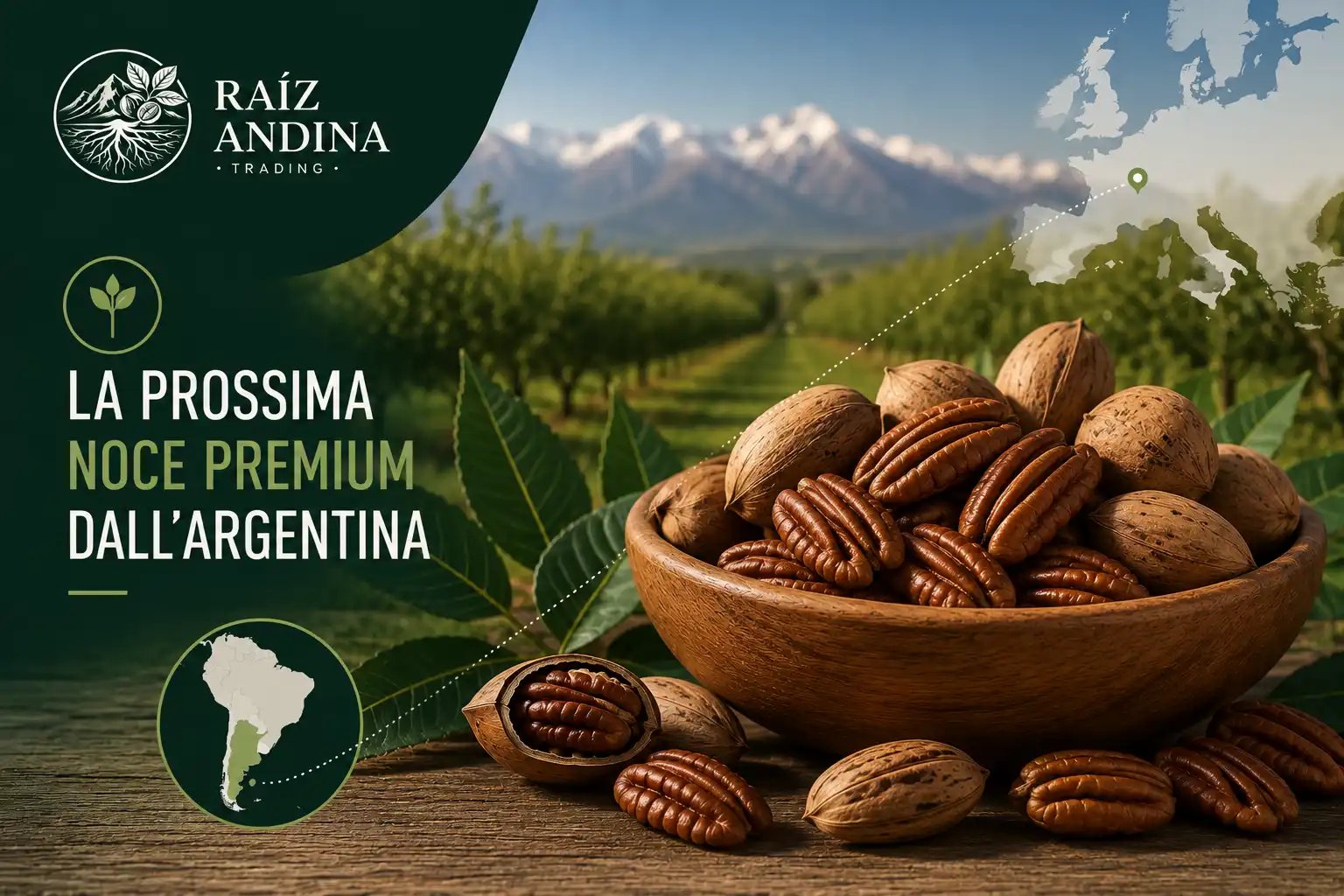
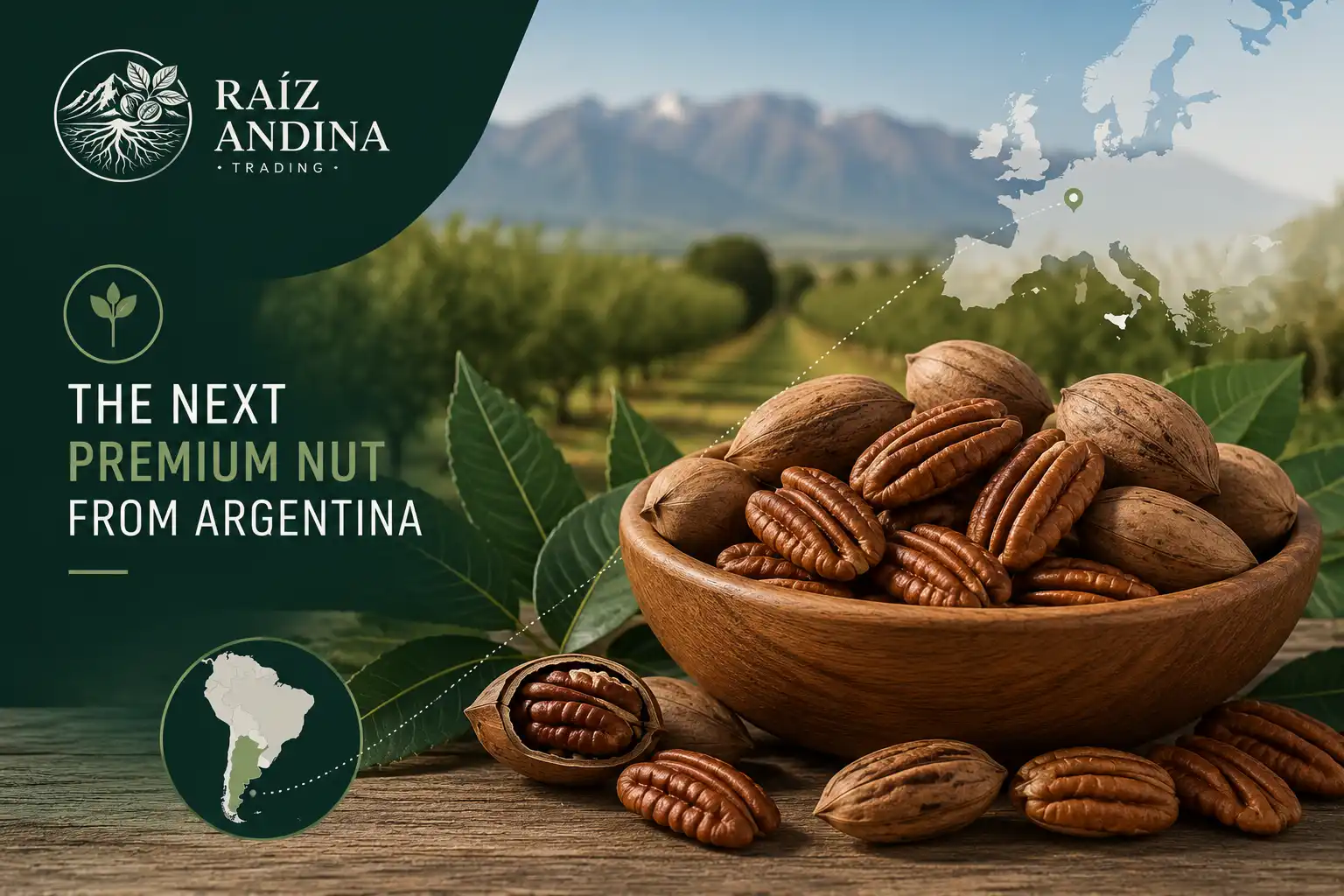
When a European buyer of tree nuts thinks “walnut,” they almost always picture Juglans regia: the common walnut, the Chandler, the one that dominates the shelves and pastry recipes across the continent. But there is another tree nut gaining ground fast in the European food industry that few buyers know in depth: the pecan (Carya illinoinensis).
Although it is a tree nut in every regulatory sense, the pecan does not come from the common walnut tree. It is the fruit of a different tree, with its own sensory and nutritional profile, and with a commercial characteristic that makes it especially attractive to the European importer: Argentina produces it counter-seasonally to the Northern Hemisphere, precisely when the United States and Mexico —the two giants of the sector— are out of season.
This article explains what the pecan is, how it technically differs from the common walnut, how Argentine production is evolving, which commercial varieties are grown, and why it represents a concrete opportunity for distributors, confectionery manufacturers and importers looking to diversify their premium tree nut offering.
What the pecan is and why it is not a common walnut
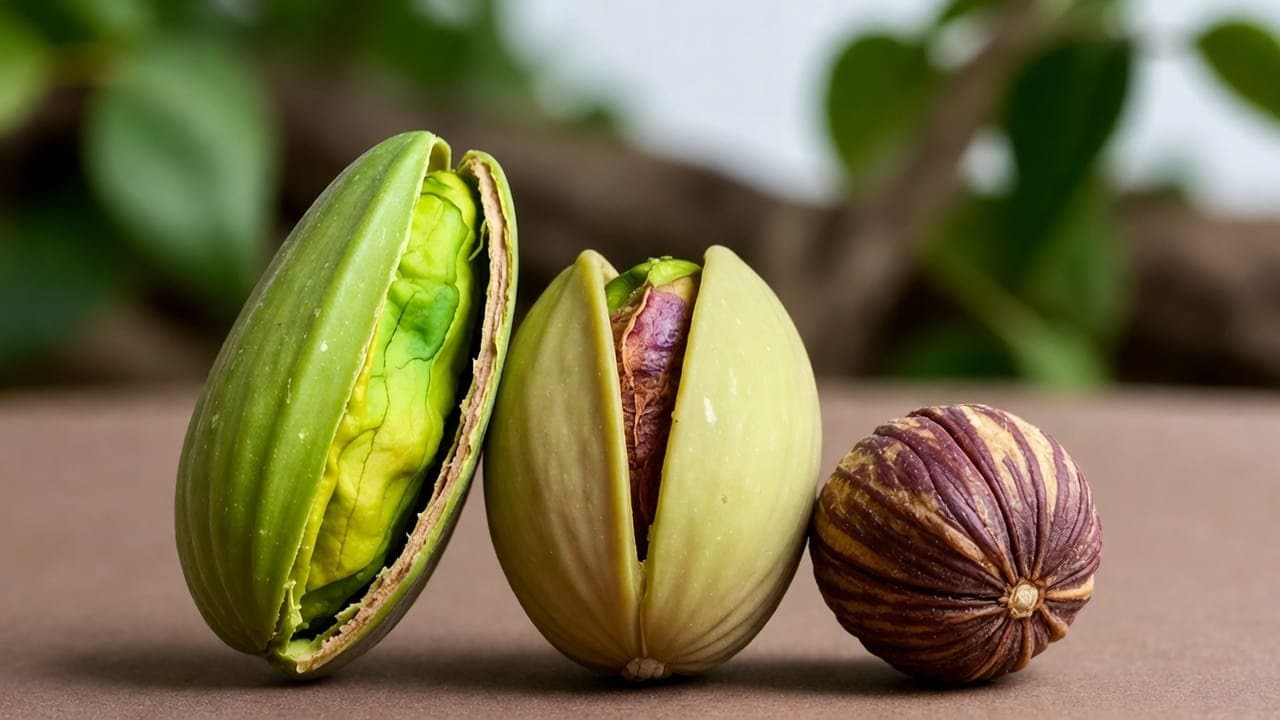
Although it is commercially known as a “pecan nut,” this fruit does not come from the common walnut tree (Juglans regia), but from the pecan tree (Carya illinoinensis), a tree of the same botanical family —Juglandaceae— but a different genus: Carya rather than Juglans. It is native to the Mississippi-Missouri river basin in the south-central United States, where it was a staple food of the native peoples long before its commercial cultivation.
This shared family explains a practical issue relevant to the food industry: both fall within the tree nut group for allergen-labelling purposes. Regulation (EU) 1169/2011 lists in Annex II both the common walnut (Juglans regia) and the pecan nut (Carya illinoinensis). As a result, cross-reactivity between walnuts and pecans is possible, and for products destined for the European market both must be clearly declared as allergens in the ingredient list.
The visible and sensory differences, however, are clear:
- Shape: the pecan has an elongated, smooth shell, dark brown in colour; the walnut is rounder and more wrinkled.
- Flavour: the pecan is noticeably sweeter and more buttery, with less bitterness; the walnut has a more earthy, slightly astringent profile.
- Texture: the pecan is softer and more unctuous; the walnut, firmer.
- Culinary use: both are interchangeable in baking, but the pecan excels especially in confectionery, ice cream, chocolate and sweet baked goods, where its natural sweetness reduces the need for added sugar.
This versatility makes it an ingredient sought after by the value-added industry, not just by the snacking channel.
Nutritional profile: pecan versus common walnut
For the industrial buyer, compositional differences matter as much as sensory ones, because they determine stability, shelf life and the positioning of the final product. These are the key contrasts between the two nuts (approximate values per 28 g / 1 ounce, USDA source):
| Parameter | Pecan | Common walnut |
|---|---|---|
| Calories | ~196 kcal | ~185 kcal |
| Total fat | ~20 g | ~18.5 g |
| Monounsaturated fat | ~11.5 g | ~2.5 g |
| Polyunsaturated fat (omega-3/6) | lower | higher |
| Protein | ~2.7 g | ~4.3 g |
| Fibre | ~2.7 g | ~2.0 g |
| Vitamin E (alpha-tocopherol) | ~0.4 mg | ~0.2 mg |
The commercial reading of these figures is as follows:
The pecan is a monounsaturated-fat powerhouse —the same stable type of fat found in olive oil and avocado, with nearly five times the content of the common walnut. This carries an important technical implication: monounsaturated fats are more stable against oxidation, which translates into a lower tendency to go rancid under proper storage conditions.
The common walnut, on the other hand, is richer in polyunsaturates and omega-3 (ALA) and in protein. It is the reference tree nut for “cardiovascular and brain health” positioning, but its polyunsaturated lipid profile makes it more sensitive to oxidation, which demands stricter storage control.
A clarification on vitamin E, often a source of confusion: the pecan is very rich in gamma-tocopherol (~24 mg per 100 g), a powerful antioxidant that —together with flavonoids— protects its fats from oxidation. However, gamma-tocopherol is not officially counted as “vitamin E” for daily-requirement purposes, because the body does not convert it into alpha-tocopherol. In terms of alpha-tocopherol —the form that officially counts as vitamin E— the pecan provides a modest amount (~0.4 mg per 28 g), similar to that of the walnut. Its differential advantage over the common walnut therefore lies in its higher proportion of monounsaturated fat, not in vitamin E.
Neither is “better” in absolute terms: they are complementary profiles. For an industry seeking a sweet, stable and versatile tree nut for confectionery applications, the pecan offers concrete advantages.
Argentine production: a regional economy on the rise
In two decades, Argentina has gone from having virtually no commercial pecan cultivation to becoming a consolidating South American origin. The take-off gained momentum from the year 2000 with the INTA PROPecán Project, which introduced US varieties and adapted them to the country’s diverse production environments —warm-humid, warm-dry and cold.
The sector’s current figures, according to estimates from CAPPECÁN (the Argentine Chamber of Pecan Producers) and INTA:
- Planted area: around 12,000 hectares.
- Estimated annual production: around 3,000 tonnes.
- Export orientation: approximately 65% is destined for export; the remaining 35% supplies the domestic market (according to some provincial sources, the exported share exceeds 85-90%).
- Cultivated varieties: between 10 and 12 commercial cultivars.
A key structural fact for the buyer: much of this area is not yet in full production. Many orchards are young —a pecan tree begins to bear fruit around its fifth year and reaches peak yield between 15 and 25 years— which means the available volume will grow steadily over the coming years, even without new plantings. CAPPECÁN estimates that production could climb towards 10,000 tonnes as the orchards mature (a sectoral projection, not a confirmed figure).
Where it is produced
Entre Ríos is the productive heartland: it concentrates around 60% of the nationally planted area, with hubs in Villa Paranacito, San José, Crespo, Gualeguay and Concordia, leveraging the infrastructure of the Paraná Delta. Buenos Aires and Santa Fe complete the historical core of the Litoral region.
Over the last decade, however, cultivation has expanded towards the north-west and other regions: Corrientes, Misiones, Córdoba, Catamarca, Salta, Santiago del Estero, Tucumán and Chaco. The north-west stands out for a high level of technification —pressurised irrigation, high density, mechanisation— and for an additional logistical advantage: proximity to Pacific ports for shipping product to South-East Asia.
The decisive advantage: counter-seasonality
This is the central commercial argument for the European importer. The pecan is grown mostly in the Northern Hemisphere —the United States and Mexico together account for roughly 88-90% of global exports, depending on the campaign, according to sectoral estimates based on USDA/FAS data (Mexico ~56%, US ~32%)—, with harvest between boreal autumn and winter.
Argentina, being in the Southern Hemisphere, harvests counter-seasonally: harvesting begins in April, peaks between June and July, and product destined for export is delivered from the start of the harvest through to February or March of the following year.
This means a European importer can access recently harvested pecans (fresh crop) mid-year, precisely when Northern Hemisphere stock has been in storage for months. For a tree nut whose freshness and lipid stability are selling points, counter-seasonality is not a detail: it is a structural competitive advantage.
It is exactly the same logic that has allowed South American walnuts to conquer new markets such as India and Dubai, now applied to a product with less competition and greater room for differentiation.
Commercial varieties grown in Argentina
Argentina produces certified cultivars, selected for their agroclimatic adaptation and commercial behaviour. The varieties differ mainly in fruit size, kernel colour and harvest timing (there are early and late cultivars). Among the most relevant:
- Pawnee: an early-harvest variety, large fruit, in high demand for export. It was the one chosen for the first shipment of Argentine pecans to China.
- Stuart: a traditional, robust cultivar of good calibre and wide adaptation.
- Kiowa, Sumner, Oconee, Cape Fear, Choctaw, Desirable: cultivars introduced and evaluated by INTA and EEAOC, present in different regions according to genotype-environment fit.
An agronomic feature with quality implications: the pecan requires cross-pollination between cultivars with different flowering times, which is why orchards combine multiple varieties. This varietal diversity, well managed, allows harvests to be staggered and different calibres and profiles to be offered throughout the campaign.
For the buyer, the important thing is to specify variety, calibre and format (in-shell or shelled) in the purchase specification, exactly as is done with the quality standards governing walnut imports into the European Union.
Commercial formats: in-shell and shelled
The pecan is marketed in two main formats, with different market logics:
In-shell: the higher-volume, lower-unit-value format. China is the world’s leading market for in-shell pecans, and in 2025 Argentina completed its first export to that destination (Pawnee variety, with phytosanitary clearance from China’s GACC handled through SENASA).
Shelled (kernels): the higher-value-added format, and the central strategy of the Argentine sector to multiply product value and develop local industrial capacity. Shelled pecans are exported to the Netherlands, Lithuania, Turkey, the United States, Brazil, Egypt, Algeria, Vietnam, Thailand and Saudi Arabia, among others.
For the European confectionery and ingredients industry, the shelled format —in halves or pieces— is of greatest interest, since it goes straight into the production line without the cost of shelling.
A critical point in both formats is storage. Because of its high fat content, shelled pecans must be kept in cool, dry environments protected from light and external odours, to preserve their organoleptic characteristics and prevent rancidity. In airtight packaging and refrigeration they keep for several months; frozen, up to two years. It is the same principle of cold-chain and humidity control that applies to any premium tree nut destined for markets with demanding quality requirements.
The regulatory and logistical framework of importing
Importing pecans into the European Union follows the same rules as any tree nut of South American origin. Three fronts to keep in mind:
Food safety: the pecan, as a tree nut, is subject to the aflatoxin and other contaminant limits of the European framework. It is advisable to require pre-shipment analysis and lot traceability in every operation, especially because post-harvest quality —drying, sorting, storage— is decisive for meeting European thresholds.
Phytosanitary documentation: SENASA is the body that certifies the health status of Argentine tree nuts at every stage of the chain, from planting to export. The phytosanitary certificate accompanies each shipment.
Cost structure and Incoterms: as in any international trade operation, defining the Incoterm correctly determines who bears the freight, the insurance and the risk on each leg. Before closing a pecan purchase, it is worth being clear on whether to operate FOB, CIF or CFR and what each option implies in terms of responsibility and risk along the transport route.
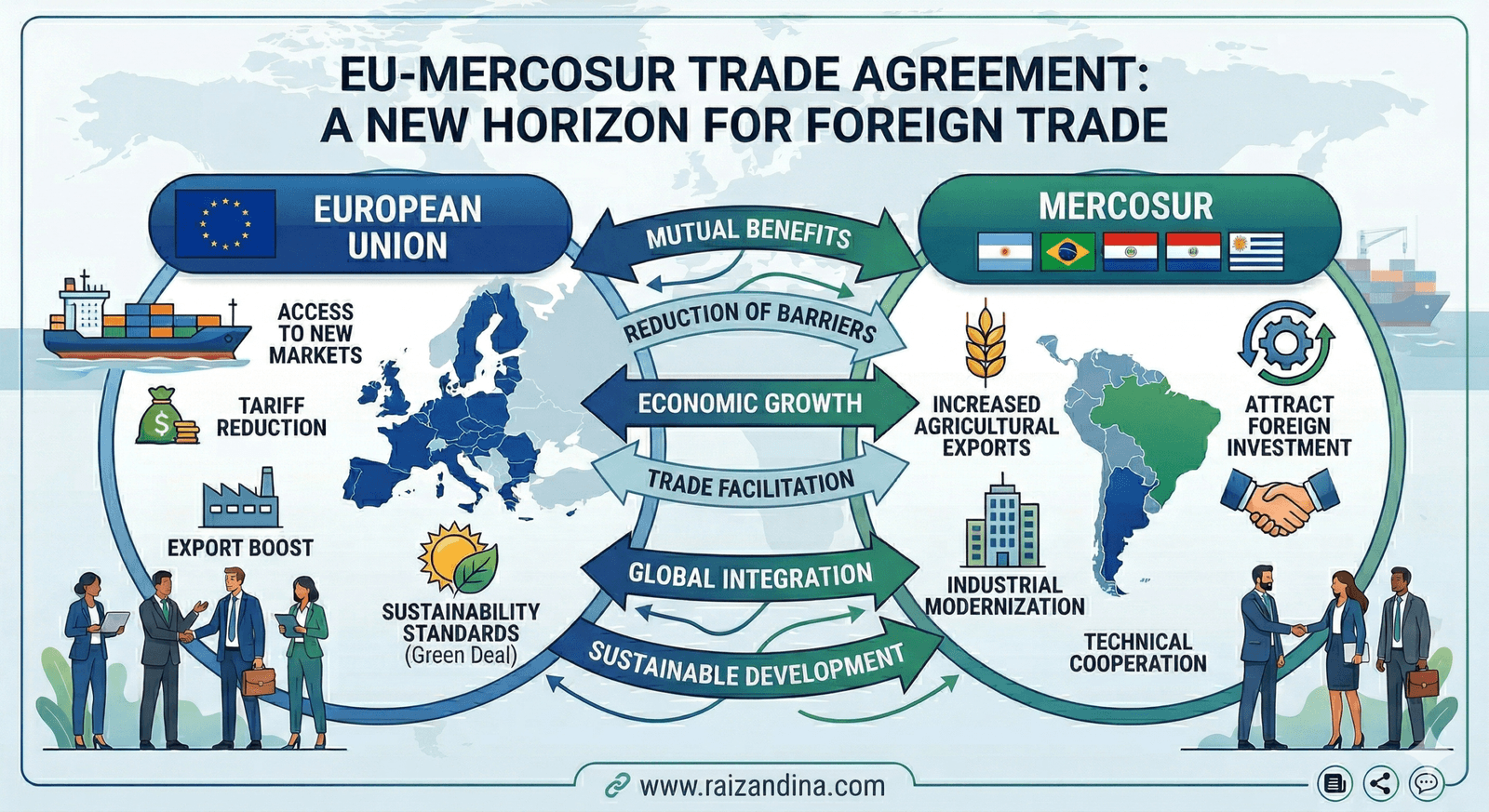
To this is added, in 2026, the new context of the EU-Mercosur agreement. The Interim Trade Agreement (iTA) has been provisionally applied since 1 May 2026, opening a new trade framework for agri-food products from the Southern Cone. It is nonetheless advisable to check the tariff line, the tariff-dismantling schedule and the specific conditions before assuming a direct improvement in import costs.
Why Argentine pecans are an opportunity for the European buyer
Summarising the commercial case, Argentine pecans bring together several factors that make them an interesting bet for European distributors and manufacturers:
- Differentiation: it is a premium product with low penetration and little competition on European shelves compared to the traditional walnut. Whoever introduces it early builds the category.
- Counter-seasonality: access to recently harvested product mid-year, when the Northern Hemisphere has been in storage for months.
- Attractive technical profile: natural sweetness, superior lipid stability and versatility in confectionery, ice cream and baked goods.
- Reliable, traceable origin: Argentina offers growing traceability, SENASA certification and an increasingly professionalised post-harvest sector.
- Growing volume: with young orchards coming into production, supply will expand steadily, providing supply stability over the medium term.
The main challenge of the Argentine origin —acknowledged by the sector itself— is to consolidate drying, sorting, storage and logistics capacity. That is why, for the European buyer, working with a trader who controls the chain from origin and guarantees post-harvest quality makes the difference between a smooth operation and a quality risk.
Conclusion
The pecan stopped being a curiosity long ago and has become a category with a future within the premium tree nut trade. For the European industry —confectionery, ingredients, high-end snacking— it represents the opportunity to differentiate its offering with a product of distinctive sensory profile, superior stability and counter-seasonal availability.
Argentina, with its expanding production, varietal diversity and Southern Hemisphere advantage, is shaping up as a competitive and reliable origin. The key, as always in agri-food trading, lies in origin, traceability and post-harvest quality control.
At Raíz Andina we work with producers of Argentine pecans and other premium tree nuts from Argentina and Chile, with lot-by-lot traceability and a focus on the quality the European buyer demands. If you are considering adding pecans to your catalogue or industrial line, we can help you structure the supply from origin.
Sources consulted
- CAPPECÁN (Argentine Chamber of Pecan Producers) — area, production and variety data.
- INTA — PROPecán Project and sectoral statistics.
- SENASA — export certifications and data on the first export to China (2025).
- Argentina.gob.ar / INTA Informa — regional pecan economy, export destinations.
- EEAOC (Estación Experimental Agroindustrial Obispo Colombres) — varietal behaviour.
- USDA FoodData Central — nutritional profiles of pecan and walnut (including alpha- and gamma-tocopherol data).
- European Commission — provisional application of the EU-Mercosur agreement (1 May 2026).
Looking to quote in-shell or shelled Argentine pecans, or assess their fit in your confectionery line? Contact us or request wholesale information.